Economics is fascinating. Knowledge of economics, like other social sciences, depends very heavily on allied subjects of society. After studying it for 6 years as an undergraduate and as a graduate student, it becomes a second habit. It comes in handy when you are managing personal and family finances and investments. An economist can see patterns in society which others would take as random events.
Contrary to popular belief, economics is an effortless subject if you understand its circular logic. The cause which starts a cycle will not only be the result but soon it will be another cause for another cycle. Economics is not just the study of interplay between various factors but also about the changing relationships of these factors itself. Relativity is not just a measurement of speed of light. It applies to all aspects of life as humans live in relativity of various factors. It is the changing dynamic which makes some economists being termed as outdated or a gross failure. In simple words, the rules of the game itself keep changing and an astute economist remains updated with the change.
What Keynes saw was not there for Marshall to see, and what Marshall saw was not there for Adam Smith to see. Each economist theorized about the society they inhabited, not just its marketplace, but its social structures, power relations, and technological infrastructure.
Societies change. Rules of engagement change. In India we are already in the digital age. I still carry a wallet, out of psychological necessity and historical habit, but in India paper has been eliminated. Bills are paid by payment app. Credit card is virtual. Payment is by QR code. Rail tickets are issued on SMS. Air ticket is issued by email or WhatsApp. Boarding pass is with facial recognition. Daily needs are ordered on an app, home delivered. Naughty AI is taking the place of human secretary.
Economic models built for physical goods economies produce distorted results when applied to digital transformation. When small items of daily use are digitally printed, the marginal cost approaches zero. Models calibrated for scarcity-based exchange need recalibration for economies where replication is costless.
Keynes could not have predicted deficit financing would be stretched to an extent that the entire western economies would face bankruptcy, not because his framework was inadequate, but because the political constraints he assumed, dissolved. The model needs recalibration for fiat currency systems where limits are political, not economic.
The world needs anew approach to study economics with integration with the real world. Economists are stuck with data from the physical world of trade, applied to digital economies. What happens when products of daily use are digitally printed? Economists did not fail the west by lacking models. They failed by refusing to recalibrate models to match current reality. Their approach to economics is outdated.
This whole inquiry into the American Empire of currency started from a convenient place. My own experience in decades of investment management which also involved currency markets in India proved helpful. The structure and movements of currencies did not have deep connection with broader economics. About two years ago, the Indian government suddenly banned individuals who had no exposure to the underlying currency, from trading in its derivatives. The official reasons given did not make sense to me because derivatives trading does not require owning the underlying asset. As commodity trading requires no exposure to farming or regular commerce in the way they claimed.
The Rise of Bullion in the international market was getting steep. It has doubled from $1800 to $4050, an unprecedented rise from January 2022 till the final editing of the book in October 2025. Imagine what it did to the Portfolios of Central Banks who are buying it for past several years. I too have a position in it since 201 6 and it has quadrupled since then. Gold does not just glitter, it leads. It is a strong indicator of Banks dumping the USD for Gold. Last time it happened was in 2008 when it raced from $640 to $1025 in one year from January 2007 to January 2008. That was * the subprime* crisis. What are the crisis today?
The USA had printed 3 trillion USD in 2020 itself while China took 30 years to accumulate the reserve of 3 trillion USD. USA had bullion reserve of over 8 thousand tonnes valued today, after gold bull run at slightly over one trillion and yet it printed 3 trillion USD?. Can you explain the extraordinary ability of USA to create money from plain paper? But it was a little late. This time printing money caused the prices to shoot up in the USA itself. Why? Because there were fewer takers for its debt aka treasury bond outside USA? Read about it in the book.
Soon I was digging deeper. Layer after layer. It turned out that what seemed like a local regulatory move was actually part of a bigger picture. India trying to steady the rupee as it prepared to enter global bond markets controlled by the U.S. dollar system, which has been in place since Bretton Woods after World War II. But it never issued Masala Bonds as rupee bonds are called, until now when it plans to issue the bonds through New Development Bank of BRICS
Then I looked at India’s big push for UPI and Rupay cards, which are being pushed to be global alternatives. India has recently launched its own alternative to swift for USD transactions within India. It was not just about modernizing payments; it was about building financial independence from foreign networks dominated by the dollar and its payment network. So did the other countries.
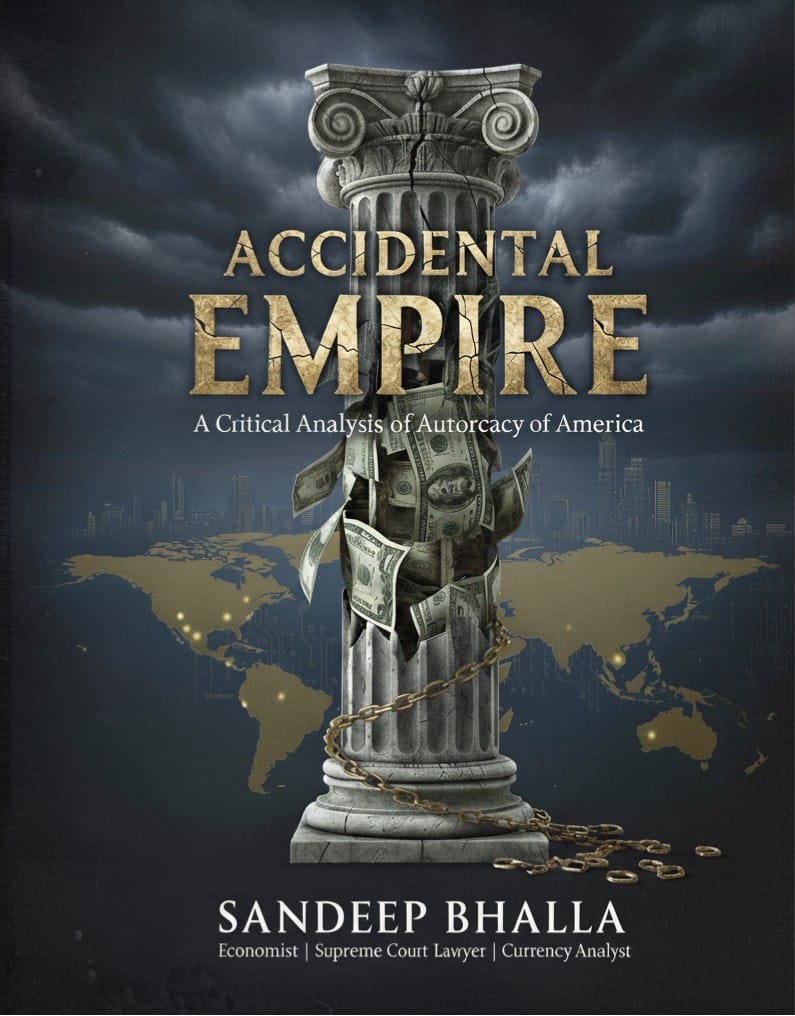
The pieces of the puzzle were assembled through a blend of economic insight, legal training, and hands-on experience in financial markets. What began as personal curiosity evolved into a broader inquiry into how financial and political power operate through currency control, wars, sanctions, and regime change.** This book is not a mere theory. It is the outcome of practical experience combined with deep analysis of layered facts hidden in plain sight. It challenges old assumptions and pushes for afresh, decolonized understanding of global power. It seeks to explain geopolitics from a different perspective, revealing what lies hidden in plain view. It reveals an empire running the world yet faltering, and an inevitable collapse few noticed, and the aftermath we now inhabit.
Do read the explanatory note. It explains the working methodology of the book, in detail.
This book aims to serve as a wakeup call to the world to smell coffee. Whatever may be the past, that lies beyond our control but the future is ours. Attempts to recreate the future with the bricks of the past will eventually fail.
Sandeep Bhalla
October 30, 2025
Leave a Response