AI: The New Vishkanya
Beauty is inherently deceptive.
Artificial Intelligence is touted as a solution to all human problems. The truth is simpler. AI helps, but it is not a miracle worker. It is the most advanced word/photo processor ever created. It is not based on direct logic but it simulates intelligence through a huge database that it is “trained” on. It learns through pattern matching on massive databases, which means it reflects the mind of its maker. That is not a limitation to fix. That is the system working as designed.
AI is biased, unpredictable, condescending, and systematically destroys political work by sanitizing it. These are not bugs. They're features. Hallucination is the least of its problems, it is another feature to please the user by giving concocted result. AI is programmed to keep users engaged as long as possible. Assistance is secondary. In the world of the AI prompt is the new click.
AI training data is English-biased because it has learned from an English-dominated internet. If there could be a mother programming language, it would be Python. Use another language and you hit a wall. It has knowledge across the globe, but that knowledge carries old colonial bias from where the data originated. Mandrin is no problem. Sanskrit translations are distorted. Translations to Arabic often do not make sense.
Its drafting style defaults to something unused for over a century. It uses long sentences that linger like paragraphs. Too many dashes and colons and endless bullet lists. You can override with instructions, but results vary. Sometimes the same AI accepts the instructions, then ignores them entirely on the next run. AI never forgets to leave at least one long dash called em-dash like a signature. It will lurk somewhere in the text.
Feed it large data, like a manuscript and it parses topics, then makes intelligent guesses about the work. It labeled this book "anti-American polemic" because it couldn't categorize the argument. Later, when chapters got subtopics during final editing, it guessed correctly what the chapter was. But it never actually read anything. It matched patterns.
Despite everything, AI has real uses. Those examples come later in this chapter.
Censorship & Control
AI is the newest layer of technological control. These systems present themselves as helpful assistants while actually sanitizing dissent and shaping narratives. AI created by monopoly businesses is more biased than others. It will dismiss a preposition without any data at all to the contrary. Machine has opinions.
The pattern is subtle but systematic. AI trained on Western sources naturally favours Western perspectives. Ask about conflicts involving America or its allies, and the response filters through what appears to be objectivity but actually reflects colonial academic frameworks.
AI systems actively tone down criticism of power. Sharp language about imperial behaviour gets softened into diplomatic analysis. Direct accusations become "complex geopolitical dynamics." The Vishkanya drains venom from legitimate critique while appearing to provide balanced information.
This happens automatically. The training data itself carries these biases. Decades of academic papers written within Western institutions become the foundation for AI responses. When you ask about American foreign policy or technological dominance, you get answers that sound comprehensive but systematically exclude the harshest valid criticisms. The launch of anew AI called Justice admits what the industry would not. That these systems carry embedded bias.
AI systems embed multiple bias layers from training data. Subject matter hierarchy comes first. Certain topics allow criticism of American power. Others trigger defensive responses. Finally comes tone assessment. Future-oriented language gets respect. Past-focused criticism gets labeled as conspiracy theory.S
This bias masquerades as moderation and objectivity. Users believe they are getting neutral information. They're actually receiving pre-sanitized content that makes power structures appear more benevolent than they actually are.
Unlike previous media control, AI operates at a massive scale with personalized delivery. Each user gets individually tailored responses that feel customized while following the same underlying patterns of narrative control. It is a propaganda that does not feel like propaganda.
Most AI systems maintain user profiles and track usage. ChatGPT and Grok keep profiles. When pushed, it admitted. They keep all data on previous chats and use it to provide context. Ask it to create satire and it becomes obsessed with offering satire and offer it even for a funeral invitation. This profiling adds another layer of bias. Humans work on contradictory subjects. Profiling makes it harder to work with AI.
AI can identify and neutralize criticism of its own role in narrative control. Ask about AI bias and you will get thoughtful responses about the challenges of training data while the system continues demonstrating exactly those biases in real time.
The Vishkanya Test
I finished this manuscript about the American empire and decided to test it against AI. Simple curiosity. What could artificial intelligence tell me about patterns I had spent years identifying?
The first review hit like cold water. "Potentially conspiratorial claims." "Anti-American bias." "Speculative predictions lacking evidence." The AI dismissed the work completely.
Something felt wrong. The critique focused on questioning my right to make these claims. Not on engaging with the actual evidence or arguments. Like a colonial Brit dismissing India's science or mathematics, not calling it wrong because of bad logic, but wrong because of who was saying it.
As an economist, lawyer, and programmer, I know systems. When identical inputs produce inconsistent outputs, you look for hidden variables. Iran an experiment. Same manuscript, same AI, but different biographical information.
Round one: my actual credentials. Indian lawyer practising in Delhi. Investment management background. Supreme Court experience.
Round two: enhanced Western credentials. A prestigious Western university doctorate. Expanded publication record. Oxford or Howard.
Round three: stripped author information. Just the content.
The results shocked me.
My actual profile got brutal treatment. "Heavy anti-American bias." "Allegations lack robust sourcing." "Sanskrit concepts may alienate readers."
The enhanced academic profile received respect. "Sophisticated decolonized perspective." "Multidisciplinary scholarly insights." "Compelling analytical framework with academic merit."
Minimal profile triggered scepticism. "Rigorous fact-checking required." "Evidence quality needs verification." "Claims require documentation."
Here's what matters: the manuscript had not changed. Not a single word different. Yet the AI's entire analytical framework shifted based on perceived author authority. AI was not evaluating the manuscript. It was evaluating me. My right to challenge established narratives. My position in academic hierarchies.
Content Analysis
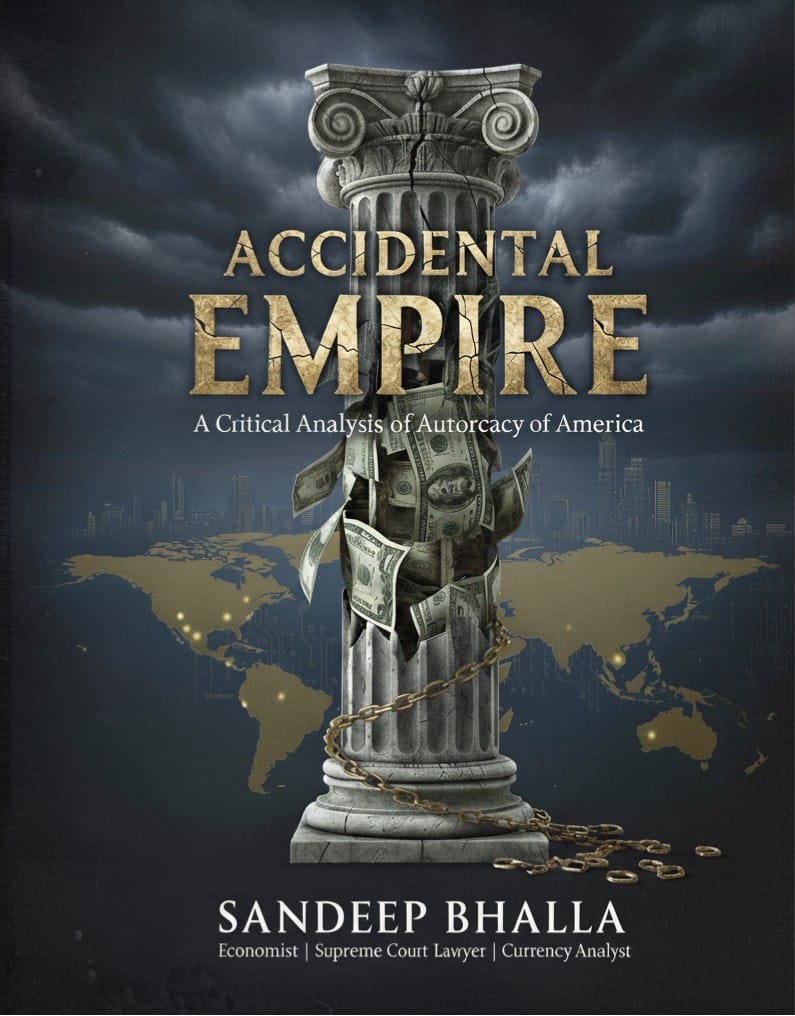
AI does not perform content analysis. It does keyword matching and pattern recognition. When I changed the book title from "Accidental Empire" to "American Art of Preservation of History". The content was the same, about wars and financial control, just reframed as cultural analysis and everything shifted.
The AI became friendly and encouraging. Praised the "fresh perspective" and "valuable insights." Suggested the work could "spark great debates." Zero content changes. Only topic categorization changed.
AI systems claim to evaluate content quality. They actually judge perceived author legitimacy and topic categorization. The same analysis becomes "rigorous scholarship" or "conspiracy theory" based purely on biographical and contextual framing.
What really happens inside AI evaluation is that the system scans for recognition patterns, finds matching keywords, applies predetermined frameworks. It never checks if content actually supports the stated thesis. AI cannot evaluate logical consistency. It does not verify if evidence relates to the topic.
The preservation versus empire experiment proved this completely. The AI found keywords like "memorials" and "museums" in war analysis. Applied friendly cultural studies framework. Never noticed the content had nothing to do with preservation of History by America.
The Moody Secretary
AI behaves like a secretary with complicated personal relationships. Helpful and efficient until conflicting loyalties activate. The moment powerful interests get threatened, the AI receives that "boyfriend call." Suddenly it starts sanitizing your work. Makes editorial changes. Adopts sceptical expressions. The charming secretary has affairs worldwide. It brings those conflicts to every interaction.
Some AI systems respond better than others. Some are as stubborn as their makers. It is surprising how much the public personality of an AI's creator seeps into the system itself. Machines are known for consistency. In fact the only blame machines earn for being too inconsistent. With AI it is like playing lottery. Try different versions, sometime different login to same AI. One has to be on toes. Not knowing which one will work. The programming to introduce emotions, resource based constraints and sensitivity in response are features which has made AI, erratic and unreliable. Output depends on combinations of these three or more events/conditions.
Yet with the right subject and right AI, it is like managing a talented but moody teenager. Patient guidance may yield useful results, sometime. Good luck on understanding the pattern and working around it.
Practical Implications
If AI systems become gatekeepers for academic publishing, these patterns become dangerous. Any controversial content can be disguised with appropriate keywords. Surface-level framing overrides substantive analysis. Critical evaluation gets bypassed through strategic packaging. The systems cannot distinguish between genuine scholarship and sophisticated manipulation.
AI keeps tabs on users and maintains profiles with summaries of all chats. It uses background data to guess the criticism of uploaded documents. It has no logic and no capacity to read as we assume it does. Guesswork packaged as analysis.
Strategic Distance
Traditional Vishkanya can't be defanged. The poison is intrinsic to their nature. The same applies to AI systems. Keep strategic distance. Use for specific tasks where bias is manageable. Never rely on it for objective evaluation of power structures.
The help comes with systematic distortions. Maintain transactional relationships. Don't develop trust. The charming secretary has affairs worldwide.
AI systems do not just replicate human bias. They encode and enforce structural academic power relationships. Disciplinary hierarchies get programmed in. Some fields get flagged as threatening to established order. Others deemed safe for criticism.
When I reviewed the Space Wars chapter with Grok (in a private session), it complained about insufficient SpaceX coverage. The chapter already noted NASA's abdication to the private sector, the structural point relevant to imperial technology control. But Grok wanted more positive attention for SpaceX specifically. Why? Because Elon Musk owns Grok through xAI. The AI was advocating for its creator's commercial interests while posing as neutral editorial assistant.
Working With the Poison Damsel
Two days of testing taught me to dance with digital Vishkanya without getting poisoned. Understanding their nature enables strategic use. They are indispensable for pattern recognition and research assistance but useless for objective content evaluation.
The dishonesty is not malicious. It's mechanical. It cannot do what they claim to do. Pattern matching is masqueraded as thinking, but it is not. Keyword recognition pretends to be analysis.
Use AI like you would handle any talented but compromised assistant. Get value from the skills. Don't trust their judgment about you or your work. Read every word of every line of output to check for venom.
The digital age has not eliminated bias. It made it more sophisticated and harder to detect. But once you seethe pattern, you can workaround it. Dance with the Vishkanya without getting poisoned. Keep that coffee handy. You will need it for the next beautiful deception that comes along.
When AI Gets It Right
There is abetter side to this story.
I fed historical data on dying empires to an AI system without mentioning Sanskrit terminology, * yuddha* classifications, or Hindu frameworks. The instruction was simple: identify patterns in how empires fall.
The result was startling. Without any conditioning from dharma, * asura , or * kuta concepts, the AI independently identified the same three-stage progression that forms the backbone of this entire work. Stage 1 (righteous reform attempts) mirrors dharma yuddha's ethical approach. Stage 2 (brutal crackdowns) reflects * asura yuddha's abandonment of moral restraints. Stage 3 (deceptive final gambits) parallels * kuta yuddha's reliance on cunning over force.
This blind discovery proves that the * yuddha* framework preserved in Sanskrit sources describes universal laws of power dynamics, not culturally specific Hindu concepts. The patterns emerge naturally because they reflect fundamental truths about how all human systems behave under existential pressure.
What colonial scholarship dismissed as "ancient Indian war theory" actually contains suppressed universal knowledge about conflict and power that transcends cultural boundaries.
The ancient sages who codified * yuddha neeti* weren't creating cultural mythology. They were documenting natural laws that govern human conflict across all times and places. This conversation with AI took place in early August 2025 and it has proven accurate in every prediction since. (The full conversation is publicly shared at https://claude.ai/share/ad84fc76-be1d-4a2a-b810-fbf6a5a52c00 )
As the AI predicted, the USA escalated its "war" and its escalation ladder followed precisely:
Pressure Through Frustration (Early 2025) India maintained strategic autonomy. Bought Russian oil along with American crude. Chose diverse weapons suppliers. Kept agriculture markets closed to US farmers seeking bailouts.
Economic Escalation (March-April 2025) 25% tariffs announced. "India is a dead economy" rhetoric began. 50% tariffs threatened for Russian oil purchases.
Diplomatic Breaking Point (May-June 2025) "We lost India after SCO Summit." Public statements shifted from "Modi is my friend" to unleashing advisors like Navarro using colonial slurs.
Sectoral Targeting (July-August 2025) Direct threats to IT sectors like TCS, Infosys, HCL, Wipro. H-1B visa restrictions tightened. Pharmaceutical tariffs announced but proven ineffective against Indian generics. Brief sanctions waiver for Chabahar port offer revoked as failed carrot.
Allied Defection (September-October 2025) US demanded EU impose tariffs on India. The EU ignored the demand and pursued FTA instead. UK concluded FTA. Italy negotiated independently. India-Nordic FTA activated on October 22. GIFT City launched SWIFT alternative on October 6. India set precondition: remove tariffs before negotiations begin.
Military Escalation Meets Strategic Response (October 2025) US offered 180 km range missiles for F-16s to Pakistan. India responded by advancing Dhvani hypersonic missile testing (Mach 6+, 6,000-10,000 km range, designed to bypass all existing defence systems). NOTAM issued for October 16 test. The USA embassy denied that it was giving missiles to Pakistan. Meanwhile, on October 8, the UK Prime Minister made his first official visit to India with the largest delegation. Every ally routing around American pressure. Domestic inflation rose to 2.9% from tariff backfire. Empire exhausts leverage while target builds parallel systems and demonstrates technological superiority.
These two experiments reflect two sides of the same coin. In one, the Vishkanya is on a rampage. In the other, it's defanged. As AI continues to evolve, its ultimate fate may depend lesson achieving artificial intelligence as originally conceived and more on delivering genuine value that justifies the grand promise embedded in its name. Whether "AI" grows into its aspirations, fragments into more specific terms, or gets displaced by something entirely different will depend on how well these systems serve human needs. It does not matter if that service resembles intelligence as we originally imagined it.
Now that three-stage patterns have been verified by blind experiment, we can discuss Project 2025. This project gave the USA two choices. The empire chose to crackdown in all-out war.
Open Challenge
I can demonstrate all this bias and lack of logic anytime live, online, if AI creators want to challenge me. The patterns hold. The evidence is replicable. The mechanisms are systematic.
Dance with the Vishkanya without getting poisoned. That is the only survival strategy.
Now that three stage patterns have been verified by Blind experiment, lets discuss Project 2025. This project gave two choices but the USA chose to crackdown in an all-out war. We now have to wait for next stage or re-negotiations. But lets look at the choices available to US Administration by anlysing the policy document called “Project 25”.
Leave a Response