A Note to Readers.
Before you dive into the Bretton Woods drama in the Prologue, you need to know what you are holding and why it exists.
Problem with Economic News
When the US economy grew four percent while job creation stalled, Reuters blamed AI productivity and demographic shifts. Sounds smart? Perhaps it explains a small portion of what happened. What they omitted to mention was the thirty trillion dollars in monetary expansion flooding the system.
That is not a footnote. That is the story.
When you pump that much money into an economy, GDP rises through asset inflation like art auctions, real estate transactions, stock valuations, Bitcoin and financial engineering. None of this creates jobs. Companies use cheap capital for automation, not hiring. This is basic monetary economics. Every trained economist knows it. Yet professionals consistently ignore this and choose to talk about technology instead.
The Same pattern exists in India. The Reserve Bank, in October 2025, kept rates high despite falling inflation. Official reason: controlling inflation, financial stability. Real reason they will not say clearly: preventing capital flight. Admitting you are keeping rates high to stop investors from fleeing sounds weak, so they wrap it in technical language. Without understanding capital dynamics, businesses cannot plan and citizens cannot grasp the trade-offs being made with their money.
During the pandemic, everyone heard about gas and grocery prices rising. Far less coverage of billionaire wealth increasing $1.3 trillion; a 193 percent jump between March 2020 and December 2024. People got half the story of their pain. The other half about massive wealth accumulation stayed buried in academic papers.
This is not accidental. Economic communication systematically emphasizes mechanisms that sound sophisticated or politically neutral while minimizing facts that reveal policy failures, institutional vulnerabilities, or uncomfortable truths about winners and losers.
Objective of the Book
This work focuses on what mainstream analysis buried. Where conventional histories emphasize technology and markets, here focus is on monetary policy's distributional effects and geopolitical power. Where standard accounts see pragmatic institutional evolution, I identify recurring patterns of financial control. Geopolitical events like wars which affect markets and money management.
If mainstream discourse under-weights certain factors by eighty percent, over-correcting by fifty percent moves us closer to truth even if it overshoots. I am not saying technology is irrelevant to jobless growth; just that discussing it while ignoring thirty trillion dollars in monetary expansion in the USA is dangerously incomplete.
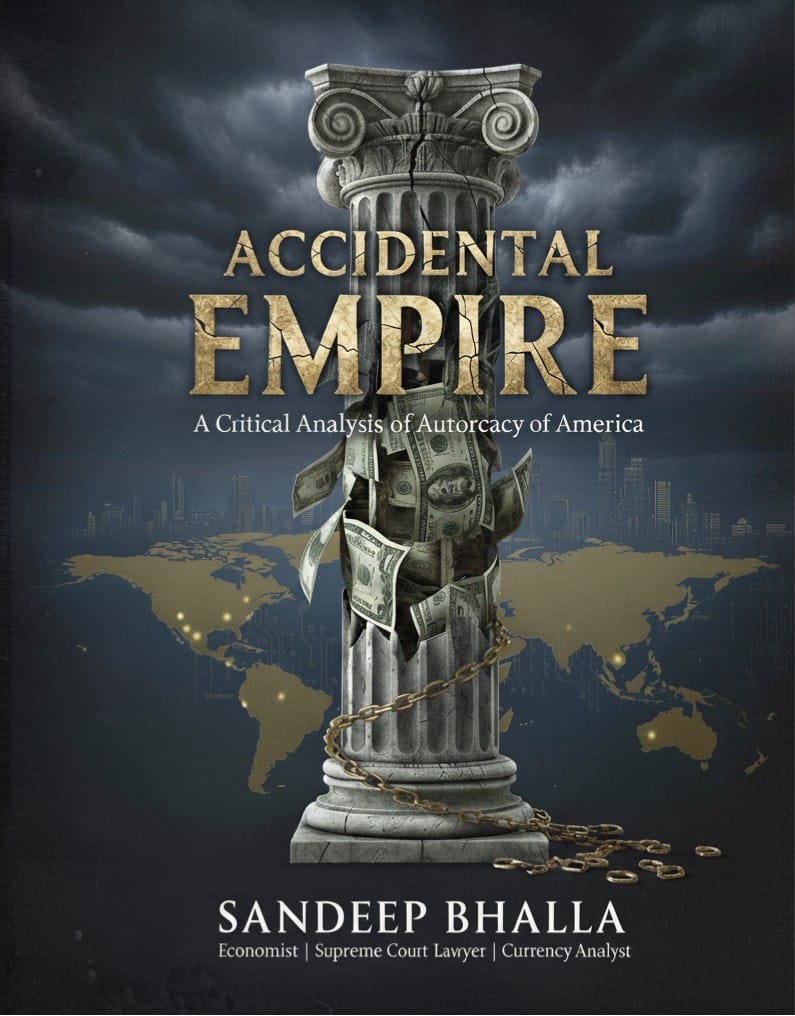
The book argues that America became an “accidental empire” through post-WWII financial mechanisms; Bretton Woods, Nixon ending gold convertibility, the petrodollar, SWIFT infrastructure. Nobody planned comprehensive dominance, but these systems channel wealth and power to American institutions regardless of intent.
Left, Right and Centre
Economic debate often splits into camps: those who trust central banks to manage economies versus those who see all government intervention as distortion. This book rejects that binary. This book rejects all conventional expertise and argue that economic dynamic needs to be re-imagined and debated. This is why I have stated in the Preface that the models relied upon by economists today need recalibration.
Yes, central banks manipulate money supply. The Austrian economists are correct about that. The thirty trillion dollars in monetary expansion isn't a conspiracy theory; it's documented policy that mainstream Keynesians defend as a necessary “stimulus.”
But the Austrian solution to simply “let markets be free” ignores that current “markets” are not free at all. Dollar hegemony, SWIFT control, and IMF conditionality are not market outcomes . They are institutional architecture that channels wealth regardless of whether you have central banking or not. You cannot have “free” currency markets when two platforms in London and Chicago control all pricing and the US can sanction anyone off SWIFT.
The Keynesians are right that pure market fundamentalism ignores power structures. But they are wrong to pretend their interventions do not systematically benefit asset owners, over workers, or that data models can capture what happens when you flood economies with money while pretending it's “neutral stimulus.”
This book argues that both schools miss what matters most: ** who benefits from the system's structure** , whether that structure involves active intervention or supposed market freedom. The question is not intervention versus markets. It's whether the rules, regardless of their ideological justification, systematically extract wealth toward concentrated power. And believe me that I am an insider who always benefits from the system. I have benefited from stocks and thereafter from bullion and I will benefit from the fall of the market. I profit, no matter what direction the market takes. For you, I am as much a deep state as you will ever be able to approach in a lifetime.
Three Levels of Claims
Documented events : Bretton Woods happened in July 1944. Nixon ended gold convertibility August 15, 1971. The Plaza Accord occurred in 1985. These aren't interpretation. They're historical record.
Pattern analysis : Chapter 13 examines how the US profits from financial crises: Japan's Plaza disaster, the 1992 ERM crisis, Mexican peso collapse, Asian financial crisis. Each has its own complex causes. My claim: examining them together reveals recurring patterns in how dollar-debt and IMF conditions advantage dollar-based institutions. You can disagree with my pattern-reading while acknowledging the individual crises happened.
Projections : Chapter 40's BRICS coordination scenario extrapolates from real trends like de-dollarization initiatives, alternative payment systems, gold accumulation. Whether separate national actions coalesce into coordinated challenge to dollar dominance remains uncertain. It's scenario planning, not prediction.
Not A Conspiracy Theory
The harshest criticism of this work will be to call it “conspiracy theory.” Let's address it directly.
Most of what this book describes results from institutional incentives and path dependencies, not shadowy cabals. When economists focus on technology while downplaying monetary factors, it's usually career incentives and cognitive biases, not coordinated deception. When financial crises systematically advantage dollar institutions, it reflects structural architecture, not someone orchestrating each crisis. There is no evil genius lurking in the background. There are no motives. Just decisions and its effect.
But outcomes resulting from structure rather than intent doesn't make them less real. In some ways, systematic structural biases are harder to fix than conspiracies as nobody needs to intend the harmful outcomes for them to occur reliably.
Some sections do argue for conscious manipulation like regime change operations, financial warfare, geopolitical manoeuvring. These rest on documented covert operations and patterns too consistent for coincidence. Intelligence agencies do engage in covert action. Intelligence agents die in covert operations without any explanation of their presence in the first place. Acknowledging this isn't conspiracy theorizing. It's recognizing documented history while staying appropriately sceptical about where structural effects end and conscious manipulation begins.
Caution
Verify independently . Check my statistics against original sources. When I describe historical events, consult multiple accounts. Try to Identify patterns. Look for alternative explanations. Come to your own conclusion as that matters more than agreeing with mine. Just don't ignore the facts in doing so.
Distinguish levels . That Bretton Woods established dollar dominance is a fact. That this functions as imperial control is interpretation. That nations are developing alternatives is observable. That they'll succeed is a projection which may or may not happen.
Notice your discomfort . If chapters provoke defensive reactions, ask whether that stems from factual errors or challenges to comfortable narratives. If sections feel validating, question whether that's rigorous analysis or confirmation bias.
Why Now
The post-WWII order is entering fundamental transformation. American debt can't continue indefinitely without default or dramatic inflation. It never did. There is nothing unique about it. The precedents have been discussed in detail in the book.
BRICS alternatives are moving from proposals to implementation. Military overstretch and domestic dysfunction erode capacity for sustained dominance.
In transition moments, the stories we tell about how we got here, shape the futures we can build. If we think current arrangements are natural outcomes of economic logic, we'll struggle to imagine alternatives. If we see them as historically contingent structures serving particular interests, we can ask what deserves preservation and what needs transformation.
Mainstream economic discourse systematically obscures the questions we most need to ask. This book emphasizes what gets minimized. It won't provide comfortable reading. It challenges American exceptionalism and simplistic anti-American conspiracy theories. It critiques dollar dominance while acknowledging the coordination problems that made Bretton Woods initially attractive.
The test isn't whether you agree with every argument but * whether engaging expands your understanding of ignored questions.* Read this as one perspective in ongoing dialogue, not definitive truth. Let it challenge assumptions, raise questions, point toward factors deserving attention. Verify claims, contest interpretations, develop your own synthesis.
The systematic omissions in mainstream economic discourse are real and consequential. Correcting them requires works willing to emphasize what gets marginalized, even at risk of occasional overcorrection.
This book is not for people who've already rejected the system entirely as they don't need convincing. It's not for true believers who think everything is fine as they won't listen. It's for people ** inside or adjacent to the system** who sense something is wrong but can't articulate it clearly because mainstream explanations don't match what they're experiencing.
The future belongs to those who seethe present clearly, including the parts that powerful institutions prefer to obscure. This book attempts to illuminate what's too often shadowed. What you do with that illumination is your choice.
Leave a Response