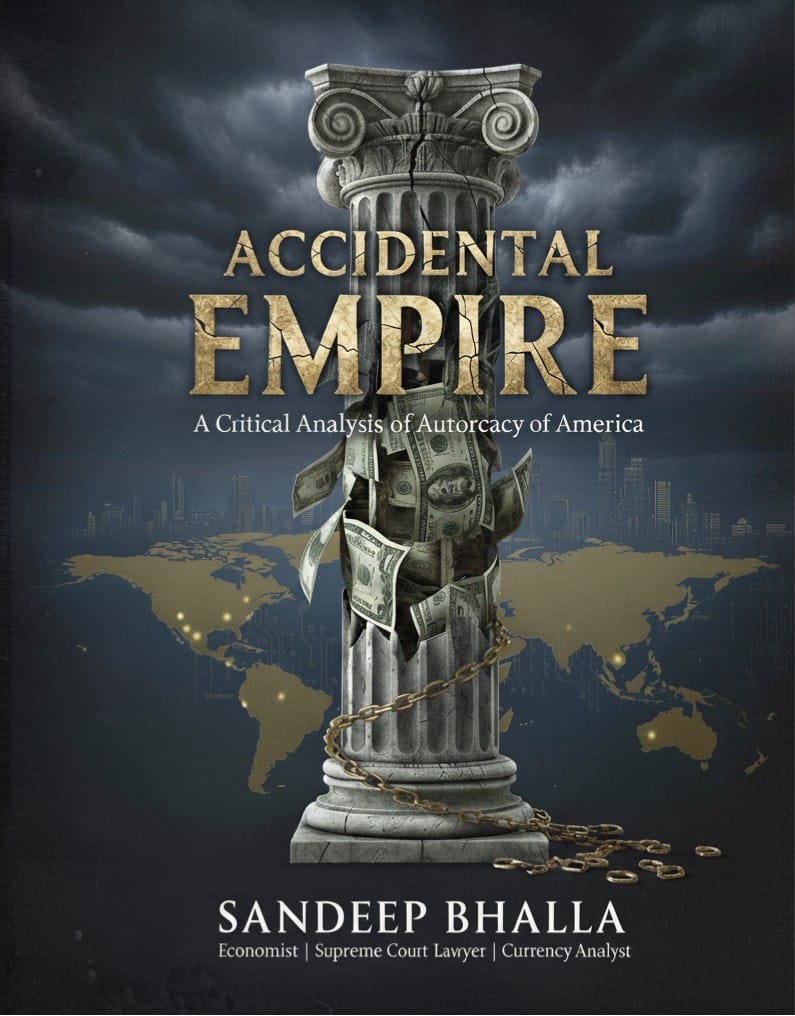
New Cold War
Recycled smartness is not really bright.
America has always chosen economic warfare against arising power. This year the empire punishes India with 50 percent tariff and H1B visa restrictions requiring employers to pay $100,000 annually per worker. Seventy percent of H1B applicants come from India. This makes Indian tech talent too expensive for most companies. Tariff of 50% is not a tax, as it is a sanction. Later the administration admitted it. It means export form India was no more welcome in USA.
Chabahar port lost its exemption from American sanctions. This chokes India's trade routes to Afghanistan and Central Asia. America is forcing India back into Pakistan dependent supply chains. Classic imperial strangulation tactics demonstrate the empire's desperation.
The world does not follow America's lead anymore. The European Union ignored American calls to impose 100% tariffs on Indian crude oil imports from Russia. Instead, EU negotiators held their 13th round of FTA talks with India in September 2025. European Commission President Ursula von der Leyen called it the largest deal of this kind anywhere in the world.
India already has 13 active FTAs covering UK, Japan, South Korea, Australia, UAE, and others. More importantly, India negotiates with about 50 countries and trading blocs for new agreements. The UK rushes to complete ratification by late 2025. Brazil provides South American market access through MERCOSUR. Africa opens bilateral deals across the continent.
The timing reveals everything about the global shift. America punishes India for Operation Sindoor. Traditional allies choose profit over American pressure. The empire loses influence when it punishes instead of cooperating. The New Cold War tactics backfire spectacularly. Economic pressure creates opportunities for competitors. European and Asian powers rush to capture Indian markets while America retreats. The multipolar world makes imperial punishment obsolete.
America scrambles for replacement military bases after losing Pakistan facilities. Afghanistan talks but refuses Bagram base access to USA. As per unconfirmed report Bagram airbase has been offerred to India. Bangladesh provides joint exercises but CIA operatives end up dead in hotels. Even proxy warfare becomes harder without reliable allies. It is classic cold war with Russia, now repeated with India.
The empire has chosen to be hostile toward a power its own allies consider reliable and rising. This strategic incompetence accelerates American isolation. India's break from the American economy creates opportunities everywhere else. The desperate empire loses influence through its own punitive actions.
This validates India's stoic silence strategy completely. Why beg America for negotiation when everyone else wants Indian partnerships. The mathis simple. America represents one market. India gets access to 50 markets through FTA negotiations.
The Future
At the outset let me clarify, predicting the future is like predicting the place where the first drop of rain will fall. Patterns tell the direction of the future, not the destiny. But there is one certainty. India and America are not going to befriends in the next 50 years, till this generation is phased out. They may have transactional relationships but nothing like strategic alliances for any reason. India will not be verbose but this will be revealed in silence.
Remember 4 years of Hitlers rule over most of Europe was catastrophic. Drunk on power, the empire inflicted unspeakable atrocities on its people. Nobody could predict the trajectory of evil. Change comes with unpredictable results. Will the USA be doing something like that to India? It is apprehensive but cannot be completely ruled out. In the last chapter we had discussed that India is anticipating an attack from the USA.
Therefore, to stay in the existing system and work on it to make it abetter solution would no longer be an option. This used to be the official position of the Government of India. The External Affairs Minister, S. Jaishankar has publicly stated “we are not anti-west. We are non-west.” He has also spoken on dollar that BRICS has no plan to introduce currency.”
On 24th October, speaking in Germany, Commerce Minister Piyush Goyal retorted to the host “We do not do trade deals with a gun to our head”. It was not diplomatic but a brutal response to an Empire drunk on its superpowers.
America became a superpower because World War Two destroyed all competitors. Britain exhausted itself fighting Germany. France collapsed under Nazi occupation. Germany got divided and occupied. Japan lay in nuclear ruins. The soviet Union bled forty million dead soldiers.
Only America emerged from 1945 with intact industrial capacity. Only America had undamaged cities and growing population. Only America could finance global reconstruction while others rebuilt from rubble. This created a unique historical vacuum. No other power could compete with American dominance for decades. The dollar became the global currency by default. American military bases spread worldwide without serious resistance.
No such vacuum exists today. Multiple powers compete simultaneously. China builds economic partnerships across Asia and Africa but is often accused of debt traps. India negotiates fifty trade agreements. Europe creates its own strategic autonomy. Brazil leads South American integration.
Yet it would definitely be logical to consider if there is any possible successor of USA in making? EU with its ragtag “Union” combination, bitter inner conflict and unelected President as CEO, does not enter the picture at all. The EU President entered a trade deal with the USA only to be rebuked by the President of the EU Council. Nobody speaks about the deal anymore. Thus, because of sheer size, there remains only three contenders. Let's deal with each one of them.
Russia
Russia is the largest country by geography and area. But it has a small economy and an even smaller population. An American politician once called it a giant gas station that has airports and people living in it. This describes Russia's fundamental limitation perfectly.
Geography does not create superpower status. Resources alone do not build global empires. Russia has one tenth the population of Africa. The entire Russian Federation has fewer people than just the continent of Africa. Its population is just 144 million. How can such a small population control global affairs?
Russia dominates its own neighbourhood effectively. The Ukraine war proved Russian military power cannot be pushed around easily. European energy dependence showed Russian resource leverage works regionally. Russian military technology focuses on specific superiority areas. They do not match American spending but achieve key advantages through quality over quantity.
Russia possesses hypersonic missiles with no counter defence system. The Kinzhal and Zircon missiles travel at Mach 9-10 speeds. No existing air defence can intercept these weapons reliably. Russia'sS-400 air defence system protects large areas effectively. It can track 300 targets simultaneously and engages aircraft at 400km range. Many countries chooseS-400 over American alternatives.
But regional dominance does not equal global superpower status. Russia lacks economic scale to finance worldwide operations. The Russian population cannot staff global empire administration. Russian technology does not lead cutting edge industries. Most importantly, Russia faces too much competition for global influence.
The multipolar world suits Russian interests perfectly. Multiple power centres prevent any single empire from dominating. Regional powers get more autonomy from global hegemon control. Russia plays the balance between competing blocs effectively. Russian leaders understand these limitations clearly. They do not seek to replace American global hegemony completely.
Russia will remain a major regional power with global military reach. But it cannot and does not seek to replace American global dominance. The vacuum that created American superpower status disappeared forever. Multiple powers share global influence now.
Most importantly, Russia faces too much competition for global influence. China outcompetes Russia economically across most markets. India attracts more international partnerships than Russia manages. America still controls global financial systems Russia cannot replace on its own. Russian leaders understand these limitations clearly. They do not seek to replace American global hegemony completely. They want regional security and respect for Russian interests. They build partnerships with China and India to balance American power.
This fundamental shift changes international relations permanently. Russia adapts to this new reality better than America does. Russian leaders accept multipolar competition as natural. American leaders still chase impossible dreams of continued global dominance.
India
India had not made it to this shortlist but as explained in the previous chapter titled “New World Order”, it is anew power centre in the world which controls the technologies, others are still experimenting with.
India surpassed Japan to become the Fourth Largest Economy in the world by GDP in mid-2025. India remains the fastest growing major world economy. This economic strength attracts global partnerships without requiring imperial ambition.
India's real economy measures more than $5 trillion according to GST transaction data. This makes it larger than official figures suggest. Private consumption drives economic growth contributing approximately 61.4% to GDP. But economic size does not create superpower status automatically.
India understands this reality better than anyone expects. India does not seek global dominance. India builds partnerships instead of empires. The mathematical truth is simple. Multiple powers compete simultaneously across every region. All the forums it is member of, are run by consensus. That is so unlike the United Nations, which has failed spectacularly due to its anomalous administrative structure.
India's response to American economic warfare proves the stoic silences trategy completely. The timing reveals everything about changing power dynamics. America punishes India for Operation Sindoor. Fifty countries immediately offer better partnerships. India's break from American control creates opportunities everywhere else.
India lifts 26.9 crore people out of poverty in one decade. No nation has achieved this scale in history. India ranks 4th globally in income equality. But India does not use this strength for global conquest. India uses it for global cooperation. The 35 million Indian diaspora builds relationships naturally across continents. It has more to do with its past. Colonised for nearly 800 years Muslims and Christian empires respectively, it would be a travesty if it develops ambition of a global empire.
At the beginning of 2025, it brought reforms in personal taxation. Income of 12,00,000 rupee per year is now tax free. Effective September 22, 2025, India has reduced its Goods and Services Tax (GST) across the board by 10% to 13% per item. Many items of daily use have been made tax free. This has been done at a time when the USA is imposing import tax under the fancy name of Tariff and people are fleeing the former Imperial power UK due to higher taxation.
In the Diwali season of 2025, one one day of Dhanteras, people of India spent 68 billion in USD which is up by 27 percent over the corresponding day in 2024. The heavy shopping included Gold and Silver, despite the higher prices. Traditions are kept in India. Now the interesting fact is that this shopping constituted 87 percent of products which were made in India. This is the economy President Trump called “dead”.
*Military Technology Validation * * *
India's BrahMos missile proves combat effectiveness completely. This supersonic cruise missile travels at Mach 3 speeds. It combines Russian propulsion with Indian guidance systems. The Akashteer Air Defence system achieved 100 % success rates in Operation Sindoor. It destroyed American and Chinese equipment without failure. American stealth technology failed against Indian radar systems. These facts have been discussed in detail in the previous chapter titled “New World Order”.
India builds defence partnerships without dependency. Indigenous production reduces foreign control. Joint ventures transfer technology while maintaining strategic autonomy. This approach validates ancient diplomatic wisdom. Patient relationship building beats imperial aggression.
*Civilizational Roots *
India's 3000 years of international engagement create psychological foundations newer nations lack. Cultural continuity spanning 5000 years enables long term thinking that others cannot match. Dharmic principles emphasize duty and ethical conduct. Products get built to last multiple seasons. Relationships get designed for decades not quarters.
Indian leaders grow from the soil they govern. This creates different approaches automatically compared to American leaders who have emotional investments elsewhere. European ancestry matters more than American neighbours to them.
Why India will not become the next empire should be obvious now. The world moved beyond single superpower systems permanently. Economic partnerships matter more than military dominance now. Trade agreements replace military occupation everywhere.
India has been the only country under colonisation for nearly a century. First it faced Turkish/Islamic invaders and thereafter British, Portuguese and French invasions. A former colony which got freedom in 1947 from the British would now aspire to colonize the world? I don’t think so.
India adapts to multipolar reality better than America does. India accepts regional competition as natural. America chases impossible dreams of continued global control. The world does not need another empire. The world needs reliable partners. India provides exactly what the multipolar future requires.
India demonstrates that civilizational approaches outperform imperial tactics. Authentic development beats manufactured consent. Patient cooperation defeats desperate aggression. Traditional/Dharmic principles emphasize duty and ethical conduct. Products built to last multiple seasons. Relationships designed for decades not quarters or for next election result.
China
China, with its large economy, military and population, is most likely contender for the tops pot. It also has a “middle kingdom” mindset which it believes gives it (read Han Chinese race) natural right to rule the world. It is the prophecy waiting to happen. AI has already given deference to the status of China as the next Imperial ruler of the world. On October 27, China made a concession. It gave up it’s claim to rule the world. China’s Foreign Minister Wang Yi said “a multipolar world is emerging”, positioning Beijing’s latest vision for global governance as a unifying and stabilising framework.
China appears economically powerful on paper. Official GDP numbers rank second globally. But these statistics hide catastrophic structural problems. The Evergrande housing bubble represented 25% of China's entire economy. When this sector collapsed, it exposed the manufactured nature of Chinese economic statistics.
Chinese growth for two decades relied on building empty cities. Ghost towns filled official GD P calculations. Construction companies borrowed against inflated property values. Banks counted phantom assets as real wealth. This created artificial economic activity. Same concrete got moved around repeatedly. Each transaction counted as new GDP growth.
China's export numbers drop consistently month after month. Global supply chains shift production elsewhere. Countries reduce dependence on Chinese manufacturing systematically. This export decline exposes the truth about Chinese manufacturing dominance. Much of it existed on paper rather than competitive advantage.
When global buyers have alternatives, Chinese market share evaporates quickly. Export dependency breakdown reveals the manufactured nature of Chinese economic dominance.
Chinese emphasis on spectacular presentation over substance created a short term impression. High speed rail networks looked impressive. Empty cities appeared economically active from satellite images. But appearance first production compromised long term functionality. Infrastructure built for show rather than purpose. Economic data is manufactured for political targets rather than accurate measurement. This approach worked while global competitors had limited alternatives. Once other options emerged, appearance-based production lost appeal rapidly. Customers wanted reliability over spectacular features.
*Demographic Spiral *
China faces population collapse worse than any major power in history. Birthrates dropped below replacement levels years ago. The working age population shrinks rapidly. This demographic crisis cannot be reversed through policy as the cultural preferences have changed permanently.
Ageing population requires more social services. Smaller workforce produces less economic output. Government spending increases while tax revenue decreases. This mathematical progression leads hurts Chinese global ambitions.
*Battle Readiness *
China maintains large military equipment inventories. The numbers look impressive on paper. But decades without real warfare create reliability questions. Chinese equipment lacks battle testing. Manufacturing quality varies across different systems. The PLA has not fought major conflicts since 1979. Equipment performs differently under real combat stress. Training simulations cannot replace actual warfare experience. China's naval expansion appears formidable. But these ships remain untested in serious conflicts. Combat effectiveness remains theoretical rather than proven.
China's military modernization focuses on copying existing designs. Innovation happens slowly in hierarchical systems. Risk aversion prevents breakthrough developments. Export versions often underperform compared to Russian alternatives.
China has lost over 25 top military officials who were in leadership positions for a variety of reasons which are not discussed in public. 9 Military officials are removed in the month of October 2025 itself. No Armed Force can enter into a war without consistent leadership and persistent loyalty in chain of command. Chinee army is incomplete disarray.
What Trumps China?
China'speak moment has already passed. The conditions that created American dominance after 1945 do not exist for China. No global vacuum awaits Chinese leadership. Multiple powers compete simultaneously across every region. China faces too much resistance to dominate globally. Regional powers build alternatives to Chinese influence. Europe develops strategic autonomy. India creates independent partnerships.
*Covid Exposure * * *
China's supposed adaptability proved false under pressure. Zero COVID policies demonstrated bureaucratic rigidity. Local officials followed central commands blindly rather than adapting to local conditions.
Strategic ambiguity became strategic confusion. Officials feared making decisions without central approval. Innovation stalled because creative thinking involved political risk. The system produced conformity instead of solutions. Hierarchical relationships created information bottlenecks. Bad news never reached decision makers. Local problems festered while leaders celebrated fake achievements. Reality and reporting diverged completely.
This approach worked while global competitors had limited alternatives. Once other options emerged, appearance-based production lost appeal rapidly. Customers wanted reliability over spectacular features.
The wolf diplomacy of China along with hoarding of medical supplies during the pandemic did not earn it any goodwill. It’s debt trap policies for smaller nations whom it called partners made other nations wary of its partnerships. When it refused to bailout Sri Lanka, which was hit by financial crises, and who had to seek India’s help, did not help China’s reputation either.
China will remain a major regional power with significant military capability. But regional dominance does not equal global superpower status anymore.
Statistical Details
For those who like to dwell in numbers, here are details about the three economies dealt above:
In 2023, the GDP in Russia was around 2.01 trillion U.S. dollars. Country Population: 145.632 million. Russia's economy remains smaller than Italy despite massive territory. Defence and security spending accounted for approximately 40% of Russia's total government spending in 2025, exceeding combined spending on education, healthcare, social policy.
Direct financial expenditure for waging the war was estimated at US$250 billion through June 2024, rising to over 20% of annual GDP. Russia's annual GDP was projected to increase by 1.35 percent in 2025. The Gross Domestic Product (GDP) in Russia expanded 1.10 percent in the second quarter of 2025. War economy mathematics show Russia spends more on war than most countries earn entirely. War spending creates artificial growth but weakens long term foundations.
China's GDP officially reached $18.7 trillion in 2024, representing 17.6% of the global economy. Growth hit 5.3% in the first half of 2025, powered mainly by industrial output rather than domestic consumption. But these impressive numbers hide catastrophic structural collapse. The housing sector that represented 25% of China's economy has completely imploded. Export numbers drop month after month as global supply chains shift elsewhere. Demographics guarantee long term contraction with birthrates below replacement levels for years. The Federal Reserve openly questions whether China actually grows at 5% given deflation pressures. China’s track record with reporting of numbers leaves much to be desired to accept its statistics.
In 2024, GDP in India was at around 3.91 trillion U.S. dollars, and it is expected to reach six trillion by the end of the decade. The Gross Domestic Product (GDP) in India expanded 7.80 percent in the second quarter of 2025. Trade (% of GDP) in India was reported at 44.67 % in 2024. GST revenues grow at 9% to 17% annually which creates doubt about GDP and its growth that it is underestimated and it may actually touch 10 trillion mark by 2030.
But remember all these calculations are in USD whose valuation in terms of other currency is highly debatable as discussed in previous chapters.
Strategic Implications
The New Cold War tactics will backfire spectacularly. Economic pressure creates opportunities for competitors. European and Asian powers rush to capture Indian markets while America retreats. America scrambles for replacement military bases after losing Pakistan facilities. Afghanistan talks but refuses Bagram base access. Bangladesh provides exercises but CIA operatives face security risks.
The empire has chosen hostility toward a power its own allies consider reliable and rising. This strategic mistake accelerates American isolation. India's break from the American economy creates opportunities everywhere else. Economic sanctions work two ways. If America chose to sanction the whole world, the question would be not that the world can survive it. The question is whether America can survive without the world?
*Future Trajectories *
Predicting the future is like predicting where the first drop of rain will fall. But there is one certainty. India and America are not going to befriends in the next 50 years. This generation must be phased out first. They may have transactional relationships but nothing like strategic alliance or close friendship.
The current administration has moved beyond its official Project 2025 documentation. There is noway to know how far it will go. Authoritarian systems accelerate exponentially once institutional restraints break.
Therefore, to stay in the existing system and work on it to make it abetter solution would no longer be an option. This happened to be the official position of the Government of India, so far. The External Affairs MinisterS. Jaishankar stated publicly that India is not anti-west but non-west. He also clarified that BRICS has no plan to introduce alternative currency. But it may change very soon.
The world has moved beyond single superpower systems permanently. Multiple powers now compete across every region. Economic partnerships matter more than military intimidation. Trade relationships require mutual benefit rather than hierarchical submission. This fundamental shift changes international relations permanently. The New Cold War tactics reveal America's inability to adapt to this new reality. Regional powers prefer genuine partnerships to imperial relationships when alternatives exist. America may chase impossible dreams of continued global control, till it fails.
In the next few chapters, we will discuss various future trajectories for America. These may not happen at all or in the order these are articulated here. But this is how it has happened elsewhere in the world. It is not prophetic predictions but possibilities which may or may not happen in any random order.
Meanwhile it is the economy stupid! Prices always follow the money.
Leave a Response