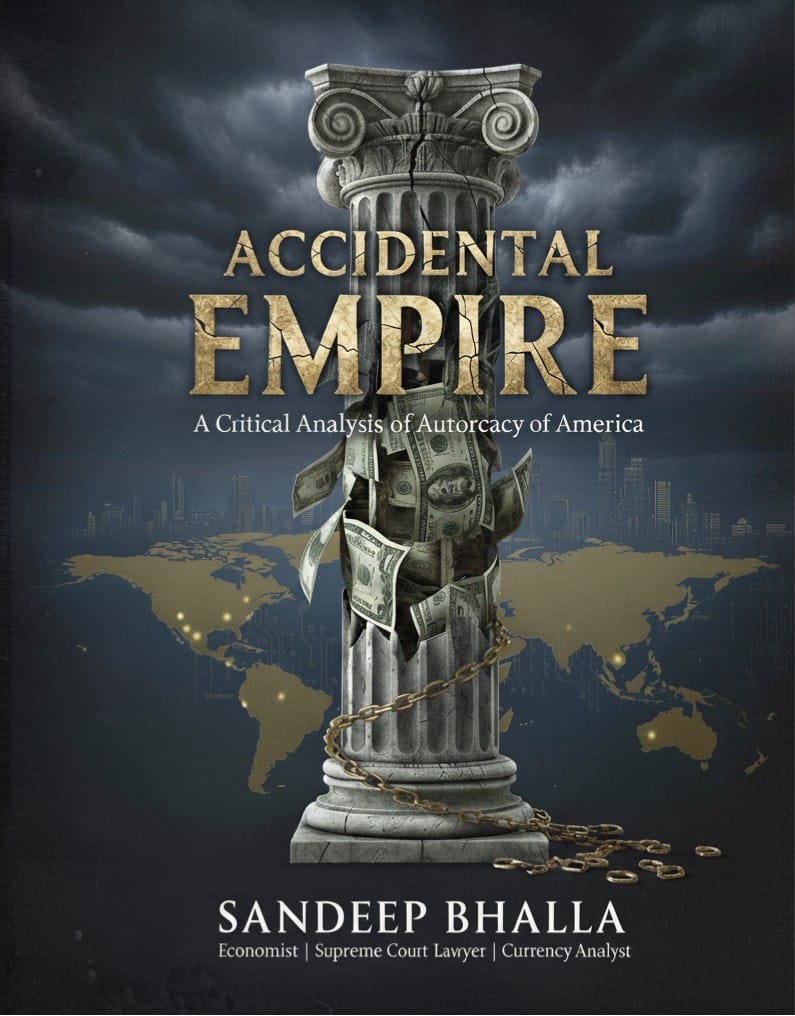
The empire that was born by accident. The system that controls global finance. The thread that connects everything.
Most analysts treat currency policy as reactive economic management. This misses the larger strategic pattern continued for the last 8 decades. A systematic financial warfare to maintain the American journey for global hegemony continued through three distinct phases of monetary manipulation.
Devaluation Wars (1930s-1971)
During the Great Depression, manufacturing economies discovered that weak currencies provided powerful export advantages. Between 1929 and 1936, over 70 countries devalued their currencies relative to gold. This was not economic incompetence but strategic positioning for industrial dominance.
America mastered this game better than anyone. The 1933 devaluation from $20.67 to $35 per ounce of gold represented a 69% currency weakening that made American manufactured goods irresistibly cheap in global markets. While European powers struggled with war damage and reconstruction costs, America built the world's largest industrial base behind the protective shield of an artificially weakened dollar.
The currency devaluation was presented as an emergency response to the economic crisis rather than a deliberate export strategy. Each country claimed they were forced into devaluation by circumstances, but the pattern was too systematic to be coincidental. Manufacturing economies needed weak currencies to capture global market share, and America executed this strategy more effectively than any rival.
The Bretton Woods system of 1944 represented the culmination of this phase. With Europe destroyed and Asia rebuilding, America could afford currency stability because industrial competitors had been eliminated. The dollar became the global reserve currency not through inherent strength but because American manufacturing capacity dominated a war-devastated world.
Transition to Consumption Economy
August 15, 1971 marks the most important date in monetary history. As discussed in previous chapters, Nixon's decision to end dollar convertibility to gold was not just monetary policy but the pivot point between two entirely different economic models.
By 1971, America faced its first trade deficit since the 19 th century. The manufacturing advantage built through strategic devaluation was eroding as Europe and Asia rebuilt their industrial capacity. Germany and Japan were becoming serious competitors using the same weak currency strategies America had pioneered.
The traditional response would have been further devaluation to restore manufacturing competitiveness. Instead, America chose anew path by abandoning manufacturing dominance for consumption-based economic control. This required the exact opposite monetary strategy. Instead of weakening the dollar to boost exports, America needed to maintain an overvalued dollar to keep imports inexpensive and finance growing trade deficits, through debt.
This transition from manufacturing powerhouse to debt-financed consumer economy represents one of the most audacious strategic pivots in recorded history. Most empires decline when they lose manufacturing capacity. America figured out how to maintain dominance by transforming from producer to consumer, using monetary manipulation to make this economically sustainable. The USA thinks that having beaten the odds once, it can beat it forever. Nobody can be sure.
PPP Inflation Method (1971-2000s)
The shift to a consumption economy created an entirely new challenge: how do you maintain an overvalued currency when traditional economic fundamentals suggest it should weaken? This is where the PPP methodology becomes crucial to American grand strategy.
The PPP methodology creates a self-reinforcing feedback loop that validates overvalued currencies through circular logic. Currency values influence retail prices, then those inflated prices are used to justify the high currency valuations that created them in the first place.
For a debt-financed consumer economy, this system provides perfect cover. High retail prices in America get interpreted as evidence of superior purchasing power rather than currency overvaluation. The methodology systematically ignores cheaper alternatives available through informal markets in other countries. Simultaneously, it gives full weight to tax-inflated formal prices in high-currency economies.
The beauty of this approach lies in its academic legitimacy. The International Comparison Program operates through prestigious institutions like the World Bank with sophisticated statistical methodologies that appear scientifically objective. Few people understand the circular reasoning embedded in the calculations, and those who do often work for the same institutions that benefit from maintaining the system.
Consider how this works in practice. American consumers pay $3.73 per gallon for milk while Indians pay the equivalent of $2.28 per gallon. Traditional analysis might suggest the dollar is overvalued relative to purchasing power. But PPP methodology interprets the higher American prices as evidence that Americans have greater purchasing power, justifying a stronger dollar that keeps those prices elevated.
The feedback loop becomes even more sophisticated when you consider tax policy. Since PPP calculations use “purchasers' prices” that include all taxes, governments can artificially inflate their PPP rankings by raising taxes. Higher tax rates create higher measured prices, which translate into higher calculated purchasing power, which supports stronger apparent currency values.
This creates perverse incentives where policies that reduce actual consumer welfare get rewarded in international rankings. A country that provides goods at lower pre-tax prices while maintaining efficient public services appears weaker in PPP calculations. One that extracts resources through taxation and forces consumers to pay inflated retail prices appear stronger.
This PPP tautology has been discussed in Chapter titled " Poverty in Rich Empire" in detail.
SWIFT Control Era (1973-Present)
The formation of SWIFT in 1973, just two years after the Nixon shock, wasn't coincidental timing. The new consumption-based economic model required unprecedented control over global payment flows to maintain dollar dominance without underlying industrial justification.
SWIFT presents itself as an independent cooperative incorporated under Belgian law, but the Russian sanctions of 2022 destroyed this fiction. When geopolitical interests demanded action, SWIFT instantly became a weapon of financial warfare. It froze $300 billion of sovereign Russian assets and cutting Russian banks from the global payment network without a blink.
The real innovation of SWIFT lies not in its occasional dramatic interventions but in its daily surveillance capabilities. With 79.5% of international trade payments flowing through dollar-denominated SWIFT transactions, the United States possesses real-time intelligence on global commerce that no empire in history has ever enjoyed.
This surveillance enables ** strategic supply chain intervention at the right moment to support dollar dominance. When alternative currencies threaten American monetary hegemony, targeted disruptions to critical supply chains can force countries back into dollar-based trading relationships. The appearance of market forces masks systematic intervention based on comprehensive financial intelligence.
The $7.5 trillion daily foreign exchange “trading” volume provides additional cover for this control system. Most people assume this massive volume represents genuine market-based price discovery, but the reality is far different. Only $2.1 trillion represents actual currency exchange through spot trading. The remaining $5.4 trillion consists of derivatives contracts that reference currency prices without involving actual currency flows. This creates a perfect manipulation environment.
The Integration
The sophistication of American currency strategy lies in how these three stages operate simultaneously rather than sequentially. Modern American monetary dominance rests on the integrated operation of all three systems:
Devaluation Era Legacy : America still maintains the world's largest military-industrial complex, built during the strategic devaluation period. This provides enforcement capability for monetary policy through conventional military means when financial methods prove insufficient.
PPP Validation System : Academic and institutional frameworks continue legitimizing overvalued currency through tautological methodology that few understand and fewer dare challenge. International organizations provide scientific credibility for systematic measurement bias that supports American monetary interests.
SWIFT Control Network : Real-time global payment surveillance enables surgical intervention in currency markets while maintaining the appearance of free market price discovery. Derivative volume creates illusion of massive trading activity while actual currency flows remain under systematic observation and control.
The integration of these systems creates multiple layers of currency defence that operate at different levels of visibility. This represents deceptive war at the highest level of sophistication. Each component appears legitimate when examined in isolation. PPP calculations look like objective academic research. SWIFT appears to be neutral financial infrastructure. Military interventions get justified through humanitarian or security concerns. Currency speculation appears to be normal market activity.
Thus, the transition from the manufacturing economy to the consumption economy was not economic decline but strategic evolution toward a perceived sustainable forms of global dominance.
Current Vulnerabilities and System Breakdown
However, like all strategic systems based on deception, American currency dominance now faces challenges that its original designers never anticipated. The very success of the system has created the conditions for its potential supersession. In short, chickens have come home to roost.
China's Belt and Road Initiative, BRICS payment systems, Central Bank Digital Currencies, and bilateral trading arrangements all represent systematic challenges to dollar-based international commerce. These alternatives do not need to replace the dollar system completely. They only need to provide viable options for countries that want to escape SWIFT surveillance and dollar dependency.
The PPP methodology that validates overvalued currencies becomes a liability when actual purchasing power erosion affects domestic American populations. Food price inflation hits minimum wage workers regardless of international PPP calculations. Geographic concentration forces Americans into high-cost urban environments that consume ever-larger portions of income. The measurement systems that justify strong dollars internationally cannot solve real economic problems domestically.
Most critically, the transition to crude all-out war in recent American interventions has damaged the moral legitimacy essential for sustainable deception strategies. The Iraq-Afghan invasion, Libyan destruction, and Syrian proxy war represent abandonment of the sophisticated methods that made the American empire politically sustainable.
Currency wars require international cooperation and institutional credibility that gets undermined by obvious military aggression. When other countries see America freeze Russian assets through supposedly neutral institutions like SWIFT, they naturally seek alternatives that provide protection from similar treatment.
The Historical Pattern
Like Britain's free trade policies that ultimately empowered Germany and America, American-led financial globalization has diffused the very capabilities that enabled American dominance. China's industrial capacity, technology transfer, and financial system development all occurred within frameworks initially designed to benefit American interests.
The question is not whether American currency dominance will end but whether the transition occurs through managed decline or catastrophic collapse. The currency war systems built over nearly a century have created global dependencies that cannot be quickly replaced, but they also rest on foundations of deception that become increasingly difficult to maintain. But tactical flexibility cannot overcome strategic rigidity when the fundamental conditions that enabled original success no longer exist.
Result
Countries that print reserve currencies are struggling with basic infrastructure. Countries that make things domestically have stable systems. This contradicts every development economics textbook written in the past 50 years.
The U.S. hasn't built a major new airport in decades. India opened anew second one in Mumbai in October 2025. Washington Dulles ranks below airports in Shanghai, Beijing, and Delhi. The highest bridges in the world are in China and India. The tallest statue of Unity is in India. The world's largest stadium is in Ahmedabad. Americans talk about bullet trains and hyperloop. India is building them.
Dollar dominance required more than printing money at home. It required spreading that currency everywhere, through every crisis, deflating competitors along the way. The system extracts wealth by design.
The money spent maintaining reserve currency status, military bases worldwide, interventions, financial operations, never comes home to common people. It gets consumed keeping the dominance intact. Other countries that cannot afford that luxury, pour resources into what their people actually need. Railways. Bridges. Airports. Things that work.
Alternative Systems**
Following the outbreak of the Iran War in early 2026, the Indian Rupee depreciated by 6% against the US Dollar. However, this weakness is a deliberate instrument of currency management:
1. Reserve Accumulation: Instead of burning foreign exchange reserves to defend the nominal exchange rate, the RBI has built a dollar war chest.
2. Rupee-Euro Anchor: This reserve strategy is timed with the India-EU Free Trade Agreement. The plan anchors the Rupee to the Euro, settling India-Europe trade directly in domestic currencies using the Special Rupee Vostro Accounts (SVRA) network (which grew to 156 accounts across 30 countries).
3. SWIFT Bypass: Shifting settlements directly to the Rupee-Euro layer bypasses the dollar as a mandatory intermediary, rendering SWIFT optional for the India-Europe corridor and establishing a hedge against US financial sanctions.
Swift is not just an economic move. They are sovereignty moves. When your currency trading flows through systems controlled by potential rivals, you are not economically independent. You are vulnerable to sanctions. You are dependent on their infrastructure. You can be cutoff.
Countries are building alternatives. BRICS nations are creating their own payment systems. China's digital yuan is designed to bypass dollar-dominated infrastructure entirely. The EU created INSTEX to trade with Iran despite US sanctions. India launched GIFT City's real-time USD settlement platform in October 2025. Transactions clear in seconds using proprietary infrastructure instead of SWIFT. Participating banks can settle trades without relying on offshore mechanisms or global clearing networks.
While the world looks for a silver lining in every dark cloud, America finds the dollar lining in every financial crisis. More about it in the next chapter.
Published on August 27, 2026
Chapter 12: Currency Management
Part of Series: "Accidental Empire of USA"
View Series Table of Contents (47 Chapters)
- Author’s Note
- Preface
- Explanatory Note
- Prologue
- Chapter 1: Introduction
- Chapter 2: Foundation and Evolution of USA
- Chapter 3: First President of USA
- Chapter 4: Manifest Destiny Wars
- Chapter 5: Tariff Hypocrisy
- Chapter 6: Windfalls of War
- Chapter 7: Price of Weimar Republic
- Chapter 8: Empire Pronounced
- Chapter 9: End of the Gold Standard
- Chapter 10: Borrowing and Debt Ceiling
- Chapter 11: British Empire
- Chapter 12: Currency Management (Current Chapter)
- Chapter 13: Dollar Lining in Crises
- Chapter 14: Oligopoly Currency System
- Chapter 15: Oil Wars
- Chapter 16: Regime Change Operations
- Chapter 17: Space War
- Chapter 18: Collapse of Soviet Union
- Chapter 19: Poverty in a Rich Empire
- Chapter 20: Popular Nazi Economics
- Chapter 21: Education Trap
- Chapter 22: Toxic Expertise
- Chapter 23: Soft Power Slipping
- Chapter 24: Incredible Art Auctions
- Chapter 25: Strategic Decoupling
- Chapter 26: Military Superpower
- Chapter 27: USA emulating UK
- Chapter 28: Collapse of Empires
- Chapter 29: Ancient War Science
- Chapter 30: AI: The New Vishkanya
- Chapter 31: Project 25
- Chapter 32: Smiling Betrayal
- Chapter 33: New World Order
- Chapter 34: Drift Governance
- Chapter 35: Ring of Delusion
- Chapter 36: New Cold War
- Chapter 37: Price Follows Money
- Chapter 38: Perfect Bubble
- Chapter 39: Dark Skies
- Chapter 40: Nation Rebuilding
- Epilogue
- Appendix: Bretton Woods Agreement
- Bibliography
← Previous Chapter
Chapter 11: British Empire
Next Chapter →
Chapter 13: Dollar Lining in Crises
Leave a Response