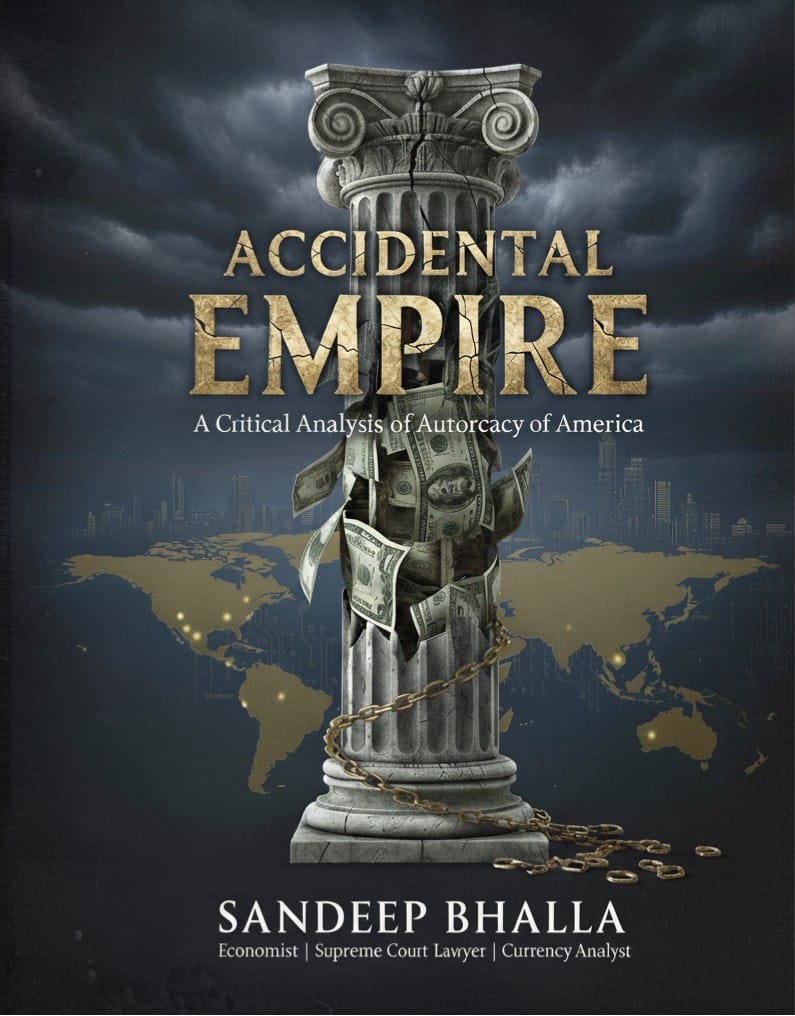
Collapse of Empires
The collapse is inevitable as * Empires always collapse .*
Human desire to control is unlimited and then it creates its own contradiction. It is the contradictions that cause empires to collapse. What do we understand by collapse?
Collapse does not always arrive as a sudden disaster. It is usually a slow breakdown of the systems that hold society together. The unravelling often starts with elites turning on each other, economies stretching beyond their limits, and people losing faith in their institutions. What begins as cracks becomes chasms.
Systems that once managed vast armies, collected taxes, and built infrastructure gradually lose their grip. The networks that connected everything start failing. Eventually, they are unable to maintain even basic coordination. The process is more decay than explosion. We tried the comparison between the British and American empires. Now let us try another method.
Collapse is a self inflicted injury. The people who claimed to be saving the Soviet Union were the ones who delivered its deathblow. Yet this tragic pattern extends far beyond Gorbachev's glasnost. Across millennia and continents, from the 3000 year old Mauryan Empire to modern America. A remarkably consistent three-stage pattern emerges in imperial collapse. One that suggests we may be witnessing its latest iteration in real time.
Universal Three-Stage Pattern
Empires facing terminal crisis follow an almost mechanical sequence. The pattern appears so consistently across different cultures, time periods, and circumstances that it functions like a law of imperial physics.
Stage 1: Initial Liberalization Under Pressure. Empires facing crisis attempt modernizing reforms to strengthen their position. This phase often lasts the longest, as empires still possess the strength to implement gradual changes while maintaining core authority.
Stage 2: Reactionary Crackdown. When liberalization unleashes forces beyond imperial control, hardliners panic and reverse reforms through brutal repression. This phase typically lasts 18-32 years in historical examples and represents the empire's desperate attempt to restore control through force.
Stage 3: Desperate Final Liberalization. With Stage two having failed and legitimacy shattered, empires make frantic final concessions. But these come too late and actually accelerate collapse. This final phase is always the shortest, lasting 10-25 years in historical cases.
Once you recognize this pattern, you can see it operating everywhere. It functions like linguistic grammar. Once you understand sentence structure, you can predict what comes next even in unfamiliar languages.
Historical Evidence
Alexander II emancipated Russia's serfs in the 1860s, hoping modernization would strengthen the empire. He created local governments and implemented what historians call the Great Reforms. His son Alexander III reversed everything with brutal repression that earned the regime international condemnation. When Nicholas II finally granted constitutional monarchy through the October Manifesto in 1905, it was too late. The revolution came 12 years later. The pattern held perfectly across three generations.
Half a world away, the Qing Dynasty (in China) followed identical logic. Early modernization attempts began int he 1860sand continued for 30 years. Then came the Boxer reaction and isolationism in the 1890s, lasting 18 years. When reform finally returned in 1901, the dynasty was already dying. The revolution ended over 2000 years of imperial system within a decade.
The Ottoman sultans tried the same sequence. Tanzimat reforms promised constitutional monarchy and equal citizenship in 1839. For nearly four decades, the empire attempted gradual modernization. Abdul Hamid II reversed everything after 1876 with an autocratic crackdown that earned him the title red sultan. The Young Turks forced constitutional restoration in 1908, but the empire collapsed within 14 years.
The Spanish Empire in America demonstrated the pattern compressed into a shorter timeframe. Bourbon reforms in the 1760s brought administrative modernization and economic liberalization. Napoleon's invasion triggered brutal suppression of independence movements from 1808 to 1814. Ferdinand VII's failed attempts at reconciliation came too late. By 1830, Spain had lost its entire mainland American empire.
The Austro-Hungarian Empire followed the same trajectory. Constitutional reforms and the Austro-Hungarian Compromise of 1867 represented genuine liberalization. Increasing centralization and suppression of nationalist movements reversed these gains from the 1870s through 1914. Desperate wartime concessions and federalization attempts during World War I only accelerated complete collapse.
The pattern appears across vastly different cultures, religions, and governmental systems. Muslim empires, Christian empires, Confucian empires, all followed the same three stages. The specific reforms varied. The crackdown methods differed. But the sequence remained constant.
Exception Proves The Rule
Britain represents the singular exception that validates the pattern. Unlike other empires, Britain implemented their liberalization, decolonization, before the terminal crisis hit. This controlled demolition approach allowed them to sacrifice the empire to save the state. They're the only former imperial Center that avoided revolution, invasion, or total systemic breakdown.
However, Britain still followed the three-stage pattern, including the crucial Stage two crackdown phase. Direct Crown rule after 1857 represented pure extraction. The Government of India Act in 1919 promised liberalization but was immediately followed by the Rowlatt Act and Jallianwala Bagh Massacre. Stage two crackdown operated in full force. Then came rapid decolonization from 1945 to 1970 as Stage three desperate liberalization.
Their geographic advantage simply meant the reactionary violence occurred thousands of miles from London rather than destabilizing the Imperial Center directly. Distance allowed them to implement the pattern without domestic revolution. But they still went through all three stages.
Desperate Alliances
A secondary pattern emerges alongside the three stages. Declining empires desperately ally with rising powers, believing they can maintain status through association. The rising power uses the alliance for its own purposes, then abandons the declining empire when it becomes a liability.
Britain assumed American support for their 1956 attempt to topple Nasser at Suez. America opposed what they saw as imperialism, forcing humiliating British withdrawal. The special relationship became a dependency relationship in a single crisis.
Germany used the Ottoman alliance during World War I for strategic purposes but abandoned them when defeat became clear. The Ottoman leadership had believed the German military might would restore their empire's glory. Instead it accelerated their collapse.
Hitler's alliance with Stalin from 1939 to 1941 represents a pattern compressed to absurdity. The shortest empire in history. Hitler's four-year European empire began with Polish collaboration with Russia, then stabbed Russia and got counter-stabbed by General Winter and Stalin.
The pattern repeats because declining powers cannot accept their changed status. They seek alliance with strength, not recognizing that strength no longer needs them as equals.
American Empire in Real Time
The evidence suggests that perhaps, America entered Stage two around 2020. The COVID-19 response revealed classic Stage two imperial psychology in operation. America destroyed 15.1 million vaccine doses while African vaccination rates remained below 10 percent. These could be given to other countries. The US blocked critical vaccine raw materials to India despite India's global vaccine distribution program. This was not rational policy. It was hoarding behaviour during the crisis.
Trump imposed 50 percent tariffs on friends like India and Brazil while calling them allies. Systematic economic punishment of traditional partners combined with friendship declarations. This contradiction defines Stage 2 behaviour. The empire punishes allies for not being subservient enough while claiming that the relationship remains strong. Later in October 2025 it threatened China with a 100 percent Tariff as a crackdown attempt.
The pattern manifests in real-time diplomatic behaviour. When Trump'steam abused Modi publicly, his months-long non-response demonstrated how traditional allies now maintain distance during imperial overreach. EU leader Von der Leyen cuts deals with Trump, accepting 15 percent tariffs, while simultaneously promising Modi an India-EU FTA by 2026. Everyone hedges against American unpredictability.
India distributed free vaccines globally while America hoarded them. This demonstrates the generous leadership America once showed with the Marshall Plan. The rising power gives while the declining power takes. The reversal is complete.
Behaviour of Tech Companies
Stage two psychology operates across domains. It manifests not justin geopolitics but incorporate behaviour. American tech companies stopped pretending to serve users. They extract openly now. The mask came off.
WhatsApp and Gmail used to monitor communication/chats to build profiles for targeted advertising. That is the established business model. They sell access to users as targeted audiences. But the system evolved beyond profile building into direct extraction. Advertisement now reflect keywords taken from real time conversations in emails/chats.
American tech companies now scrape user content openly for AI training without compensation. They lock people into ecosystems with noway out. They use AI to replace workers while extracting their training data first. Artists create work that trains models designed to replace artists. Writers produce content that feeds systems meant to eliminate writers. Employees develop expertise that gets captured by AI before those same employees get terminated. The extraction operates openly without apology.
Ecosystem lockdown intensified. Once you enter Apple, Google, or Meta environments, extraction begins and exit becomes impossible. Your photos, messages, contacts, purchased content all held hostage to continued platform use. The prison builds itself around you gradually until escape requires abandoning years of accumulated digital life.
Microsoft Word, the software that had dominated document creation for four decades , could no longer perform the most basic computing operation. Copy and paste, a function perfected in the 1970s, now took 20 to 30 seconds. Sometimes it failed entirely. Its spelling and grammar check is far inferior than that of the free software of Zoho.
They force paid tiers for basic features that used to be free. Features that were free suddenly require paid subscriptions. The bait and switch completes. Users who built their workflows around free tools now pay monthly fees or lose functionality. The companies extracted user dependency first, then monetized it.
Facial recognition and fingerprint requirements spread to basic services. Biometric surrender becomes mandatory for routine transactions. The data vacuum operates continuously, storing intimate behavioural patterns, location history, relationship networks, purchasing habits, search queries, private communications. The difference between strategic profile building and desperate brutal extraction reveals system state. Profile building serves long-term value creation. Brutal extraction indicates terminal phase desperation. The tech sector mirrors the geopolitical pattern perfectly.
This is Stage 2 behaviour. When empires feel threatened, they stop attracting and start extracting. They squeeze harder. They grab what they can while they can. The brutality increases as the system destabilizes. American Tech companies with its global reach are operating like occupation forces and demonstrate the same imperial psychology as tariffs on allies and vaccine hoarding.
Acceleration Factors
Historical timelines must account for modern communication speed. The Russian Empire took decades to move from Stage one to Stage three because information travelled by horses and telegraph. Decisions took months. Policy reversals required years to implement.
The internet compresses everything. Stage two behaviour that historically lasted 26 to 32 years now operates on timescales of two to five years. Decision cycles move at internet speed. Policy shifts happen overnight. International coordination occurs in real time.
If Stage two began around 2020, we may be approaching Stage three transition by 2025 to 2028 . Across-the-board tariff imposition was unexpected but it verifies the timeline. It will be shown in the Chapter titled “Project 25” that it is a choice consciously made over other choices. The crackdown intensifies before desperate liberalization begins.
Observable Indicators
Stage 2 behaviour now operate openly. Systematically punishment. Economic warfare against partners. Friend-plus-tariff combinations. These signal that Stage 3 liberalization attempts will begin soon. Major policy reversals. Relationship repair efforts. Frantic attempts to restore partnerships through concessions.
But the pattern shows these efforts come too late. By Stage 3, the damage is done. Partners have developed alternatives. Trust is shattered. The desperate reforms accelerate collapse rather than preventing it.
The historical grammar predicts what comes after. Stage one represents the subject. Empires leading through attraction. Stage two provides the verb. Empires using force and punishment. Stage three becomes the object. Empires attempting damage repair. The back stab pattern supplies the punctuation. How imperial sentences end.
Relativity of Information
Information without context is noise. The imperial pattern does not change, but technology compresses how fast it plays out. Horse-and-telegraph empires took decades to cycle through their phases. Internet-age systems do the same thing in months or years. The steps stay identical. The clock just runs faster.
Most people miss this because they are hunting for the wrong timeframe. They expect decades when they should be watching months. They dismiss rapid shifts as flukes instead of recognizing compressed repetition. The Russian Empire needed 57 years from 1860 reforms to its 1917 collapse. America might traverse the same sequence in five to eight years. Same relationships between stages, but wildly different speed. Modern communication does not create new patterns. It just accelerates the old ones. Policy reversals and relationship repairs that once took a generation could now unfold in months.
Technology operates both ways. It is technology which prevented the immediate collapse too. More about this later, when we discuss the financial and economic aspects of decline.
Implications
The three-stage imperial decline spiral appears to be a universal human response to institutional crisis. When systems fail, there is an instinctive grab for authoritarian control that paradoxically accelerates breakdown. The harder empires squeeze, the faster everything slips away. Whether this represents an inevitable decline or merely another cycle in great power competition remains to be seen. But the pattern itself, identified across empires spanning over two millennia, appears remarkably consistent.
As stated earlier, the people who claim to be saving empires are often the ones who deliver their deathblow. Will they make America great again? The irony remains poetic, and apparently universal.
Ancient Indian strategic thought recorded in Sanskrit recognized this same pattern millennia ago. The * Dharmic* perspective identified the three-stage collapse through different terminology, but the mechanism remains identical. In the next chapter we explore how ancient wisdom validates this phenomenon.
Leave a Response