Participatory governance is an unfounded belief.
The USA government is trapped in policy paralysis. When it acts, the purpose remains unclear. Is this anew policy or a desperate pursuit of old ones? Decisions often seem tactically correct but lack strategic vision. Governance is drifting to accommodate everything except the interest of the State or its people.
Violence
A policeman on the street is the first symbol of the State. The state owns the monopoly on violence. When that monopoly cracks, everything else follows. In the USA in 2023 alone, 754 people died in 604 mass shootings across America. In 2024, another 711 people were killed in 586 shootings. That's over 1,400 dead in two years. Not in war zones. In shopping malls, schools, and streets.Pew research pegs the total number of deaths due to gun injuries in 2023 at 46,728 people.
Now look at the other end. A 20 year old fired eight rounds at Republican Presidential candidate Donald Trump in an election rally in Butler Pennsylvania, killing one firefighter and critically injuring two others. The bullet grazed his right ear. There was a second attempt in Florida. The Secret Service suspended six agents for failures in protection. When a gunman can get that close to a former president, the system isn't working at street level or elite level. These are not two different problems. This is one problem. The violence aimed at common people and the violence aimed at leaders come from the same root. State failure.
India proved this the hard way. Indira Gandhi turned the police into her political weapon. She used state violence to crush opponents. In 1984, she was killed by her own security guards. Her son Rajiv Gandhi justified the anti Sikh pogroms that followed. He said when a big tree falls, the earth shakes. Seven years later, the LTTE blew him up in Parmudur. When leaders think law and order only matters for controlling others, they discover too late that it also protects them.
America is discovering the same truth now. Defund ing the police was presented as a reform. In California, Proposition 47 made theft under $950 non-prosecutable as a felony. But when you tell criminals the state won't enforce basic order, you're not making a strategic choice. You're announcing abdication.
The shootings keep happening because the state stopped defending its monopoly on violence. The attempts on Trump keep happening for the same reason. When state capacity erodes, chaos fills the vacuum at every level. Mall shootings and political assassinations are symptoms of the same disease. Governance has drifted away.
Making America Great
“ Together, we will bring back our jobs, we will bring back our factories, and we will bring back our American Dream” so said President Trump. He wanted factories back in America. His main tool was tariffs. Make foreign stuff expensive. Force companies to comeback. Punish imports until manufacturing returns home.
Carrot Approach
India decided to make manufacturing attractive. Simple as that. They created the Production Linked Incentive scheme. Companies get cash rewards when they actually make stuff in India. Not for promises but for production. They built special manufacturing zones. These zones came with tax holidays. No hassles with red tape. Ready infrastructure waiting. They setup de fence corridors in Tamil Nadu and Uttar Pradesh. Startups got tax breaks too.The government basically rolled out the red carpet. Come manufacture here. We'll make it worth your while. We'll handle the infrastructure headaches. You focus on making products.
The result was that manufacturing output jumped from 1.4% (2023-24) to 4.26% (2024-25) in just one year. Foreign investment in manufacturing shot up 69% over ten years. Companies looking to move out of China found India ready and welcoming.
This worked because India pulled companies in. They made manufacturing profitable and easy. Build it and they will come turned into make it profitable and they will come. The approach was positive. Rewards beat punishment every time.
Stick Approach
In April 2025, the USA imposed a 10% tariff on everything. Countries with big trade deficits got hit even harder. The thinking seemed simple. Jack up import costs. Companies will have no choice but to manufacture in America.But here's what actually happened. Manufacturing lost 33,000 jobs in 2025. After the tariff announcement, 42,000 more jobs vanished. Four straight months of job losses total 78,000 workers.
Experts pointed out the obvious problems. America lacks the infrastructure for massive re-shoring. There aren't enough workers. Many Americans don't want factory jobs anyway. Half the companies surveyed said re-shoring would double their costs. Many started hunting for other low tariff countries instead.
Japan did commit $550 billion after getting their tariff reduced to 15%. But the Government could not seek approval from Parliament as it fell. Now the new Prime Minister has to decide. The picture is not rosy.
The problem is simple. Tariffs punish but don't reward. They make imports expensive without making American manufacturing attractive. No infrastructure help. No workforce training. No financial incentives. Just penalties and hope. You can't push rope. Manufacturing needs to be pulled back with actual benefits. Punishment alone doesn't build factories. It just makes everything more expensive while companies hunt for workarounds.
Strategic Paralysis
The United States government finds itself trapped in what can only be described as “Drift Governance.” This is a condition where sophisticated institutional capabilities exist but lack strategic coordination to translate intelligence into coherent long-term planning. This is not merely bureaucratic inefficiency. It represents a fundamental breakdown in the executive synthesis required for superpower leadership.
Unlike failed states or institutionally weak nations, drift governance afflicts capable states that possess advanced intelligence capabilities, economic analytical tools, military resources, and diplomatic instruments. Yet these assets cannot be coordinated toward coherent strategic outcomes. The United States has become tactically sophisticated but strategically rudderless. It reacts to events rather than shapes them.
New York incidents
The September 24th 2025, UN incidents reveal drift governance operating at the micro level. America couldn't coordinate basic logistics for a major diplomatic event.
The escalator failed at UN building, during Trump's arrival . Nobody knew why. Was it sabotage or maintenance? The government demanded investigations but had no answers. The teleprompter went blank during Trump's speech. He improvised from handwritten notes. Basic preparation systems failed when they mattered most.
French President Macron's motorcade got stuck in traffic. Local police blocked a foreign president's convoy. Federal and city authorities never coordinated protocols. He had to call President Trump from his phone but ultimately had to walk on foot to his hotel.
Each agency did its job correctly. The escalator safety system worked as designed. Police followed security procedures. Traffic management operated normally. But nobody managed the big picture. The Secret Service protected Trump. The NYPD controlled traffic. Building maintenance ran safety checks. Tech crews managed equipment. All these groups had their own priorities. None coordinated with the others. The result looked chaotic from outside.
This mirrors national drift governance. Individual capabilities remain strong. Strategic coordination breaks down. America has the tools but can't use them together. The world watched these failures unfold. Foreign leaders saw American disorganization. Citizens lost confidence in basic government functions.
When America can't run an escalator and traffic smoothly, how can it lead globally? Micro failures reveal macro problems. Drift governance starts with small coordination breakdowns.
The Vision Vacuum
President Trump addressed the United Nations on September 23, 2025. He complained of teleprompter and elevator to the public. He proclaimed America's golden age. Boasted of economic records and ended wars. He rejected climate policies as scams. He dismissed globalism as a failed experiment.
But the speech contained no actual vision for the future. Just descriptions of current achievements and a list of rejected policies. American leadership was offered without destination. Sovereignty was praised while demanding other nations to follow the American example.
The contradiction revealed a strategic vacuum. America knows what it opposes. Climate cooperation. Multilateral institutions. Globalization. Foreign aid. But what does America actually want to build? The speech never said. This is drift governance in rhetorical form. Tactical competence without strategic direction. Professional execution of reactive policy. No coherent picture of the desired end state. Just actions without purpose. Leadership without destination.
Washington celebrates ending seven wars but articulates no vision for the peace that follows. It demands NATO increase spending but explains no threat that the spending may justify. It rejects globalism but offers no alternative framework for international cooperation. The blank canvas is complete. America leads nowhere because America does not know where it wants to go. This is no vision. This is a vacuum.
The evidence of drift governance manifests across multiple policy domains with devastating consistency. Here are more examples.
Conflict of Interest
Conflicts of interest damage governance. When Trump signed the stablecoin law called GENIOUS, his family made billions from crypto. Now every regulation looks suspect. Did he sign it for America or for his bank account? This doubt spreads fast.
The Qatari government offered a luxury Boeing 747-8 jumbo jet as a “gift” to President Trump. It has an estimated value of around US $400 million. President Trump said that it would serve as a temporary “Air Force One” and later be donated to his presidential library. A report by the U.S. House Oversight Committee found that during Trump’s presidency, 117 gifts from foreign governments/officials were not properly disclosed with estimated value around US $291,000 .
Obama took $400,000 for a Wall Street speech after leaving office. People wondered if those relationships shaped his banking policies while president. The Clintons raised millions for their foundation from foreign governments. Donors got State Department meetings. Coincidence?
Foreign governments seethe opening. Abu Dhabi sent $2 billion to Trump ventures after inauguration. They're not investing in crypto. They're buying access.
Each case chips away at trust. Career officials watch their bosses profit from the industries they regulate. Why follow ethics rules when leadership ignores them? The damage compounds. Good laws get questioned because of who profits. Bad laws get cover because everything looks dirty. Citizens stop believing anything works for them. Half of them refuse to vote and democracy suffers.
Ukraine Preparation
The Biden administration received intelligence about a potential Russian invasion as early as late 2021. U.S. intelligence agencies provided highly unusual releases of intelligence findings about Russian President Vladimir Putin's plans to attack Ukraine, warning repeatedly that a major assault was imminent. Yet this foreknowledge translated into contradictory actions. The administration waived sanctions on the No rd Stream II pipeline in May 2021. It failed to ramp up ammunition production beyond peacetime levels of 30,000 shells monthly. As explained in earlier chapters, no apparent diplomatic effort was made to press Ukraine toward Minsk Agreement implementation.
When the Russian invasion materialized in February 2022, the United States found itself scrambling. It took until September 2024 to increase ammunition production to 60,000 rounds monthly. This capacity should have been achieved months before the conflict began. The world's dominant military power is rationing artillery shells to Ukraine. It is an absurd spectacle of drift governance.
If entry into Ukraine war was unplanned, the exit from Afghanistan was tragically ridiculous. It says that when you overstay your purchased welcome, you have to leave in the middle of the night without farewell.
Afghanistan Exit Strategy
Every American president since 2001 promised withdrawal from Afghanistan. Yet it required twenty years and a chaotic midnight evacuation that transformed the United States into a global laughingstock. President Biden's execution of withdrawal, while ultimately necessary, was conducted with such operational incompetence that it undermined any strategic benefits of ending the conflict.
The irony deepened when President Trump, after ridiculing Biden's withdrawal, in September 2025 demanded tore-possess Bagram AirBase. He was refused by the very Afghan government the United States had spent two decades trying to eliminate. This represents the perfect encapsulation of drift governance. To add insult, India joined Russia and China aginst the USA’s preposition to build any military infrastructure in Afghanistan.
Pakistan
On 25 October 2025, a former CIA officer John Kiriakou revealed about US operations in Pakistan from 2002. It exposed not just policy failures, but a systemic absence of strategic thinking. Immediate tactical gains consistently override long-term coherence, producing the very instability America claims to prevent.
Kiriakou describes how the US "essentially purchased" President Musharraf, funneling "tens of millions of dollars in cash" to Pakistan's intelligence service (ISI). This wasn't alliance-building; it was renting cooperation.
In March 2002, Kiriakou'steam raided an LeT safe house in Lahore and recovered anAl-Qaeda training manual. LeT is a known Pakistan proxies. Recovery was the first documentary proof connecting Pakistan's state-sponsored terrorists with the enemy America was fighting globally. The US responded with nothing. The relationship was deemed "bigger than India-Pakistan" because tactical needs. Kiriakou also claimed that he was told the Pentagon controlled Pakistan's nuclear arsenal in 2002, handed over by Musharraf fearing terrorist access.
USA was fighting the war withAl-Qaeda and its ally Pakistan was ally of both. Does that sound like an ideal governance model?
Russion Oil
The USA has no Ukraine policy because Ukraine is not the goal, atleast not anymore. Oil price management is the goal. Everything else is theater.
When prices sit comfortably at $75, Trump can be friendly with Putin. When they fall toward $57 and shale producers panic, he sanctions Russian oil companies. The sanctions are designed to leak, so Russian supply stays in the market and prices don't spike too high. This keeps both American shale and Russian oil revenues healthy.
The zigzag pattern isn't confusion. It's calibration. Each move tests where oil prices settle. Rhetoric is free. Sanctions that actually work would spike prices and anger voters, so enforcement stays deliberately weak. Shell companies proliferate faster than Treasury can target them, and everyone knows it.
Washington frames this as toughness on Russia. Moscow accepts it because higher prices compensate for modest volume losses. Both oil industries win. Ukraine gets words, not weapons, because the war's continuation serves energy interests better than its resolution would. Policy drifts with price of oil.
The policy works exactly as designed. It just isn't designed for Ukraine.
India in Blindspot
Perhaps the most revealing drift was the repeated American failure to anticipate India. In 1998, the preparation for a nuclear explosion went undetected by its intelligence. Perhaps the CIA is more focused on the formations of Governments in other countries rather than their activities. It also failed to read the published papers on Quantum Communication and Electromagnetic Pulse research by India.
It also failed to anticipate how India's massive refining infrastructure expansion would interact with Ukraine sanctions. India's petroleum refining capacity increased from approximately 45 million tonnes to over 60 million tonnes between 2019-2022. This represented roughly $4.5-7.5 billion invisible industrial investment.
This expansion was not hidden. Refining complexes, tank farms, and port facilities are among the most visible industrial infrastructure from satellite imagery. Yet when Russia invaded Ukraine, American policymakers appeared genuinely surprised. They expected India to abandon billions in fresh infrastructure to comply with sanctions requests. The disconnect between intelligence gathering capabilities and economic strategic analysis could not be starker. It only supports India’s stance that it was encouraged by the USA.
Demands that India open agricultural markets to GMO products. When India refuses, now from position of strength and threats follow. The rhetoric escalated after Sindoor in May 2025. Now the USA demanded India to stop buying Russian oil. Commerce Secretary Lutnick: "We have countries to fix, like India. They need to react correctly to America." Navarro attacked "Brahmins profiteering," using Hinduphobic colonial slur to justify tariffs. Trump called India's economy "dead," mockingly suggested buying oil from Pakistan. This is not negotiation. This is rage at losing what you tried to control through deception. It is a human reaction to loss of strategic advantage.
Anticipatory Governance
The contrast becomes even sharper when examining how other nations demonstrate genuine strategic foresight. In 2024, Indian ministry officials issued advisories recommending government migration from American email services like Gmail to Zoho-backed platforms. This occurred precisely as “friendly” President Trump was entering office. This suggests sophisticated analysis that personal relationships provide no protection against intelligence gathering or policy volatility.
While Zoho may maintain some technical dependencies on Google services, the content sovereignty achieved through Indian server storage represents meaningful protection from routine U.S. government data harvesting. This is exactly the kind of anticipatory risk mitigation that American policy demonstrates that it cannot execute.
Structural Nature of Drift
What makes drift governance particularly concerning is its persistence across administrations and political parties. Every president over recent decades has exhibited the same pattern:
Campaign promises contradicted by governing reality: Afghanistan withdrawal promises made and broken repeatedly until Biden's chaotic execution
Intelligence capabilities divorced from strategic planning: Ukraine invasion intelligence failing to trigger adequate preparation
Tactical competence without strategic vision: Professional military capabilities undermined by incoherent political objectives
Islamic Jihad: Promising to fight Islamic Jihad but embracing Zolani of Syria and Asim Munir of Pakistan. Zolani is a proclaimed terrorist. Munir heads an Army with official tag line “Jihad-Fi-Sabilillah.”
Presidential personality is irrelevant now. Whether Obama's intellectual analysis, Trump's transactional instincts, or Biden's institutional experience, the outcomes remain consistently reactive rather than strategic. The problem appears structural rather than personal.
On top of it there is a diplomatic humiliation cycle , where heads of states/governments are humiliated on camera. White House officials completely bypass diplomatic niceties and hurl slurs on others like they are in High School canteen.These diplomatic episodes reveal how drift governance creates self-inflictions that undermine American prestige.
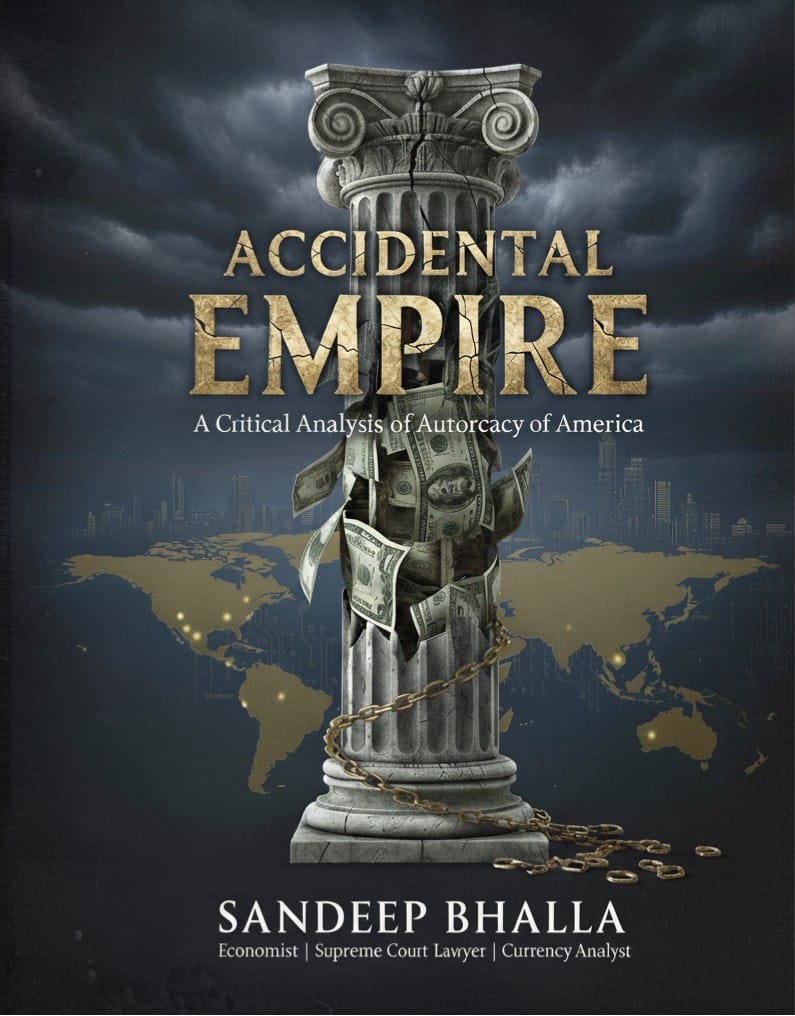
Drift governance represents the operational mechanism through which America's “accidental empire” maintains itself until it inevitably cannot. Desperation is the natural next inspiration for another tactical move. Strategic planning remains absent. History tells us that poorly thought military adventures result from such desperation. Will America rush into war? Will America stumble into conflict? Will America lash out militarily? And more importantly to whom?
And it happened. On February 28, 2026, the US and Israel launched coordinated airstrikes on Iran under Operation Epic Fury, resulting in the death of Supreme Leader Khamenei. In response, Iran declared the Strait of Hormuz closed on March 4, 2026, laying mines and charging merchant transit tolls exceeding $1 million.
Despite massive US naval deployments (centered on Carriers USS Abraham Lincoln and USS George H.W. Bush), a military deadlock ensued:
1. Asymmetric Deterrence: Iranian hypersonic missiles keep Carrier Strike Groups beyond 1,000 km, while threats of a dirty bomb radiological event and subsea internet cable severance prevent a direct invasion of energy assets.
2. Sovereign Fund Custody: The core negotiation deadlock centers on Iran's refusal to route oil revenues through US-monitored banking channels, avoiding the sovereign asset seizures suffered by Iraq, Libya, and Venezuela.
3. Domestic Theater: The conflict remains managed and unresolved, serving domestic arms sales and political calendars rather than achieving a clean strategic victory.
India-Middle East-Europe Economic Corridor (IMEC)
By mid-2026, the India-Middle East-Europe Economic Corridor (IMEC) has evolved from a US-sponsored G20 announcement into a project built independently by India and Europe. While American interest drifted, India assembled the European terminal architecture across five countries:
1. The Mediterranean Hinge: Cyprus established the "Friends of IMEC" group of EU states to coordinate port registration and feeder routes.
2. Port Acquisitions: India's Gautam Adani acquired the port of Haifa (Israel) and entered negotiations for Alexandroupolis (Greece).
3. Terminal Commitment: Italy committed Trieste as the European gateway for the corridor.
At the operational layer, the corridor is likely to be managed as a digital operating system using automated, computerized node-to-node routing. A container loaded at Mundra (Gujarat) carries a digital label readable from Dubai to Trieste, separating IMEC traffic from local transit through unified digital coding.
The contrast between America's founding strategic vision and current policy incoherence would indeed shock the architects of American foreign policy doctrine. This is precisely the trap America now finds itself unable to escape.
Read more about such moves about India in the next chapter called Ring of Delusion.
Published on August 27, 2026
Chapter 34: Drift Governance
Part of Series: "Accidental Empire of USA"
View Series Table of Contents (47 Chapters)
- Author’s Note
- Preface
- Explanatory Note
- Prologue
- Chapter 1: Introduction
- Chapter 2: Foundation and Evolution of USA
- Chapter 3: First President of USA
- Chapter 4: Manifest Destiny Wars
- Chapter 5: Tariff Hypocrisy
- Chapter 6: Windfalls of War
- Chapter 7: Price of Weimar Republic
- Chapter 8: Empire Pronounced
- Chapter 9: End of the Gold Standard
- Chapter 10: Borrowing and Debt Ceiling
- Chapter 11: British Empire
- Chapter 12: Currency Management
- Chapter 13: Dollar Lining in Crises
- Chapter 14: Oligopoly Currency System
- Chapter 15: Oil Wars
- Chapter 16: Regime Change Operations
- Chapter 17: Space War
- Chapter 18: Collapse of Soviet Union
- Chapter 19: Poverty in a Rich Empire
- Chapter 20: Popular Nazi Economics
- Chapter 21: Education Trap
- Chapter 22: Toxic Expertise
- Chapter 23: Soft Power Slipping
- Chapter 24: Incredible Art Auctions
- Chapter 25: Strategic Decoupling
- Chapter 26: Military Superpower
- Chapter 27: USA emulating UK
- Chapter 28: Collapse of Empires
- Chapter 29: Ancient War Science
- Chapter 30: AI: The New Vishkanya
- Chapter 31: Project 25
- Chapter 32: Smiling Betrayal
- Chapter 33: New World Order
- Chapter 34: Drift Governance (Current Chapter)
- Chapter 35: Ring of Delusion
- Chapter 36: New Cold War
- Chapter 37: Price Follows Money
- Chapter 38: Perfect Bubble
- Chapter 39: Dark Skies
- Chapter 40: Nation Rebuilding
- Epilogue
- Appendix: Bretton Woods Agreement
- Bibliography
← Previous Chapter
Chapter 33: New World Order
Next Chapter →
Chapter 35: Ring of Delusion
Leave a Response