Imitation often emerges from loneliness and the challenges of connection.
Britain's imperial decline offers a sobering preview of what happens when military commitments exceed economic capacity. The parallels to America's current situation are uncomfortable and worth examining closely.
Overstretch Pattern
By 1914, Britain was trying to police global trade routes, maintain naval supremacy on seven seas, and manage an empire covering a quarter of the world's landmass. The Royal Navy needed bases from Gibraltar to Singapore. The Indian Army required constant funding. Colonial administration consumed thousands of British officials and enormous administrative costs.
Sound familiar? America today operates 800 military bases across 80 countries. It maintains security commitments spanning from NATO's eastern border to the Taiwan Strait. The Pentagon plans for simultaneous conflicts in multiple theatres while deterring nuclear powers and supporting dozens of allies worldwide.
Britain discovered that global dominance creates its own momentum. Each commitment requires supporting commitments. Protecting India meant controlling the Suez Canal. Controlling Suez meant managing Egypt. Managing Egypt meant dealing with Sudan. Before long, the empire was everywhere because it had to be everywhere.
Financial Haemorrhage
Britain's debt crisis was not just about borrowing too much money. It was about the costs of maintaining global dominance eventually exceeding any economic benefits the empire provided. By 1976, interest payments on British debt had become larger than defence spending. The empire that once generated wealth was consuming it faster than the economy could produce it.
America crossed that same threshold recently. Interest payments on the national debt now exceed defence spending for the first time since World War II. The military that once protected American prosperity is becoming a drain on it.
Strategic Rigidity
Perhaps the most dangerous parallel lies in strategic inflexibility. Britain kept using gunboat diplomacy when the world had moved beyond that approach. Even after World War II proved that industrial capacity mattered more than colonial possessions, British leaders continued thinking in imperial terms.
The 1956 Suez Crisis perfectly captured this delusion. Britain and France invaded Egypt using 19th century methods in a 20th century context. When America opposed the invasion, Britain discovered it could no longer act independently of its former colony. The special relationship had become a dependency relationship.
America shows similar rigidity in its response to asymmetric warfare. It fights insurgencies with conventional forces designed for peer competitors. Yet the Pentagon continues building the same types of expensive systems. The F-35 program persists despite questionable performance against the guerrilla tactics and cyber warfare that actually threaten American interests.
Resistance Curve
Colonial independence movements learned from each other, developing strategies that made British control impossibly expensive. Gandhi's non-violent resistance in India inspired similar movements across the empire. Military techniques used successfully in one colony quickly spread to others. The cost of suppressing coordinated resistance eventually exceeded any benefits of continued control.
Today's pattern is strikingly similar. Iran, North Korea, China, India and Russia study each other's approaches to countering American technological advantages. Cyber warfare techniques, anti-access strategies, and economic warfare methods spread rapidly between adversaries. The cost of maintaining dominance against coordinated resistance is growing exponentially.
Dependency Trap
Britain's final trap was economic dependence on its rivals. By 1945, Britain owed enormous debts to America while still trying to compete with American industrial growth. The creditor had become more powerful than the debtor, but British leaders could not accept this reality.
America faces a similar contradiction today. It owes trillions of dollars to China while trying to contain Chinese expansion. It owes trillions of dollars to the entire world put together because those countries are holding dollars as reserve currency. It depends on global supply chains controlled by potential adversaries while maintaining military superiority over them. The contradiction is becoming harder to sustain.
If major dollar holders decided to sell Treasury bonds simultaneously, it would hurt them first. But the damage to the American economy would be catastrophic. Everyone knows this but nobody acts on it.
Imperial Schizophrenia
Nations, like people, can suffer from schizophrenia. They hold contradictory beliefs simultaneously and act against their own interests while convinced they are being rational. Britain demonstrated this perfectly in its final imperial decades. So does America today.
Both empires reached a point where strategic decisions were made for prestige rather than practical benefit. Britain's aircraft carrier programs in the 1960s consumed enormous resources for minimal strategic value. The expense was justified by the need to maintain great power status, not by actual military requirements.
This was not stupidity. British leaders were intelligent, well-educated people with access to excellent information. They knew their economy was devastated. They understood that America had become the dominant industrial power . They could see that colonial resistance was making empire increasingly expensive. Yet they kept acting as if none of this was true. They built aircraft carriers they could not afford, fought wars they could not win, and made promises they could not keep.
The problem went deeper than bad analysis. It was the inability to reconcile what they knew to be true with what they needed to believe about themselves. The gap between knowing and doing grew too wide to bridge. America displays similar symptoms. America's procurement shows the same pattern. As stated earlier, the Columbia-class submarine program costs $115 billion for 12 boats whose primary mission is deterrence. The B-21 bomber costs over $200 billion for capabilities that may never be used. 1.7 trillions spent on a fighter plane which gets lost in Monsoon rain in Kerala in 2025. More about that in next chapters. These programs continue because superpowers are supposed to have them, not because these plans address actual threats.
Pentagon planners know that peer competitors like China and Russia will not fight the kind of conventional wars American forces are designed to win. They understand that insurgencies, cyber attacks, and economic warfare represent the real threats. Intelligence agencies provide detailed assessments of how adversaries are adapting to American advantages. Yet procurement continues optimizing for the wrong conflicts. The Navy builds aircraft carriers that might not survive in contested waters against modern missiles. The Air Force develops manned fighters for an era of drones. The Army prepares for tank battles while actual conflicts involve urban warfare and irregular forces.
Military institutions have their own logic and momentum. Carriers and aircraft are built on traditional competencies. Contractors profit from familiar technologies. Allies expect certain capabilities regardless of practical value. But the gap between strategic reality and procurement decisions grows wider each year.
The financial schizophrenia is even starker. Everyone knows that current spending levels are unsustainable. Interest payments exceed defence spending and continue growing. Infrastructure crumbles while military budgets increase. The mathis simple and terrifying. Yet the response is to plan even more expensive systems. American leaders commission studies, hold hearings, and express concern about fiscal sustainability. Then they approve the next round of procurement increases because nobody wants to be remembered as the one who weakened American defences.
This is the pattern. Knowing the truth but being unable to acton it because it conflicts with too many other needs. Psychological needs. Political needs. Institutional needs. This is the most dangerous form of schizophrenia. Having the warning and choosing to ignore it anyway.
The cure is the same whether you are treating a person or a nation. Face reality and make coherent choices based on that reality rather than on wishful thinking. Britain never managed this transformation. Whether America can remains the defining question of the decade.
Future Prospects
History provides the precedent, but not the verdict. America's future depends entirely on choices made in the coming decade. The British example shows what happens when global commitments exceed economic capacity, but it does not prove this outcome is inevitable.
America retains advantages Britain lacked in its final decades. The dollar's reserve currency status provides financial flexibility no other nation enjoys. American technological innovation continues leading global development in crucial sectors. The domestic market remains large enough to support major industries without colonial extraction. America also holds gold reserves worth approximately $1 trillion. That's all.
More importantly, America can still choose different paths. Britain's leaders never seriously considered reducing global commitments to match economic realities. They preferred managed decline to strategic adaptation. American leaders face the same choice, but they are not bound by British decisions.
Doubling Down
America could choose to maintain current global commitments regardless of cost. This means accepting higher debt levels, increased defence spending, and growing economic strain. The British tried this approach after 1945 and lasted about 30 years before the 1976 IMF bailout forced reality upon them.
But Britain had a safety net America does not have. When British numbers broke, the IMF stepped in. American institutions managed British collapse, extracted concessions, reshaped policy from the top. The decline was controlled. America runs the IMF. America controls the dollar. There is no institution above America that can manage American collapse. No external authority. No higher court. When America hits the wall, there is only the wall.
Maintaining current alliances and deterrent effects offers clear advantages. Allies continue receiving security guarantees while adversaries face overwhelming military superiority. Global stability benefits from predictable American dominance. But the financial decline accelerates.
As stated earlier, interest payments already exceed defence spending and continue growing. Civilian infrastructure needs compete with military budgets for resources. Social programs face funding pressure while procurement costs escalate. Eventually, economic constraints force strategic retrenchment anyway, but from a much weaker position.
Managed Retrenchment
America could systematically reduce global commitments to match economic capacity. This means prioritizing core interests while gradually withdrawing from peripheral regions. Allies would assume greater responsibility for their own defence while America focused on essential strategic relationships. President Trump has been saying this to Europe for quite sometime. The EU has indicated to raise its military budget.
Financial sustainability becomes possible. Reduced military commitments free resources for domestic investment and debt reduction. Strategic focus on vital interests improves effectiveness while reducing costs. The risk is instability during transition periods. Regional powers might exploit American withdrawal to settle old scores or expand influence. Allies could hedge their bets by developing independent capabilities or alternative partnerships.
Strategic Innovation
America could develop new methods for maintaining global influence at reduced cost. This means leveraging technological advantages, economic relationships, and alliance partnerships more effectively while reducing direct military commitments. Influence through innovation rather than occupation. Innovation must be affordable too. It has a reputation for building expensive contraptions which nobody can afford.
This maintains global leadership while reducing financial strain. Technological superiority provides deterrent effects without requiring massive force deployments. Economic partnerships create mutual dependencies that serve American interests without military coercion. Alliance burden-sharing reduces American costs while maintaining collective security.
Critical Decade
This decade will likely determine which path America takes. Current spending trajectories are unsustainable beyond this decade without major economic growth or significant policy changes. Interest payments continue growing while infrastructure needs become more urgent. Military procurement programs require decisions about next-generation capabilities that will define American power for decades.
The true cost of military superpower is not just the $30 trillion in current commitments. It is the opportunity cost of resources that could address other challenges while maintaining essential security. Understanding that cost is the first step toward choosing wisely.
Britain never managed the transformation from knowing to doing. Leaders commissioned studies about decline while approving the same expensive systems. The gap between strategic reality and actual decisions widened until the system broke.
America is following the same path. The difference is that America has Britain as a warning. The British did not have an immediate precedent to learn from. They stumbled into decline without knowing what it looked like. America knows. The pattern is clear. The trajectory is predictable. The consequences are visible.
Empires collapse sooner or later. People and countries go on. In the next chapter we shall discuss the pattern of collapse of empires.
Published on August 27, 2026
Chapter 27: USA emulating UK
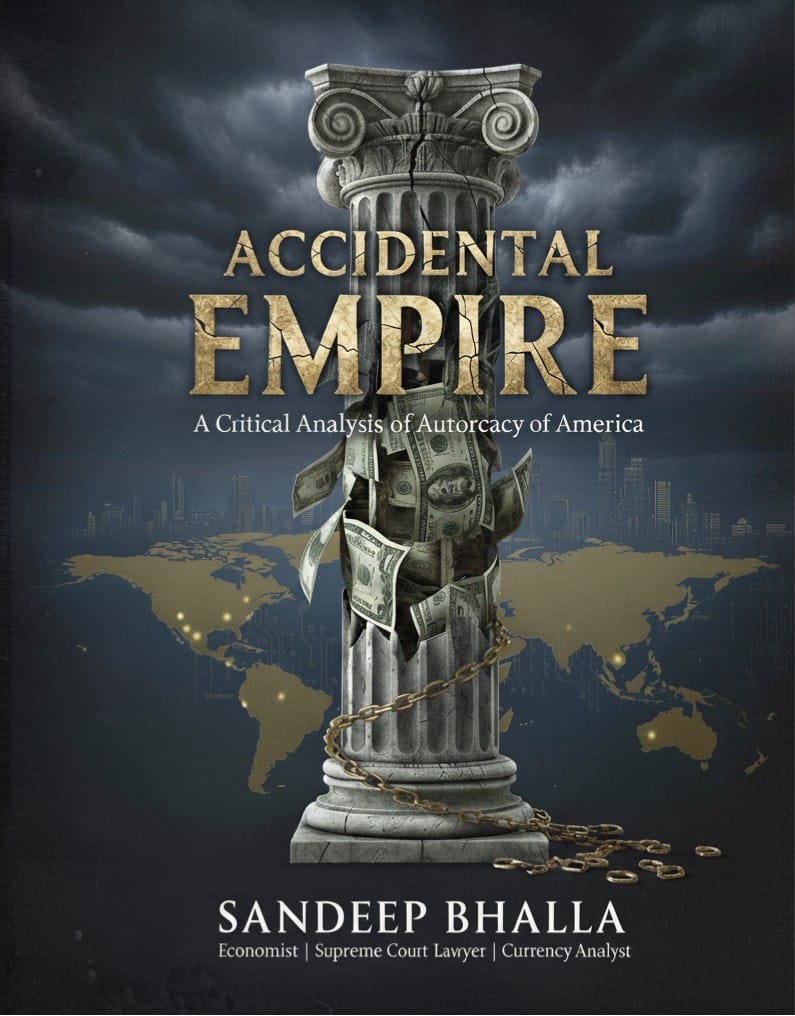
Part of Series: "Accidental Empire of USA"
View Series Table of Contents (47 Chapters)
- Author’s Note
- Preface
- Explanatory Note
- Prologue
- Chapter 1: Introduction
- Chapter 2: Foundation and Evolution of USA
- Chapter 3: First President of USA
- Chapter 4: Manifest Destiny Wars
- Chapter 5: Tariff Hypocrisy
- Chapter 6: Windfalls of War
- Chapter 7: Price of Weimar Republic
- Chapter 8: Empire Pronounced
- Chapter 9: End of the Gold Standard
- Chapter 10: Borrowing and Debt Ceiling
- Chapter 11: British Empire
- Chapter 12: Currency Management
- Chapter 13: Dollar Lining in Crises
- Chapter 14: Oligopoly Currency System
- Chapter 15: Oil Wars
- Chapter 16: Regime Change Operations
- Chapter 17: Space War
- Chapter 18: Collapse of Soviet Union
- Chapter 19: Poverty in a Rich Empire
- Chapter 20: Popular Nazi Economics
- Chapter 21: Education Trap
- Chapter 22: Toxic Expertise
- Chapter 23: Soft Power Slipping
- Chapter 24: Incredible Art Auctions
- Chapter 25: Strategic Decoupling
- Chapter 26: Military Superpower
- Chapter 27: USA emulating UK (Current Chapter)
- Chapter 28: Collapse of Empires
- Chapter 29: Ancient War Science
- Chapter 30: AI: The New Vishkanya
- Chapter 31: Project 25
- Chapter 32: Smiling Betrayal
- Chapter 33: New World Order
- Chapter 34: Drift Governance
- Chapter 35: Ring of Delusion
- Chapter 36: New Cold War
- Chapter 37: Price Follows Money
- Chapter 38: Perfect Bubble
- Chapter 39: Dark Skies
- Chapter 40: Nation Rebuilding
- Epilogue
- Appendix: Bretton Woods Agreement
- Bibliography
← Previous Chapter
Chapter 26: Military Superpower
Next Chapter →
Chapter 28: Collapse of Empires
Leave a Response