Yemen Then And Now
Yemen today is the deliberate erasure of a civilization. The architects of this war have treated the country as a geopolitical chessboard. They include Riyadh’s royal courts, Abu Dhabi’s naval command, and Western capitals that provided the ordnance and diplomatic cover. Not to forget its own local rulers and their alliances. It is viewed as a buffer zone to be managed, divided, and starved. This is done to protect someone else's sphere of influence.
The tragedy of Yemen is not just that it is suffering. Real tragedy is that it is pushed in the dark, stripped of its rich historical context in the global imagination. This land once fed the ancient world's luxury markets. Now, it is the site of modern history's worst engineered famine. A people who built the Great Dam of Marib are dying of thirst. The proud Zaydi highlanders, whose ancestors defied empires, are reduced to statistics on a UN casualty report.
But it was not always like this. Once it was called 'Arabia Felix'.
The Land They Now Call Cursed Was Once Called Blessed.
The Fortunate Land
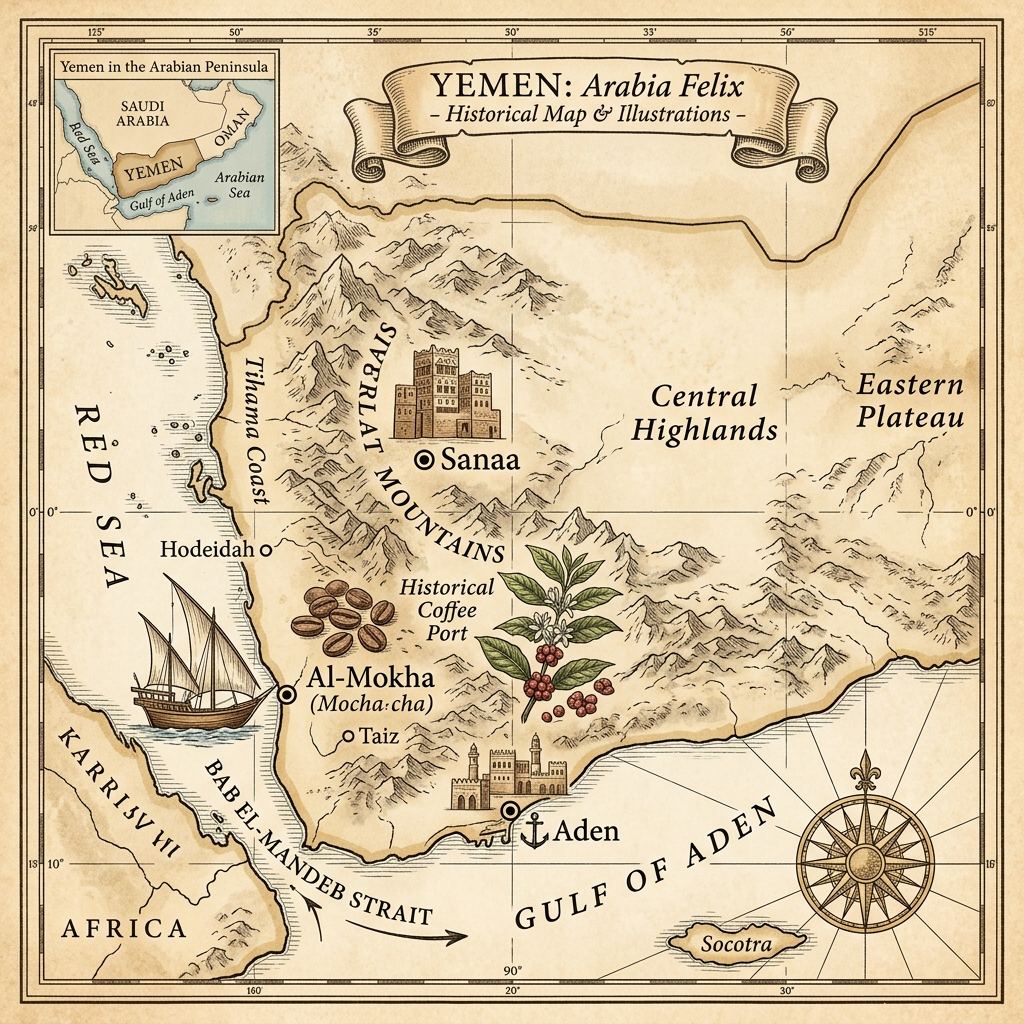
In Arabic, al-Yaman traces its etymology to the root yumn. It is layered with connotations of the right-hand side, but more profoundly, of prosperity, blessing, and good fortune. Ancient Greeks and Romans looked toward the southern edge of the Arabian Peninsula. They did not see the unforgiving sand seas of the Najd or the Empty Quarter. They saw a miracle of geography. They named it Arabia Felix (Fortunate Arabia).
For centuries, the Yemeni highlands caught the Indian Ocean monsoons. Ancient engineers captured this rainfall. They carved elaborate agricultural terraces into the sheer faces of the mountains. They built the Great Dam of Marib, an engineering marvel of the ancient world. The builders were the Sabaeans. Their kingdom is widely associated with the Queen of Sheba, known in Arabic as Bilqis. The biblical account of her visit to King Solomon reflects the Sabaean reputation for legendary wealth. The dam sustained a sprawling oasis and supported a dense, self-reliant civilization.
This was the land of frankincense and myrrh. It was also the birthplace of coffee. The Red Sea port of Al-Mokha gave the world the word mocha. For centuries, Yemen produced the only coffee reaching the outside world. Every cup consumed from Cairo to Constantinople passed through this single port. It was the anchor of trade routes that supplied the luxury markets of the Mediterranean and the Near East. Arabia Felix was fertile, wealthy, and sovereign.
That sovereign identity hardened in the mountains. For over a millennium, the northern highlands were the fortress of the Zaydi Shia civilization. Today, the Zaydis are often dismissed in Western capitals as a marginal, Iran-sponsored militant sect. In reality, they are the historical backbone of Yemeni highland identity. They formed the Mutawakkilite Kingdom, which endured as the last Islamic imamate in the modern era until 1962. They were fierce, stubbornly independent, and practically unconquerable. The Ottomans, bleeding out in the mountains, came to call Yemen the "graveyard of the Turks."
Yemen is also a land of two distinct worlds. The rugged northern highlands are the domain of the Zaydi tribes. They are ancient, insular, and fiercely independent. The south is a different story. The coastal lowlands and the port of Aden have always been more open, more cosmopolitan. Aden was a British colonial port until 1967. After independence, the south became one of the Arab world's few Marxist states. North and South Yemen were separate countries until 1990. That division never fully healed. It still defines the fault lines of today's war.
The Engineering of a Dustbowl
The distance from Arabia Felix to the present reality is not just a political collapse. It is an ecological disaster.
Yemen is on track to achieve a grim milestone. It may soon become one of the first countries in modern history to completely exhaust its drinkable groundwater. This catastrophe is partially self-inflicted, but heavily accelerated by war. For decades, the proliferation of diesel-powered deep-well drilling drained ancient aquifers to feed the qat economy. The cultivation of this mild narcotic cash crop now consumes more than 40 percent of Yemen's agricultural water. It is literally drinking the country dry for a fleeting high.
Then came the bombs. Since 2015, the Saudi-led coalition’s air campaign has systematically dismantled the architecture of survival. Airstrikes have not merely targeted military depots and missile launchers. They have repeatedly shattered municipal desalination plants, pulverized irrigation systems, and destroyed central water-treatment hubs.
When you break a nation's water supply, you unleash biological warfare without needing a laboratory. The destruction of sanitation infrastructure triggered the worst cholera outbreaks in recorded modern history. Historical pasturelands turned to parched dust. The green terraces of Arabia Felix have been engineered into a humanitarian dustbowl.
A Catastrophe of Siege
The true devastation of Yemen is not in explosions, it is in silence.
According to United Nations assessments, the conflict has claimed over 377,000 lives. Yet the mechanics of this slaughter defy the conventional imagery of warfare. Nearly 60 percent of those victims were not blown apart by shrapnel or crushed beneath collapsing buildings. They died quietly, of preventable diseases and severe malnutrition.
They died because the war in Yemen is primarily a war of blockade. Northern Yemen is home to about 70%, the vast majority, of the Yemeni population. For nearly a decade, the northern highlands have been subjected to a deliberate economic siege. Commercial airspace over Sanaa was shut down.
Blockade has trapped tens of thousands of critically ill patients who perished waiting for medical evacuation. Naval interception protocols choked the Red Sea port of Hodeidah, causing massive delays for commercial fuel tankers. Without diesel, hospital generators went dark. Municipal water pumps stopped. Food could not be transported across the mountains. Civil service salaries for teachers, doctors, and public workers were frozen.
Blockade was not a collateral damage. It was a primary military lever. A method of weaponizing geography and logistics. This aimed to extract political concessions from the Houthi forces controlling the north. But the leverage was applied directly against the lungs of a civilian population. It turned homes into famine zones and collapsed the healthcare system entirely.
You must have heard about the internet shutdown in Kashmir for a few months being protested as a human rights issue. You must have seen agitations in USA over human rights of Palestinian people. But Yemen and its people are alone in their darkness.
How does a civilization with this heritage, this history, this culture, get reduced to a footnote? How can this happen in a war someone else started? Do Shia Muslims rank inferior to the Sunnis of Kashmir and Palestine? There are no easy answers.
What about India? Does Yemen have, or did it ever have, any connection with India? If yes, why is India silent on Yemen?
We shall discuss this aspect in the next chapter.
Leave a Response