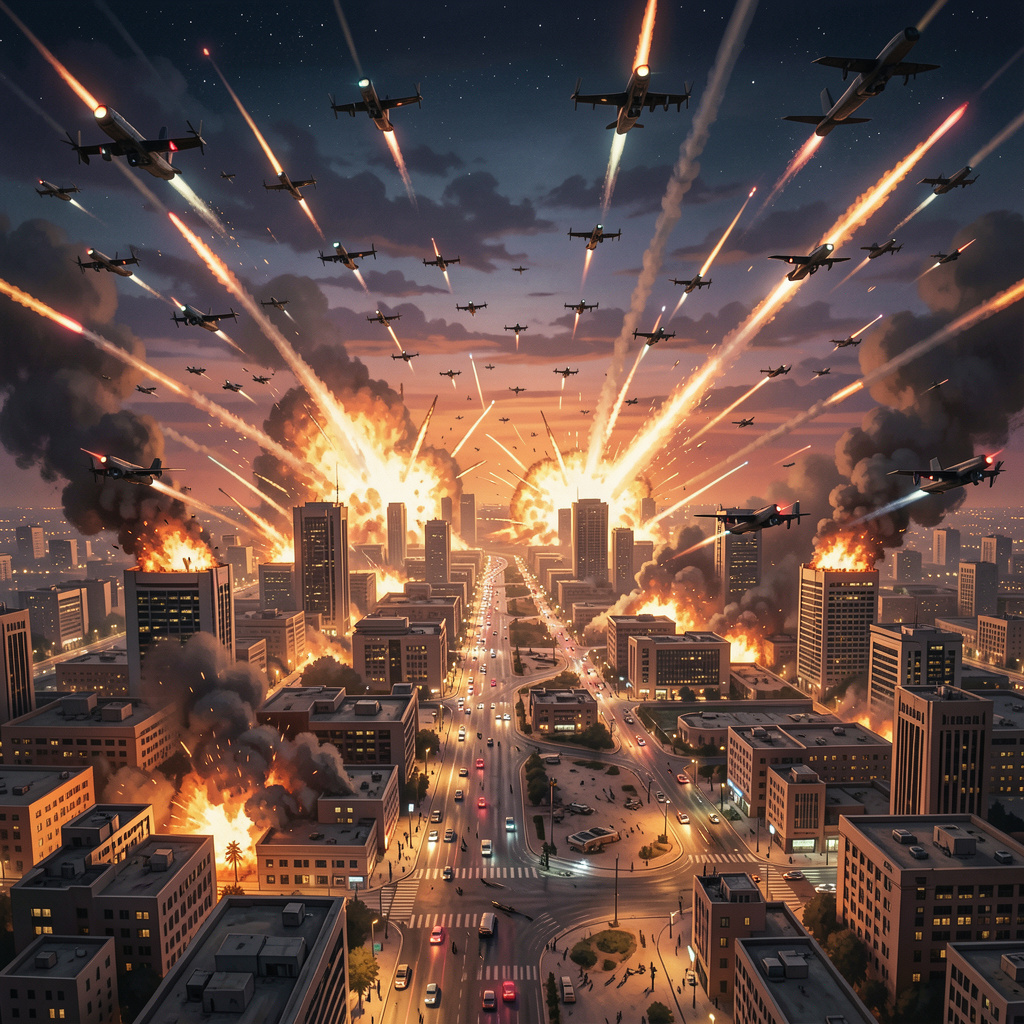
The Reckoning
A War Lost on Purpose
When a war enters its tenth year, it ceases to be a policy. It becomes a self-feeding engine. Thucydides noted that war is an affair of chances. The longer it lasts, the more uncertainty it creates. Clausewitz warned that no military intervention remains an isolated act.
The steel arteries of the Arabian Peninsula lie quiet in the desert sun. Across 1,200 kilometers of sand, the East-West Pipeline has stopped pumping. It was built to bypass dangerous maritime chokepoints.
Yet cheap loitering drones changed the equation. Highland insurgents guided basic commercial technology to target critical infrastructure. They achieved what decades of geopolitical posturing could not. They halted the flow of Saudi oil.
The moment a bomb leaves the bay, control evaporates. The Saudi intervention was meant to be a swift demonstration of regional dominance. It became a textbook lesson in the trap of prolonged conflict.
When Cheap is Effective
Saudi Arabia is caught in a mathematical snare. The kingdom must defend vast energy infrastructure against cheap devastation. Riyadh fires multimillion-dollar Patriot interceptors to swat down $15,000 drones. This is a slow-motion economic bleed.
When initial deterrence failed, Riyadh tested its checkbook alliances. It promoted the Mecca Pact alongside Turkey and Pakistan. It was framed as a non-Western Islamic defense shield.
Yet checkbook alliances evaporate when missiles launch. Pakistan offered diplomatic communiqués, citing domestic economic troubles. Turkey issued vague calls for de-escalation to protect regional trade. Meanwhile, the United States opened direct back-channel talks with the Houthis in Muscat. Washington secured safe passage for American ships, leaving Saudi routes exposed.
Riyadh cannot exit cheaply. The Houthi demands are uncompromising. They demand an immediate end to all blockades. They require direct payment of northern salaries in hard currency. They insist on sovereign recognition and a share of oil revenues. The insurgency has transformed into a fortified proto-state.
The Throne and the Social Contract
In Riyadh, Crown Prince Mohammed bin Salman faces this pressure alone. A palace coup is structurally impossible.
Between 2017 and 2020, he dismantled every traditional center of royal power in Riyadh. The Ritz-Carlton purges broke the merchant-royal elite. Security services were unified under his direct command. His brother Khalid took the Ministry of Defence. The National Guard was neutralized. No rival prince possesses the authority or networks to launch a revolt.
There is no one in the palace to challenge the authority of Crown Prince. The real challenge is domestic economics. The Crown Prince rewrote the social contract in Saudi Arabia. He asked citizens to trade political voice for economic modernization. He promised Vision 2030 megaprojects like NEOM. That promise requires an uninterrupted river of petrodollars.
If Red Sea exports remain blocked, project funding starves. An absolute ruler who centralized all authority would have to bear the blame for failure, alone.
To avoid this he has to come up with a solution to resolve the situation sooner than expected.
Possible Outcomes for Riyadh
How does a war without military victory finally end? Geopolitically, there are four possible outcomes:
1. The Expensive Settlement:
Riyadh buys a ceasefire through Omani mediators. It satisfies Houthi financial demands. The pipelines restart. The cost is the permanent cementing of an Iran-aligned Houthi state on the southern border. This also appears to be the most likely path.
2. The Beijing-Brokered Truce:
China uses its economic weight in Tehran to demand Houthi restraint on energy routes. Riyadh deepens alignment with Beijing, settling oil sales in yuan. Saudi oil flows again, but Western security ties weaken further. Riyadh is already in the eyes of storm for allegations of using Chinese military hardware.
3. The Cape of Good Hope Economic Bleed:
If the negotiations fail it could be worst. Asian-bound tankers avoid the Bab el-Mandeb Strait. They circumnavigate Africa, adding fourteen days of sailing time. High freight and insurance costs make Saudi crude uncompetitive. It may be forced to sell at steep discount. Vision 2030 starves for capital.
4. The Escalatory Desperation Strike:
Hawks in Riyadh push for a unilateral air blitz against coastal targets. Without coalition support, this provokes immediate retaliation. Houthi drones target desalination and power plants in Jeddah and refineries at Ras Tanura. A border war becomes a domestic emergency. This path carries the highest risk. If past trajectory is any indication, it is least likely to succeed.
The realistic outcome will synthesize the first two paths. Riyadh will choose a costly financial settlement over economic strangulation. It will pay the de facto authorities in Sanaa to keep oil moving.
Cost of War
Statecraft fails when spectacle replaces strategy. Saudi Arabia used airpower as a substitute for political negotiation. Instead of engaging a complex neighbor, it chose a decade of bombardment. The campaign produced no military resolution. It produced an enduring strategic trap. That shall be the subject matter of next chapter, which shall also be the last in this series.
Leave a Response