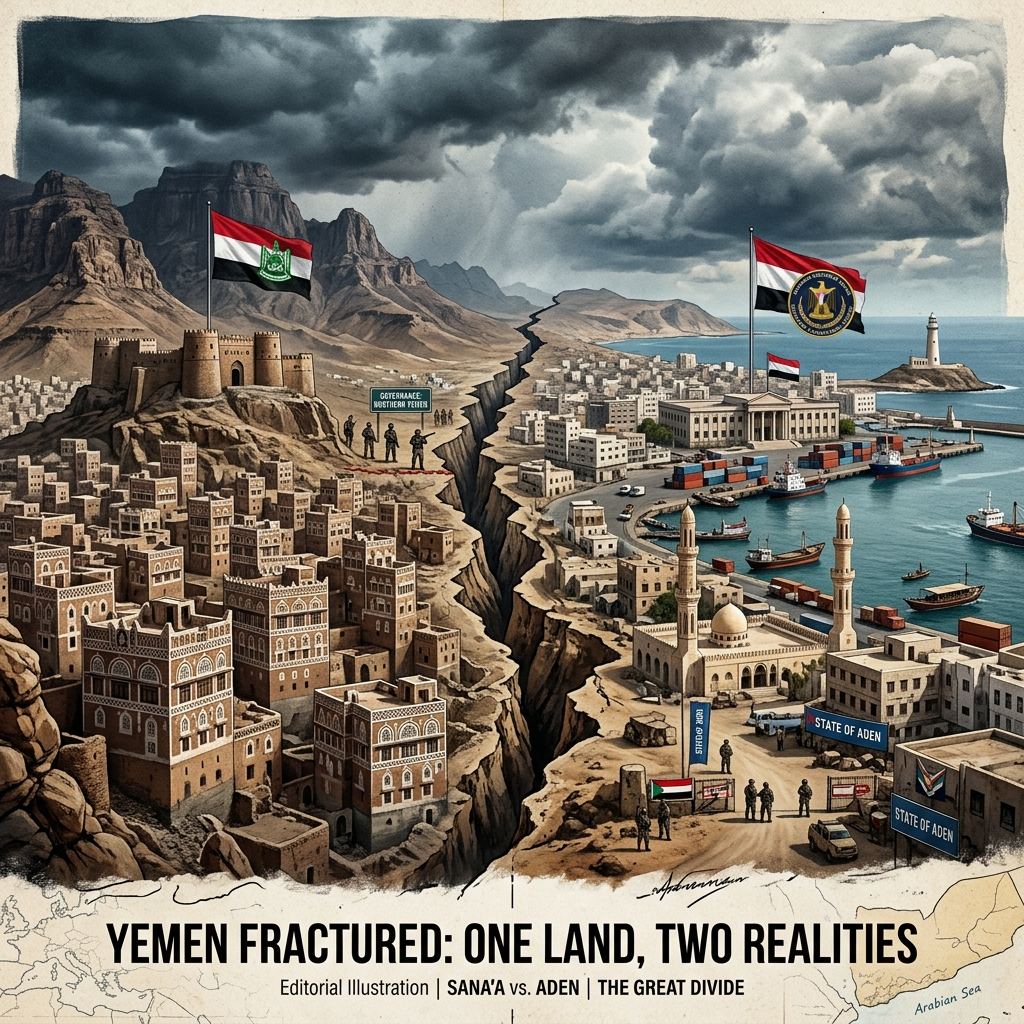
Yemen Today: Governance of Chaos
Yemen is a country that no longer exists as a single state. The international community still refers to the "Republic of Yemen," sending diplomats to press conferences and filing reports at the United Nations. But on the ground, that unified republic is a fiction.
Yemen has partitioned into competing zones of control, ruled by rival authorities with different currencies, different security apparatuses, and opposing foreign patrons.
As we saw in the previous chapter, decades of Saudi meddling, tribal patronage, and state decay culminated in the rise of Ansar Allah (the Houthis). But the mountain insurgency forged in the Saada Wars did not just survive Saudi bombardment; it conquered the core of the state.
Today, Yemen is a fractured realm. To understand who governs what, one must look at the two radically different worlds operating within its borders. One is the centralized, iron-fisted de facto state in Sanaa and the rest is the chaotic, divided coalition in Aden.
The De Facto State of Sanaa
The Houthis are often depicted in foreign media as a ragtag guerrilla force hiding in mountain caves. That image is dangerously outdated. Today, the Houthis control Sanaa, the historic capital, along with the heavily populated northern highlands and key Red Sea ports like Hodeidah. Within this territory lives more than 70 percent of Yemen's population.
The Houthis' path to total dominance was sealed in December 2017. Having allied with their former persecutor, ex-President Ali Abdullah Saleh, to seize Sanaa in 2014, the Houthis systematically hollowed out Saleh's political network. When Saleh realized he had been trapped and attempted to switch sides to negotiate with Saudi Arabia, the Houthis acted with ruthless speed. Within forty-eight hours, they surrounded his compound in Sanaa and killed him. The dance on the heads of snakes was over. The Houthis became the sole, undisputed masters of northern Yemen.
Since then, they have built a functioning, highly centralized authoritarian state. They do not merely occupy government buildings; they run ministries, collect taxes, administer courts, issue passports. They also command a regular military apparatus.
To secure their grip, the Houthis established a shadow governance structure known as the Supervisory System (al-Mushrifun). Houthi ideological loyalists were placed in every ministry, government department, military unit, and state enterprise. While formal civil servants handle day-to-day administrative paperwork, the Houthi supervisor holds true executive authority. No decision, budget allocation, or policy passes without their approval.
This administration is funded through an aggressive war economy. The Houthis collect customs duties at internal borders separating their territory from government-held areas. They levy heavy taxes on telecommunications and private businesses and confiscate the assets of political opponents. They divert international humanitarian aid to supply their war effort.
Governance in the north is tight, disciplined, and deeply repressive. Dissent is ruthlessly crushed. Independent journalists, civil rights activists, and political opponents face arbitrary arrest, torture, and forced disappearances. Through mandatory ideological courses, summer camps for youth, and strict religious codes, the Houthi leadership is systematically reshaping northern Yemeni society around their ideology.
One must be careful not to romanticize them. They are not a clean liberation movement. Within their territory, they are deeply authoritarian. They repress dissent, silence journalists, and rely on the systemic recruitment of child soldiers. They rule through a mix of religious mandate and coercion.
The Iranian Partnership
Outside powers, particularly in Riyadh and Washington, frequently label the Houthis as a mere proxy of Tehran. They are labeled as an instrument designed solely to execute Iranian military orders. This narrative fundamentally distorts the relationship.
Iran did not create the Houthis, nor does it control their domestic agenda. The Houthis are an indigenous Yemeni movement driven by their own local grievances, Zaydi identity, and national ambitions. However, geopolitics abhors a vacuum. As Saudi Arabia unleashed its military campaign against the Houthis in 2015, Tehran recognized a high-leverage, low-cost opportunity to bleed its primary regional rival.
The partnership between Tehran and Sanaa grew rapidly out of mutual strategic interest. Iranian advisors from the Islamic Revolutionary Guard Corps (IRGC) Quds Force, alongside Lebanese Hezbollah operatives, provided vital technical training and strategic guidance. More importantly, Iran established covert supply corridors. Iran smuggles missile components, drone technology, guidance systems, and anti-ship weaponry through overland routes in Oman and maritime channels across the Red Sea.
With Iranian technical assistance, the Houthis performed an astonishing military transformation. They upgraded old Soviet-era Yemeni army stockpiles and integrated Iranian drone and missile tech to build long-range strike capabilities. A movement that began with light infantry weapons in the mountains of Saada acquired long-range ballistic missiles. Now they are capable of striking targets over 1,500 kilometres away like Riyadh and Abu Dhabi. Not to forget the international shipping lanes in the Red Sea.
The Houthis are aligned with Iran's "Axis of Resistance," but they retain their own strategic autonomy. They accept Iranian arms and expertise because it serves their survival and regional power projection. As regards taking orders from Tehran, it looks unlikely.
The Fractured South
If the North is defined by Houthi central authority, the South is defined by fragmentation and chaos.
The South has the internationally recognized government of Yemen. Its authority is acknowledged by the UN, Saudi Arabia, and Western powers and it operates out of the southern port city of Aden. But calling it a unified government is a stretch.
Following the resignation of President Abdrabbuh Mansur Hadi in 2022, executive authority was transferred to an eight-member Presidential Leadership Council (PLC). Created under heavy Saudi pressure, the PLC was meant to unite anti-Houthi factions under a single umbrella. In reality, it is a council of rivals whose leaders spend as much time fighting each other as they do opposing the Houthis.
Aden's Shadow Government
The most powerful actor in the South is not the central government, but the Southern Transitional Council (STC). Backed, armed, and funded by the United Arab Emirates (UAE), the STC is a secular, southern secessionist movement. The STC intends to dissolve unified Yemen and restore an independent South Yemen state (which existed prior to 1990).
As stated, the STC controls Aden and key southern coastal regions. Its armed forces have repeatedly clashed with troops loyal to the internationally recognized government. This division reflects a deeper geopolitical rift between the coalition partners themselves:
-
Saudi Arabia favors a unified Yemen governed by a friendly central authority in Sanaa or Aden, reliant on Sunni political networks like the Islah party.
-
The UAE favors a fractured Yemen, backing southern separatists and coastal militias (such as Tareq Saleh's Joint Forces along the Red Sea coast). UAE aims to secure strategic ports, maritime trade routes, and islands like Socotra.
As a result, the South remains caught in administrative paralysis. Multiple security forces answer to different foreign commanders. The public infrastructure has collapsed, electricity blackouts are endemic, and public protests erupt regularly against systemic corruption and economic decay.
The Two Yemens: Economic Division and Daily Survival
The political partition of Yemen has created two separate economic ecosystems, plunging ordinary citizens into unprecedented hardship.
In 2016, the internationally recognized government moved the headquarters of the Central Bank of Yemen from Houthi-controlled Sanaa to Aden. In response, the Houthi administration in Sanaa refused to recognize the authority of the Aden Central Bank and banned the use of newly printed banknotes issued by Aden. This trigger divided the economy into two distinct financial regimes:
-
In the Houthi-controlled North, the supply of old currency notes remained strictly fixed, maintaining an artificially stable exchange rate. It also caused acute cash shortages and severe economic stagnation.
-
In the South, the unrestricted printing of new banknotes led to currency depreciation, skyrocketing inflation, and the rapid erosion of purchasing power for ordinary families.
For ordinary Yemenis, state collapse is not an abstract political concept but a matter of daily survival. Over 1.5 million public sector employees, including teachers, doctors, and civil servants in northern Yemen, have gone without regular salaries since 2016. Goods moving between the North and South are taxed twice at internal checkpoints, driving the cost of food and basic medicine out of reach for millions.
Houthi warlords in Sanaa and coalition-backed elites in Aden profit from lucrative black-market trade, taxation schemes, and aid diversion. But over 80 percent of the Yemeni population relies on international food assistance to survive.
The Balance of Power
Saudi Arabia launched its military intervention in 2015 with the stated goal of restoring the legitimate government, disarming the Houthis, and securing its southern border within weeks. This is the achievement after a decade of war:
1. The Houthis hold the core: They command the historic capital, rule the vast majority of the population and govern a disciplined state apparatus. The Houthis also possess a long-range strike arsenal that threatens regional oil infrastructure and global maritime trade.
2. The anti-Houthi coalition is fractured: The South remains divided among competing militias with opposing geopolitical agendas.
3. Yemen is structurally partitioned: Reconciling the Houthi-ruled North and the STC-dominated South into a single unified republic is virtually impossible without another major war or a total overhaul of the regional order.
Saudi Arabia entered Yemen to crush an insurgency on its border. Instead, it accelerated the creation of a battle-hardened, Iranian-aligned de facto state that now holds the keys to Yemen's future. This is Yemen today.
In the next chapter, we shall discuss the Saudi-led military campaign that transformed a domestic civil war into a regional quagmire. The campaign was named Operation Decisive Storm. It is a different matter that it proved to be neither decisive nor a storm.
Leave a Response