Beginning of War in Yemen
How Riyadh Kept Yemen Weak?
The Yemen-Arabia border stretches for 1,800 kilometres. It is a jagged scar cutting through the highlands and sinking into the desolate expanse of the Rub' al Khali, the Empty Quarter.
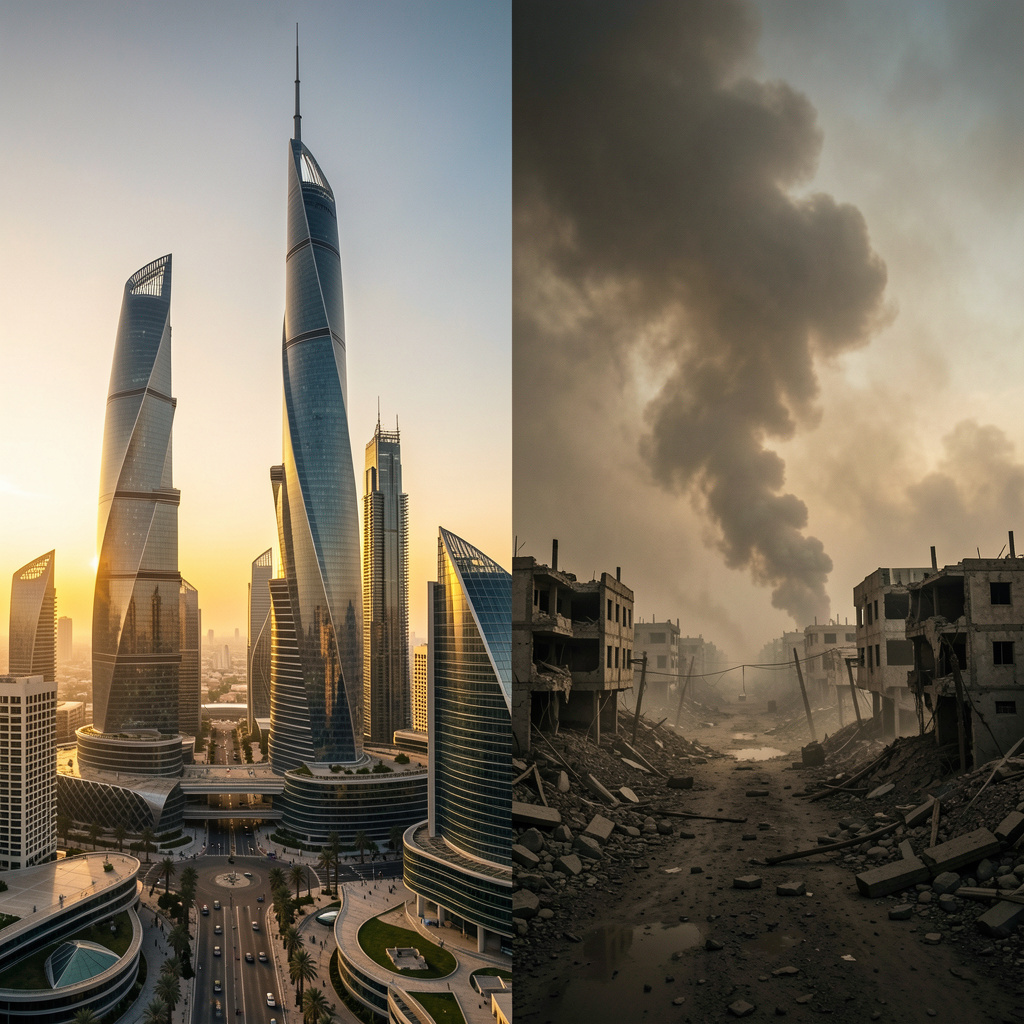
The border separates the wealthiest petro-monarchy on earth from its populous, impoverished neighbour. The sky kissing high rise building speaking the language of opulence is on Saudi side. In Yemen, the war ravaged concrete wasteland with population struggling to survive in it, without water.
For decades, the stewards of Riyadh looked south and operated on a single, unyielding calculus. Keep Yemen stable enough so that its chaos does not spill northward. Ensure it never grows unified or strong enough to challenge Saudi hegemony. The clearest distillation of this doctrine occurred in the 1960s.
The Monarchs and the Mountains
In 1962, a cadre of nationalist military officers in Sanaa overthrew the traditional Zaydi Shia Imamate. They declared the birth of the Yemen Arab Republic. They were inspired and heavily backed by Egypt's Gamal Abdel Nasser. Nasser promptly dispatched tens of thousands of troops to secure the new government.
Take a pause here and think. Saudi Arabia was still consolidating its newly formed Kingdom. Egypt's economy was in tatters but it did not resist the temptation to seek influence over Yemen. This is the typical 'Islamic' politics in the west Asia aka middle east.
For the House of Saud, this was a waking nightmare. A revolutionary, pan-Arab republic aligned with Cairo had materialized on their southern flank. Nasser's brand of secular nationalism was an existential contagion. It threatened to sweep away hereditary Gulf monarchies entirely.
The Saudi response was swift, ruthless, and illuminating. Saudi Arabia was an ultra-conservative Sunni Wahhabi state. Yet it began bankrolling, arming, and offering sanctuary to the ousted Zaydi Shia royalists. These northern highland tribesmen were the direct ancestors of the future Houthi movement. The irony is staggering, but the logic was perfectly sound.
For Riyadh, ideological purity was a domestic luxury. Regime survival was an absolute necessity. Countering the secular republican threat in Yemen mattered infinitely more than any Sunni-Shia doctrinal divide.
This era is the glaring proof that Saudi interventions in Yemen were never about Islamic ideology. It was pure realpolitik.
Funding the Godless
The 1960s demonstrated that Riyadh could ally with Shia royalists to crush secular nationalists. The 1990s proved it could fund avowed communists to prevent a unified democratic rival. All this happened while Riyadh simultaneously funded Wahhabi madrasas and mosques across the rest of the world.
Following the unification of North and South Yemen in 1990, a fragile new state came into existence for a short while. A unified, heavily populated Yemen buzzed with democratic energy and harboured historical grievances against Riyadh. It was viewed as a demographic and military rival.
Yemen erupted into civil war in 1994 when the southern leadership attempted to secede. The southern faction was led by the Yemeni Socialist Party, hardline Marxists. Saudi clerics routinely denounced them from the pulpit as atheists and apostates. Yet when the fighting began, Saudi Arabia funneled millions of dollars to the Marxist separatists. The Marxists were used as a tool to split Yemen in half.
The gambit failed, and Yemen remained unified under Ali Abdullah Saleh. But the Saudi intent was undeniable.
Dancing on the Heads of Snakes
Saleh ruled Yemen for over three decades. He famously described governing his country as "dancing on the heads of snakes." Riyadh had its own choreography.
The Saudi state managed Saleh through a sprawling, industrialized patronage system. For decades, Prince Sultan bin Abdulaziz directed the Special Office. This dedicated committee maintained a massive shadow payroll of Yemeni tribal leaders, military generals, and cabinet ministers. This was not about cultivating theological affinity. It was the wholesale purchase of loyalty. The goal was to ensure that Sanaa's strings could always be pulled from Riyadh. Yet Saleh was no passive puppet.
The limits of this transactional relationship were repeatedly tested over the kingdom's quiet ambition. Riyadh wanted to bypass the congested maritime chokepoints of the Persian Gulf and the Red Sea. Plans were drawn for a pipeline running from the Empty Quarter south through Yemen's eastern governorates to the Arabian Sea. Saleh repeatedly engaged in negotiations.
Saleh agreed to allow the pipeline through Yemen but refused to cede the sovereign, territorial security corridor protecting it. Saleh knew that granting Saudi Arabia a permanent physical slice of Yemen was political suicide. The pipeline was never built.
Birth of Ansar Allah
While buying loyalty at the top, Saudi Arabia was simultaneously reshaping the cultural topography at the bottom. Throughout the 1980s and 1990s, Riyadh poured vast sums into building Salafi and Wahhabi educational infrastructure across northern Yemen. The crown jewel was the Dar al-Hadith seminary in Dammaj. It was planted deep inside the Zaydi heartland of Saada. This was a calculated deployment of soft power of Islam.
Plan was to dilute Zaydi autonomy and build a pro-Saudi following in the northern highlands. But actions invite reactions. The aggressive encroachment by Salafism triggered a fierce defensive backlash among Zaydi youth. They felt their religious identity and historical autonomy were being systematically erased.
From this crucible of reactionary grievance, the Believing Youth (Shabab al-Mumin) emerged. They would soon evolve into the Houthi movement. The Houthis take their name from their founder, Hussein al-Houthi.
Shabab al-Mumin (Believing Youth) was a peaceful cultural movement. It ran summer camps and taught Zaydi theology. Then the Yemeni government attacked. Between 2004 and 2010, six military campaigns in Saada transformed a religious revival into an armed insurgency. These became known as the Saada Wars. After the founder's death in battle, the movement renamed itself Ansar Allah, meaning Supporters of God. The world calls them Houthis, after Hussein al-Houthi. They call themselves Ansar Allah. Both names describe the same movement at different points on the same road.
Saudi Arabia sought to engineer a compliant buffer. Instead, it manufactured the very conditions that birthed its most intractable enemy.
The Price of a Policy
History is rarely as neat as a ledger. But the balance sheet of Saudi policy in Yemen is stark.
Riyadh funded the Salafi movement that radicalized the north, thereby creating the Houthi insurgency. It bankrolled Shia royalists in the 1960s and Marxist separatists in the 1990s. It maintained a tribal patronage system that rotted the Yemeni state from within. It vetoed every attempt at genuine national cohesion.
The Arab Spring of 2011 swept Saleh from power after thirty-three years. It left behind a fractured country with hollowed institutions, a militarized north, and a deeply suspicious south. Into this vacuum walked the movement that Saudi money had inadvertently created and Saudi neglect had left free to grow. A broken neighbour, it turns out, is a dangerous neighbour. Saudi Arabia is learning that lesson now.
A broken country is cursed with a broken governance. That is Yemen Today.
We shall discuss that in the next chapter.
Leave a Response