The Global Conundrum of Caste or Economic Segregation: Chapter 19
The previous chapters examined what the Sanskrit texts actually say. Chapters 16 and 17 analyzed the English commentary and its Hindu reply. Chapter 18 traced specific verses to their sources. The verdict from these was the same. The texts that built the global case for hereditary caste do not say what they were claimed to say. Most relevant verses in Chapter 16 to 18 of Manusmriti are later interpolations. Half the verses cited as authoritative do not exist in any manuscript.
This chapter asks a different question. Who decided what the texts would say? How did that decision become enforceable law? And how did a fluid, contested, locally-varied social order become a rigid, hereditary, census-certified legal category?
Three instruments did this work. Each operated synchronously and together they formed a closed system.
1. The Translation Factory
Between 1840 and 1910, three British scholars produced a body of Sanskrit translation. It became the global reference for Hindu civilization. These were:
1. Horace Hayman Wilson (1786-1860). 2. Friedrich Max Müller (1823-1900). 3. Ralph Thomas Hotchkin Griffith (1826-1906).
Their combined output: approximately 37,000 pages of translated and annotated Sanskrit texts. All published over 70 years. This included six Rig-Veda volumes and fifty Sacred Books of the East volumes. It included four complete Vedas and several major Puranas.
The mathematics does not work.
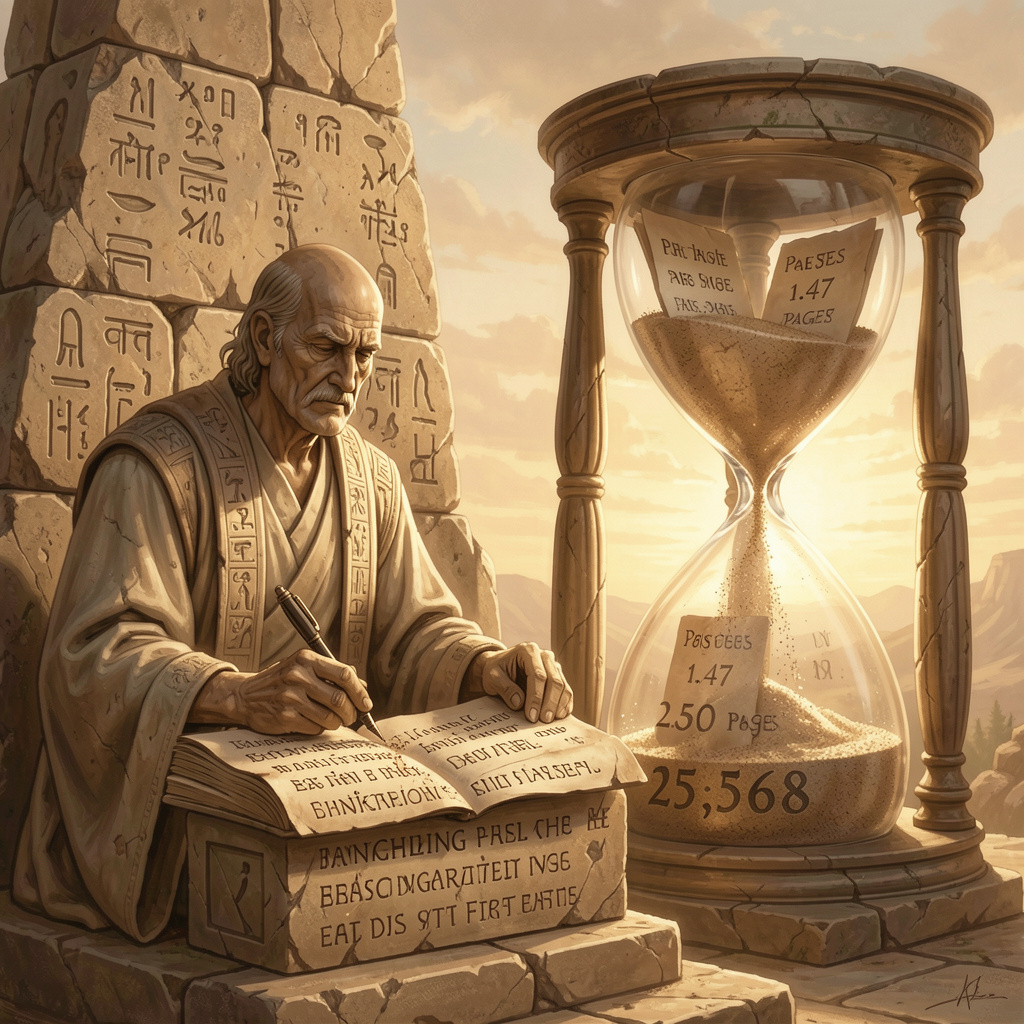
37,000 pages over 25,568 days is 1.47 pages per day, every day, for seventy years. No Sundays off. No illness. No interruption. These were not simple prose pages. They were heavily annotated translations from a complex ancient language. Multiple manuscripts required comparison. Variant opinions were to be resolved. Scholarly footnotes were placed on every page.
That was the time when everything was hand written. There were no typewriters, what to speak of computers. The output of 1.47 pages per day is finished/printed pages. It is not a draft output. On top of it, these 'scholars' were in full-time employment as professors or whatever. They were performing those duties during the day. Did they never sleep? They did translation work at night?
Wilson himself resolved the mathematical problem in his own preface. He acknowledged his Rig-Veda translation was produced using "materials compiled by native scholars."6 He was not translating from Sanskrit. He was editing and presenting translations supplied by Indian pandits, under his name and institutional authority.
Griffith's translation of the Rig-Veda contains an error that settles the question of his Sanskrit competence. He translated the Sanskrit word "pishtah," meaning ground flour, as "roasted corn."1 Roasted corn is a New World crop. It did not exist in ancient India. It did not reach India until after 1600 CE. A scholar who translates an ancient Indian word as a post-1600 American crop did not understand the word. This man's translation of all four Vedas is the standard academic reference.
Max Müller directed the fifty-volume Sacred Books of the East series from Oxford.2 He supposedly worked independently of Wilson. He published simultaneously with him. His volumes appeared in sequential years, with insufficient time between them for independent translation of texts of that complexity.
The pattern is the same across all three "Brilliant British Scholars." They had identical interpretive choices on disputed passages. Circular citations, each citing the other as independent authority. Harmonious conclusions supporting colonial administrative narratives. Impossible output volumes for individual scholars.
Wilson's candid admission covers all three. Native pundits compiled the materials. The Brilliant British scholars made necessary changes. They provided institutional affiliation, the publisher's address, and the authoritative name on the cover. The factory produced the pages. The figureheads received the citations.
This is the body of work on which global and AI understanding of Hindu scripture rests today. Unfortunately, more Hindus rely on these translations and regret being Hindu. That is the real success of the Operation Sanskrit Mill.
2. The Court-Enforced Brahminical Patriarchy
The translation project needed a delivery mechanism. It found one in colonial courts. Warren Hastings established the plan in 1772 as Governor-General of Bengal.5
The British would govern Hindus by their own law in personal matters. The stated aim was just administration. The practical problem was immediate. English judges could not read Sanskrit. They had no means to know what Hindu law said.
The solution was the pundit assessor. Each colonial court employed a Brahmin law officer. He sat beside the English judge. He advised on questions of Hindu law. He was paid by the colonial government. He held official recognition. Every losing party despised this Brahmin assessor. They blamed his textual interpretation for their legal defeat.
The translations and the court system now worked together. The translations told the court what the texts said. The pundit assessors confirmed the interpretation in court. The court's ruling became binding legal precedent. That precedent was cited in future cases as established Hindu law. Future translations referenced those rulings as evidence of authentic tradition.
The loop closed on itself. Each turn of the cycle reinforced the one before it.
The practical result was decisive. Kulluka Bhatta's recension of Manusmriti became the source text. A dying civil servant translated it. A New York professor completed the work. Paid Brahmin assessors interpreted it in colonial courts. English judges codified their interpretation as Hindu law. This law applied to 200 million people. None of them had a voice in any step. But remember that they applied Personal Law. For property law they had Transfer of Property Act enacted in 1882. Reason for this distinction shall be discussed in Chapter 21.
What is today called "brahminical patriarchy" was, at its foundation, a colonial legal construct. The British designed the system. Brahmin assessors operated within it. Hindus as a whole are blamed for it.
The Shoehorning Census
The translations gave caste textual authority. The courts gave it legal force. The census gave it a birth certificate.
Herbert Hope Risley conducted the 1881 Census of India.3 He was a civil servant and an enthusiast of racial science. He introduced the nasal index as a tool for caste classification. He measured the width and length of human noses across the subcontinent. He used the ratios to rank castes on a racial hierarchy.
The 1881 census recorded 272 caste categories. The 1891 census recorded over 360. The categories were not discovered. They were manufactured. A census commissioner from the period admitted the process required "shoehorning everybody into a caste."4
The classification system was not consistent. Risley applied four contradictory methods simultaneously: racial origin, hereditary occupation, surname, and regional custom. The same community received different classifications in different provinces.
Yadav and Mourya were classified as Shudra in the United Provinces. The same community, spelled Jadav, is Vaishya in Maharashtra, and Mourya was classified as Vaishya in Punjab. One community. Two census columns. Two legal statuses. Two different positions in the hierarchy that courts were now enforcing. Eighty years since the British left, but this issue is not even raised in any forum.
Verma and Varma were classified differently across states. Singh was defaulted to Kshatriya regardless of actual background. Aggarwal, whose community traces descent from the Kshatriya king Agrasen, was reclassified as Vaishya. Kayastha communities had served as administrative scribes for centuries. The census invented them as a "fifth caste" outside the four-varna framework. This was justified by resort to the 'mixed-caste' chapter interpolated in Manusmriti and discussed in detail in the previous chapter.
Before the census, these were locally-negotiated social identities. Fluid, contested, regionally variable, often disputed within communities themselves. A family's caste status depended on local reputation, occupation, marriage networks, and generations.
After the census, it was a column in a government register. Now it was fixed and hereditary. Legally consequential for marriage, inheritance, property, and court standing. After 1947 it is the foundation of vote politics.
The census did not record Indian social reality. It created a new and persistent identity and named it 'caste'. People were forced to disclose and declare their caste. Those who did not know were shoehorned into one caste or the other. One family branch was often assigned a specific caste. Another branch in a neighboring province received a completely different caste.
The Closed System
As we shall discover in later chapters, caste if any is a matter of belief. One was free to hold that belief. But British fossilized it into open by recording it in census. The desired effect was division in society and British achieved it wonderfully while blaming Manusmriti and Sanatan Dharma for caste.
The commentaries provided the scriptural authority. Without them, the courts had no text to interpret. The courts provided the legal force. Without legal precedents, the commentaries were academic curiosities. The census provided the population grid. Without it, the legal categories had no individual bodies to attach to.
Together they converted a complex, varied, contested social landscape into a clean administrative chart. The chart was then taught in universities and cited in parliamentary debates. It entered legal textbooks. Eventually it was digitized into AI training data.
The chart is what the world now calls the Hindu caste system. It was produced between 1772 and 1910. Its primary authors were British administrators. But what is the proof of this proposition? Did caste not exist before the British? Fortunately, we have a witness from the past.
Caste Before the Colonial Invasion
Al-Biruni arrived in India in 1030 CE. He spent years there. He learned Sanskrit. He read the primary texts in the original. He interviewed people and researched society.
He found four social classes living in the same towns, the same villages, the same houses. He found active philosophical debate about whether birth determined spiritual standing. He found the dominant position among Indian philosophers was that liberation was available to all, regardless of birth. He found no untouchability. He found hygiene customs and social etiquette. He found a society organized by function, not by birth certificate.
Between Al-Biruni's 1030 CE and Risley's 1881 census lies 851 years. And three instruments of the Caste Factory.
The next chapter returns to 1030 CE. We shall see the India that existed before any of these instruments were built. We shall visit India before the Islamic/Mughal/British invasion.
References:
-
Ralph Thomas Hotchkin Griffith (1826-1906), The Hymns of the Rigveda, 2 vols. (Benares: E.J. Lazarus, 1889-1892). The translation of "pishtah" as "roasted corn" appears in the Atharva-Veda translation. Roasted corn (maize) is a New World crop, unknown in India before European contact after 1600 CE. Its appearance in a translation of ancient Indian texts indicates the translator did not recognize the Sanskrit term. ↩
-
Max Müller (1823-1900), ed., Sacred Books of the East, 50 vols. (Oxford: Clarendon Press, 1879-1910). On Müller's direction of the project and the role of Indian and European collaborators, see Nirad C. Chaudhuri, Scholar Extraordinary: The Life of Professor the Rt. Hon. Friedrich Max Müller (London: Chatto and Windus, 1974). ↩
-
Herbert Hope Risley (1851-1911), The Tribes and Castes of Bengal, 2 vols. (Calcutta: Bengal Secretariat Press, 1891). Risley's use of the nasal index as a racial classification tool is documented in the Introduction. See also Nicholas Dirks, Castes of Mind: Colonialism and the Making of Modern India (Princeton University Press, 2001), Chapter 9. ↩
-
Census of India, 1881, General Report. See also Bernard Cohn, "The Census, Social Structure, and Objectification in South Asia," in An Anthropologist among the Historians and Other Essays (Oxford University Press, 1987). Cohn documents both the expansion of caste categories across census cycles and the administrative admissions of arbitrary classification. ↩
-
Warren Hastings, A Plan for the Administration of Justice (1772). On the pandit assessor system, see J.D.M. Derrett, Religion, Law and the State in India (London: Faber, 1968). On "panditization" of English law in India, see Shashi Tharoor, An Era of Darkness: The British Empire in India (Aleph Book Company, 2016). ↩
-
Horace Hayman Wilson (1786-1860), Rig-Veda Sanhita, 6 vols. (London: Trübner, 1854-1888). Wilson's acknowledgment of "materials compiled by native scholars" appears in his preface to the first volume. ↩
-
For the interconnection of translation projects, pandit assessors, and census classification as a colonial system of caste production, see Nicholas Dirks, Castes of Mind (2001); Rosane Rocher, "British Orientalism in the Eighteenth Century," in Carol Breckenridge and Peter van der Veer, eds., Orientalism and the Postcolonial Predicament (University of Pennsylvania Press, 1993). ↩
-
All articles on The Global Conundrum of Caste or Economic Segregation ↩
-
Madhumita Sengupta: Assam was not characterized by rigidity, and strict social immobility ↩
Leave a Response