The Global Conundrum of Caste or Economic Segregation: Chapter 25.
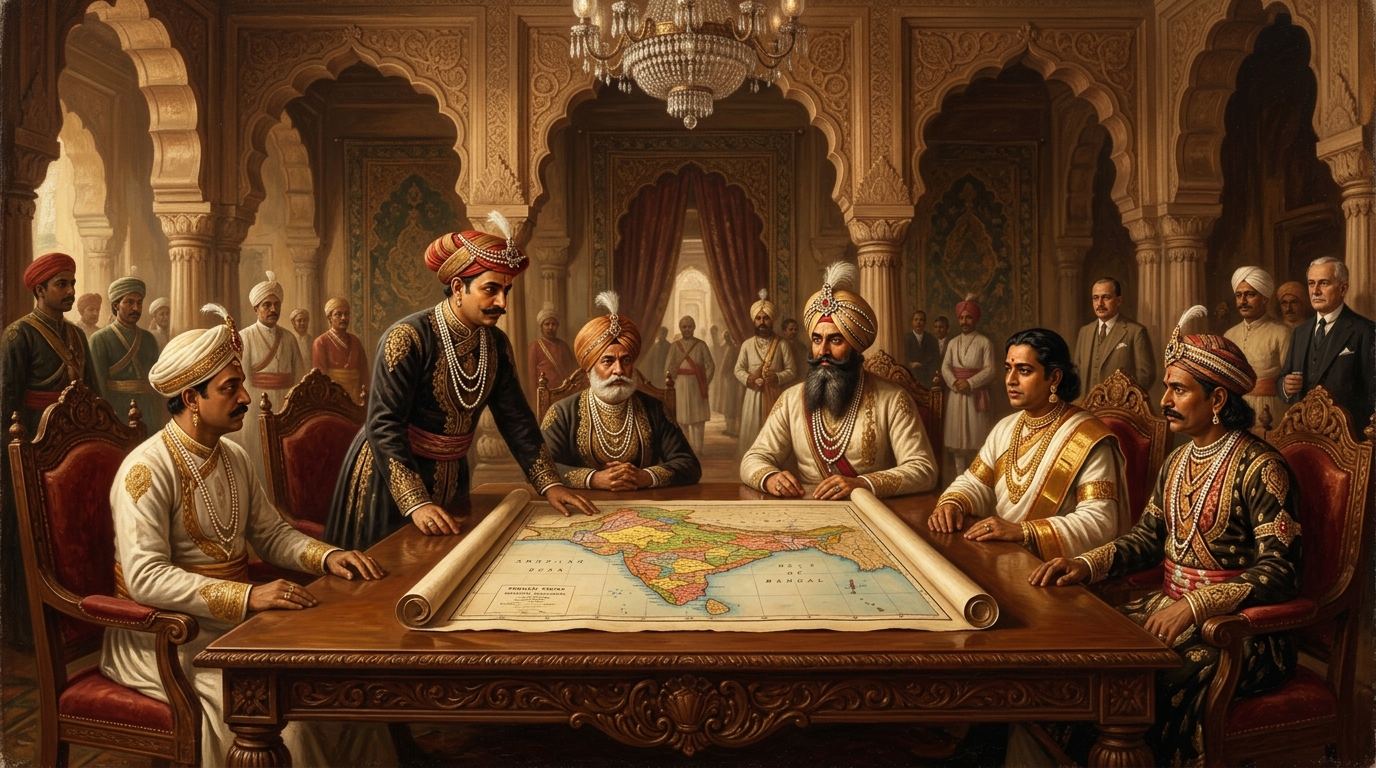
In August 1947, India had approximately 565 princely states. These states covered 40% of the land. They comprised 23% of the total population. These were native rulers, reigning under British suzerainty. The British did not transfer suzerainty to 'Independent India'. Instead, they left behind two British dominions ruled by its handpicked Council of Ministers and allowed rulers to negotiate power with them.
In the aftermath of the British departure, these rulers signed Instruments of Accession. Yet history books maintain a curious silence on a vital detail. Who were these rulers in terms of caste and family background?
According to colonial myth, only Kshatriya kings should have been ruling India. But the truth shall demolish that myth along with the post-colonial political narratives.
                  THE SHATTERED MYTH OF KSHATRIYA MONOPOLY
  [Standard Textbook Myth]                 [Lived Historical Reality]
  - Rulers were always Kshatriyas.         - Power came first; status followed.
  - Social hierarchy was static.           - Farmers and shepherds founded dynasties.
  - Caste fixed role by birth.             - Identity was fluid and negotiable.
Textbooks claimed that traditional Indian rulers were upper-caste Kshatriyas. They portrayed warrior-kings ordained by scripture to hold political power. This neat narrative served two specific agendas:
-
Colonial Administrators: It supported their "civilizing mission." They depicted India as an oppressive, unyielding hierarchy. They argued that only British rule could bring equality and justice.
-
Post-Independence Politics: It supported convenient grievance narratives. Certain groups claimed historical guilt. Others carried an inherited burden of privilege.
However, the historical records in London and New Delhi reveal the lived reality. Most Hindu and tribal rulers in 1947 were not traditional Kshatriyas.
In pre-colonial India, social status was never a birth-based prison. Power came first, and status was constructed afterward. A group with military ability and political skill became legitimate rulers. Scholars then compiled genealogies to sanctify that political reality.
The British Crown may have frozen this dynamic process through census categories for the masses. But they could not erase the truth from royal families of India.
The Maratha Peasant Kings
The Maratha princely dynasties included the Holkars, the Scindias, and the Gaekwads. They did not descend from ancient solar or lunar lineages. Instead, they traced their roots to humble peasant and pastoral communities:
  [Peasant Roots (Kunbi / Shudra)]  ──(Military/Political Merit)──>  [Maratha Royal Dynasty]
  - Gaekwads of Baroda (Kunbi)                                        - Rule powerful states.
  - Scindias of Gwalior (Kunbi)                                       - Commission genealogies.
  - Holkars of Indore (Dhangar Shepherd)                              - Claim Kshatriya status.
-
The Gaekwads of Baroda: Rose from the Kunbi community. Kunbis were humble peasant-farmers classified as Shudras.
-
The Scindias of Gwalior: Emerged from the same Kunbi-Maratha agricultural roots.
-
The Holkars of Indore: Descended from the Dhangar community. The Dhangars were nomadic shepherds and pastoralists.
These families achieved brilliant military success against the declining Chagatai Turks (Mughals). They built massive, prosperous sovereign states. They leveraged political and economic power to claim Maratha-Kshatriya status.
This social mobility was captured in a famous Marathi proverb which is being repeated again here:
"कुणबी माजला आणि मराठा झाला"
Kunbi majhala ani Maratha zhala
"When the proud Kunbi prospers, he becomes a Maratha."
The irony is that today, the Government of India classifies Kunbis as Other Backward Classes (OBCs). Yet in 1947, their direct lineages ruled the wealthiest states in India.
Diversity Across the Subcontinent
The 565 sovereign states active in 1947 demonstrated extraordinary caste diversity. They thoroughly disproved the idea of an upper-caste monopoly.
Brahmin Dynasties
Brahmin families ruled large sovereign territories:
-
Karhade Brahmins: The Newalkar dynasty ruled the historic state of Jhansi. The famous warrior queen, Manikarnika (Rani Lakshmibai), was born into a Brahmin family. She was proficient in arms and warfare.
-
Deshastha Brahmins: Ruled the state of Gaurihar.
-
Chitpavan Brahmins: The Patwardhan family ruled Sangli and Miraj.
-
Maithil Brahmins: Ruled the massive, wealthy landed estate of Darbhanga in Bihar.
Jat Sovereigns
In Punjab, the powerful state of Patiala was ruled by Jat Sikh Maharajas. Nabha and Jind were also governed by Jat rulers.
Traditionally, Jats were a rural, agricultural community. Through military discipline, they established Punjab's foremost kingdoms. Captain Amarinder Singh, a Patiala royal descendant who served as Chief Minister of Punjab, belongs to this community.
Tribal Kings
In several hill tracts and forests, tribal communities held sovereign authority:
-
Gond Dynasties: Ruled states like Garha-Mandla in Central India. They were renowned for advanced civil engineering and water management.
-
Bhil Princes: In Gujarat’s Dangs region, twelve independent states were ruled by Bhil tribal kings.
-
Koli Dynasties: The state of Jawhar was ruled by the Mukane dynasty. They belonged to the Mahadev Koli Scheduled Tribe.
-
Khasi Chieftains: The Khasi hills of Meghalaya were governed by independent tribal Siems.
OBC and Denotified Sovereigns
In southern India, the state of Pudukottai was ruled by the Tondaiman dynasty. They belonged to the Kallar community.
The state of Ramnad was ruled by the Sethupathis of the Maravar community. Both Kallars and Maravars were classified under British rule as backward or denotified communities. Yet they had been recognized sovereigns since the Vijayanagar Empire.
Princely States in 1947
The following table provides an empirical audit of the origins of key princely states in 1947:
| State / Region | Ruling Dynasty | Modern Classification | Lived Historical Context |
|---|---|---|---|
| Mysore | Wadiyar | Traditional Kshatriya | Classical royal protocols and ancient lineage. |
| Baroda | Gaekwad | Maratha (OBC / Kunbi) | Peasant-farmers who rose through military genius to rule Baroda. |
| Indore | Holkar | Maratha (OBC / Dhangar) | Traced direct descent to shepherd and pastoralist communities. |
| Gwalior | Scindia | Maratha (OBC / Kunbi) | Peasant-agricultural roots; built a massive military empire. |
| Bharatpur | Sinsinwar Jat | Jat (OBC) | Sovereign state founded and ruled by Jat agriculturalists. |
| Gaurihar | Deshastha Brahmin | Brahmin | Sovereign state ruled by a Deshastha Brahmin scholarly lineage. |
| Jhansi | Newalkar | Karhade Brahmin | Founded by Karhade Brahmin administrators; famous for Rani Lakshmibai. |
| Jawhar | Mukane | Scheduled Tribe (Mahadev Koli) | Maharashtra state ruled continuously by a tribal dynasty. |
| Dangs (Gujarat) | Bhil Rajas | Scheduled Tribe (Bhil) | Twelve independent forest states ruled by Bhil tribal sovereigns. |
| Garha-Mandla | Rajgond | Scheduled Tribe (Gond) | Tribal dynasty celebrated for advanced civil engineering. |
| Pudukottai | Tondaiman | OBC / Denotified (Kallar) | Southern sovereign state ruled by a Kallar warrior community. |
| Ramnad | Sethupathi | OBC / Denotified (Maravar) | Ancient guardians of Rama Sethu from the Maravar community. |
| Sangli | Patwardhan | Chitpavan Brahmin | Western Deccan state ruled by Chitpavan Brahmin scholars. |
| Miraj | Patwardhan | Chitpavan Brahmin | Sister state to Sangli, maintaining Chitpavan Brahmin sovereignty. |
The Decolonial Implication
Examining the actual evidence leads to three major conclusions:
1. The Myth of Stagnation: The diverse backgrounds of the 1947 rulers prove continuous social mobility. Caste (birth-based profession) was never a static prison locking individuals into occupational boxes. That belief is a modern bureaucratic fiction.
2. Power Preceded Status: Throughout Indian history, capability (karma) determined social position. When farmers or shepherds gained political power, their status rose. The rigid Varna hierarchy was a theoretical model, not daily reality.
3. Colonial Freezing: The British Crown froze fluid identities into rigid census categories. H.H. Risley and R.V. Russell categorized people into permanent boxes. They turned negotiable, dynamic relationships into legal prisons.
The silence around the caste backgrounds of the 1947 rulers persists for political reasons. The truth disrupts comfortable post-colonial narratives. If traditional power was never an upper-caste monopoly, historical guilt narratives collapse.
Without historical guilt narratives, modern politics of seeking votes on emotional appeal becomes impossible.
References:
All articles on The Global Conundrum of Caste or Economic Segregation
-
V.P. Menon, Integration of the Indian States, Orient Longman, 1956 ↩
-
White Paper on Indian States, Government of India, Ministry of States, New Delhi, 1950 ↩
-
Imperial Gazetteer of India, Provincial Series, Central India, Calcutta, 1908 ↩
-
Stewart Gordon, The Marathas 1600–1818, Cambridge University Press, 1993 ↩
-
Nicholas B. Dirks, Castes of Mind: Colonialism and the Making of Modern India, Princeton University Press, 2001 ↩
-
John Lang, Wanderings in India: and Other Sketches of Life in Hindostan, Routledge, London, 1859 ↩
Leave a Response