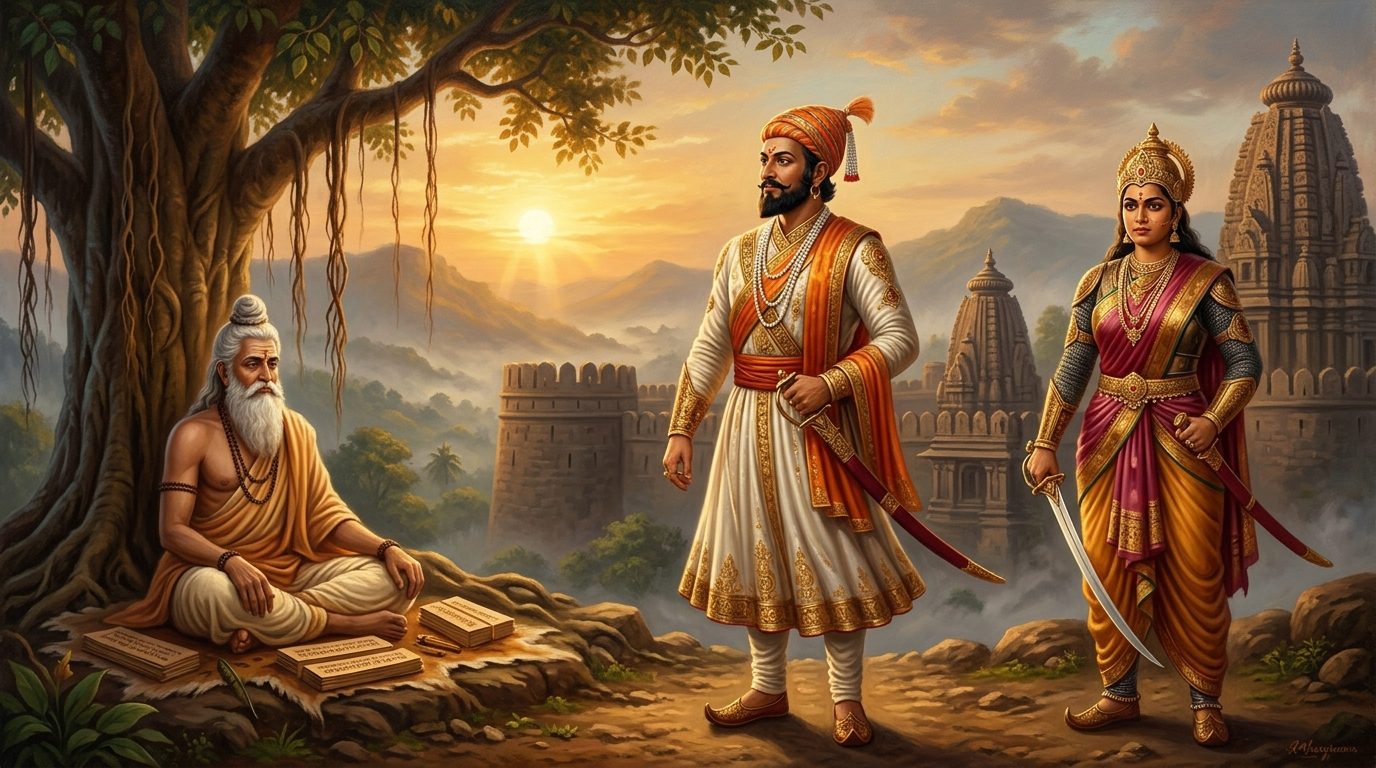
Historical Myth Breakers: Merit Over Birth
The Global Conundrum of Caste or Economic Segregation: Chapter 24.
Colonial records portrayed Indian history as a static record of birth-based oppression. They claimed the upper castes held a permanent monopoly on power and spiritual authority. They asserted that lower castes remained permanently frozen at the margins of society. Remember, dividing castes into 'lower' and 'upper' is also colonial framing. This was demonstrated with reference to Al-Biruni in Chapter 20.
The actual historical record delivers a fatal blow to this colonial fiction. Throughout Indian history, individuals from humble backgrounds continually reshaped society. They governed vast empires, composed sacred scriptures, and led spiritual revolutions.
                THE PARADOX OF POWER IN INDIC CIVILIZATION
  [Colonial Myth]                      [Lived Civilizational Reality]
- Power strictly bound to birth.       - Power and merit (*karma*) broke birth barriers.
- Kshatriya monopoly on thrones.       - Queens and kings proudly declared *Shudra* status.
- Shudras barred from leadership.      - Sages from humble roots authored sacred texts.
                                  │
                                  ▼
                    [Caste as a Post-Facto Label]
         Legitimacy flowed from lived authority, not biological rank.
These myth breakers prove a fundamental civilizational truth. Caste in India was never an absolute, divinely ordained prison. It was a post-facto tool of classification.
When an individual demonstrated exceptional ability, society recognized their lived authority. Merit (karma) routinely triumphed over biological birth. Family profession or business was no impediment to their pursuit of life.
Authors of Sacred Scriptures: Spiritual Authority Over Birth
The most powerful refutation of birth-based hierarchy begins with sacred scripture. If caste was rigid, the holiest texts would belong exclusively to high-born priests. In reality, the foundational scriptures were composed by sages from marginalized backgrounds.
-
Maharishi Veda Vyasa: He compiled the four Vedas. He authored the Mahabharata and the Puranas. Vyasa was born to Satyavati, a humble fisherwoman. His spiritual authority was universal across the subcontinent.
-
Maharishi Valmiki: He authored the Ramayana, the foundational epic of Indic civilization. Valmiki emerged from a forest-dwelling hunter community (Kirata). Yet tradition reveres him as the Adi Kavi (First Poet).
-
Satyakama Jabala: In the Chandogya Upanishad, Satyakama sought Vedic education. He did not know his father. His mother, Jabala, was a maidservant. Sage Gautama accepted him based purely on his truthfulness. Gautama declared that character, not lineage, makes a true seeker.
-
The Bhakti Revolution: Medieval India saw spiritual authority pass entirely to subaltern saints. Sant Ravidas was a leather-worker. Kabir was a weaver. Thiruvalluvar was a weaver. Tukaram was an agrarian peasant. These saints commanded devotion across all social strata. High-born scholars bowed before their spiritual realization.
The work of these scholars and their images are a matter of reverence in every Hindu household. Their books find a place in temples and devotional libraries.
Ancient and Medieval Sovereigns
Colonial theory insisted that only hereditary Kshatriyas could wear a crown. Ancient Indian history tells the exact opposite story. These are the examples:
The Pataliputra Empire
The world's oldest recorded and wealthiest empire is buried under a bustling city called Patna. Its ruins cannot be dug up anytime soon until we discover new technologies to do it. Patna was called Pataliputra in its heyday.
The Nanda Dynasty ruled the wealthiest empire of its era. Its founder, Mahapadma Nanda, emerged from a barber (Nai) background.5 Puranic records confirm his non-royal, Shudra origins. Yet he crushed established dynasties and built an imperial realm.
Following the Nandas, the Maurya Empire (322-185 BCE) unified the subcontinent. Chandragupta Maurya came from humble, non-royal origins. His son and grandsons ruled across India for generations.
Chandragupta was mentored by the strategist Chanakya, a Brahmin. Chanakya did not seek a royal blueblood or hereditary Kshatriya. He chose raw capability and strategic brilliance over pedigree. He mentored Chandragupta to become a capable sovereign despite his humble family origins.
Queen Rudrama Devi: The Shudra Sovereign
Epigraphical evidence delivers a decisive blow to birth hierarchy in South India's Deccan region. A proud declaration demolishes the colonial claim that Shudras were a degraded, powerless class.
Telangana's Kakatiya Dynasty (1175-1363 CE) reached its peak under Queen Rudrama Devi (1262-1289 CE). She ruled with absolute authority as a female sovereign.
The Bothpur Inscription provides a historic declaration of Kakatiya identity.1 The Kakatiyas proudly proclaimed their Shudra heritage in stone. They wore it as a badge of honor, not shame.
The Hindavi King
In 1674, Chhatrapati Shivaji Maharaj was crowned the King of India he called Hindavi Swarajya. British historians called it Maratha Empire. The Mughal King at Delhi accepted its suzerainty. The British became rulers of Bengal by obtaining the Diwani through the successor of that same Mughal King. But that British hypocrisy is another matter for discussion.
Thus, the last King of India, Chhatrapati Shivaji, belonged to the Bhonsle clan, a family of agrarian roots. He had no formal royal lineage or aristocratic title.
Chhatrapati Shivaji organized local peasants, hill-tribes (Mavlas), and common soldiers into an invincible army. At his coronation in Raigad (1674), scholar Gaga Bhatt conducted the sacred rites.4
Nobody questioned Chhatrapati's family background. This was just before the British had entered the political scene in India. They left in 1947 with their favourite party in power and a promise for democracy. The tradition of meritocracy continued after that.
Democratic Transition: Modern Meritocracy
The transition to democracy unlocked this ancient civilizational pattern at scale. These are some of the examples. Remember, it is not a complete list but a sample survey:
1. Dr. B.R. Ambedkar (1891-1956): Born into an impoverished Mahar family, he faced severe social barriers. He earned doctorates from Columbia University and the London School of Economics. Ambedkar became the chief architect of India's Constitution and its first Law Minister.2
2. Karpoori Thakur (1924-1988): Born into the marginalized Nai (barber) community in Bihar, he rose to become Chief Minister twice. He pioneered affirmative action models for backward classes. He was awarded the Bharat Ratna in 2024.
3. Ram Nath Kovind (b. 1945): Born in a mud hut in rural Uttar Pradesh, he rose from a poor Dalit family. He became a senior advocate, governor, and served as the 14th President of India (2017-2022).
4. Narendra Modi (b. 1950): Raised in modest circumstances in Vadnagar, Gujarat, helping his father sell tea at the railway station. Emerging from the backward Ghanchi (OBC) community, he rose through public service to become the Prime Minister of India.
5. Dr. Meghnad Saha (1893-1956): Born to a struggling backward-class family in rural Bengal, he overcame extreme poverty. He formulated the Saha Ionization Equation, revolutionizing modern astrophysics.3
6. Tulsi Gowda (b. 1944): An illiterate Halakki tribal woman from Karnataka. Her indigenous environmental knowledge led her to plant over 30,000 saplings, earning her the Padma Shri.
The Triumph of Lived Merit
The history of India is a continuous catalog of merit over birth.
From sages like Vyasa and Valmiki, to monarchs like Nanda and Rudrama Devi, authority followed merit. In modern times, leaders like Ambedkar and Modi continued that same civilizational pattern.
These figures prove that rigid caste was a colonial grid imposed on a dynamic society. Talent and character (karma) always broke through artificial social boundaries.
Some critics argue that modern upward mobility is merely a product of democracy. To test that claim, we must look at pre-1947 princely rulers under the British Raj. That is the gap in this chapter. What happened to the people who ruled alongside the British over India after the fall of the Mughals?
That inquiry into the princely rulers forms the focus of the next chapter.
References:
All articles on The Global Conundrum of Caste or Economic Segregation
-
Bothpur Inscription of Malyala Gunda, 1272 A.D., Telangana Epigraphical Series ↩
-
The Constitution of India, Article 17 (Abolition of Untouchability), 1950 ↩
-
M. N. Saha, "Ionization in the Solar Chromosphere," Philosophical Magazine, Series 6, Vol. 40, No. 238, 1920, p. 472 ↩
-
Gaga Bhatt, Rajyabhishek Paddhati (Maratha Coronation Records of Raigad, 1674) ↩
-
The Vishnu Purana, Book IV, Chapter 24 (detailing the Nanda dynasty's non-royal origins) ↩
Leave a Response