The Global Conundrum of Caste or Economic Segregation: Chapter 16.
In the previous chapter we established what Manusmriti actually is. It is neither a scripture nor the Shruti. It is a directive legal code. It was a mere guiding tool of ancient times to guide the Kings to dispense justice. One voice among forty-seven competing Dharmashastra authors. Correctable by the Vedas. Never treated as infallible, even by its own tradition.
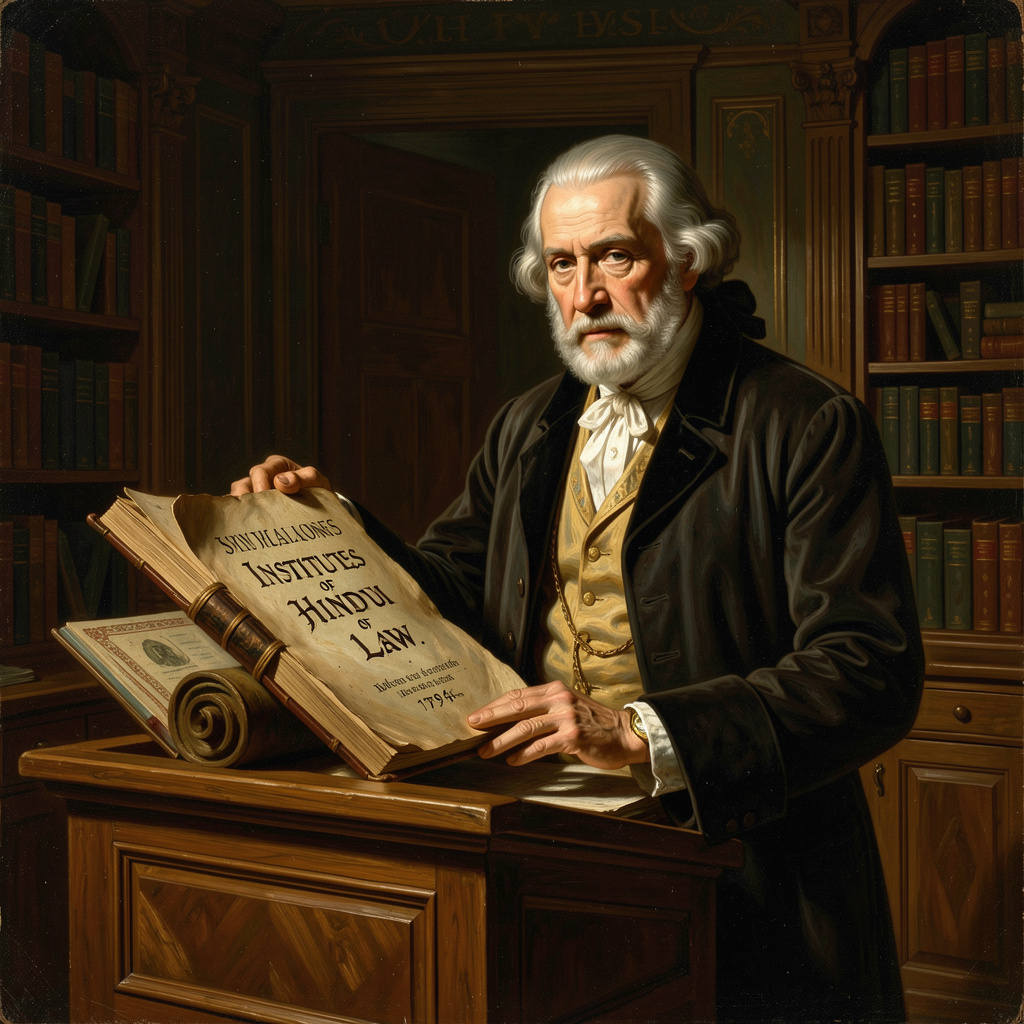
Sir William Jones produced the first alleged English translation of Manusmriti in 1794 called Institutes of Hindu Law. Jones' attempt to elevate Manusmriti into the sole, binding legal code for British courts in India soon proved deeply flawed. A mistake Jones himself realized, and one that no authentic Sanskrit pundit would ever have endorsed.
The British assumed, and stubbornly clung to the idea that like Christianity, Hindu faith had to be a single book code of conduct somewhere. They also presumed that it had to be Manusmriti to be presented to the world to prove it. Therefore, they either commissioned or sponsored many commentaries on Manusmriti without ever compiling the real text of what was Manusmriti.
Circular Verification
One such project was Arthur Coke Burnell and Edward Washburn Hopkins’ The Ordinances of Manu (London, 1884). The idea was simple. Today we call it circular verification. Multiple projects pointing in the same direction would itself be proof of a fact that was never established.
It was a pre-internet way of creating noise about something which either did not exist or was not in the manner claimed by multiple sources.
There are at least eight more known commentaries on Manusmriti. All claim to be translations of the original, but all are commentaries with variations/improvements made by each author. None of these authors cited original Sanskrit text. These books are:
1. Sir Graves Chamney Haughton (London, 1825): Mánava-Dherma-Śástra; or The Institutes of Menu. Re-edited Jones' text with additional glosses, continuing the exclusive reliance on Cullúca. 2. Georg Bühler (Oxford, 1886): The Laws of Manu (Sacred Books of the East, Vol. 25). Attempted to reconcile six conflicting medieval commentators (Medhātithi, Govindarāja, Cullúca, Nārāyaṇa, Rāghavānanda, Nandana) without presenting the Sanskrit source text. 3. Manmatha Nath Dutt (Calcutta, 1908–1909): The Dharma Shastra: Manusmriti. Continued the English commentary format for Indian university audiences. 4. Mahamahopadhyaya Sir Ganganath Jha (Calcutta, 1920–1939): Manusmṛti with the Manubhāṣya of Medhātithi (10 Volumes). The largest English commentary project, translating Medhātithi's 10th-century commentary alongside comparative notes across Dharmashastras. 5. Kewal Motwani (Madras, 1934 / 1958): Manu: A Study in Hindu Social Thought. A sociological commentary on Manu's social structure. 6. Wendy Doniger & Brian K. Smith (London & New York, 1991): The Laws of Manu (Penguin Classics). Modern psychological and structuralist commentary continuing the Western editorial tradition. 7. Patrick Olivelle (Oxford, 2005): Manu's Code of Law: A Critical Edition and Translation of the Mānava-Dharmaśāstra. Admitted after 200 years that Cullúca's recension was merely a 12th-century editorial product, not the ancient text.
A question may arise as to why these projects continue well into the 20th century? The explanation is simple. The British empire may have collapsed in public perception but actually the seat of empire shifted across the Atlantic to America. Read about this empire in my book Accidental Empire of USA, here.
Therefore, Wendy Doniger is carrying the torch that was lit by Brilliant British Scholars in the 18th century. The industry of distortion of Sanatan Dharma continues in USA.
Problems with William Jones' Manusmriti
Jones's honesty was his biggest flaw. He admitted that his work was based on hearsay. He was a judge of the Supreme Court at 'Calcutta' as it was spelled back then. Yet he did not refrain from telling this honestly in the first few pages of his book. The title of the book itself reads "Verbally Translated from the Original Sanscrit". This is hearsay as per modern standard. There is no point in going into the Sanatan Epistemological tradition.
The other problem was its vocabulary which was European unadulterated by the 'secular' narrative of today or the colonial narrative of the past century.
Operating at the end of the 18th century, Jones used the secular political vocabulary of Enlightenment Europe. He translated varna using European estate terms: "Sacerdotal Class", "Military Class", "Commercial and Servile Classes", and "Mixed Classes". He called the twelve divisions "Chapters" (Adhyaya).
Jones viewed Manu through the lens of Roman lawgivers like Solon or Numa. Till that time the 19th-century imperial census and bio-hereditary "caste" taxonomies were not constructed. Jones relied on what native pundits narrated out loud to him from Cullúca Bhatta's 12th-century commentary. Jones' so-called "verbal translation" was, from its very inception, an English commentary on a medieval Sanskrit commentary as recalled by one person on the basis of his memory.
Remember that the British census system, implemented systematically from 1872 onwards, served as the primary instrument for making caste census a permanent feature. In 1881, they found it difficult to record the caste of each individual. How they discovered it and recorded it in the census in later years is another story. But the narrative around individual caste started around the same time.
Coke Burnell Hopkins Project
Arthur Coke Burnell was a replacement commissioned to rectify the errors of Jones. The preface and introduction of his 1884 book also explicitly confess, this was not a direct translation of Manu at all. It was an English commentary built on top of medieval commentaries. Burnell chose Kulluka Bhatta’s 12th-century recension as the base text, while Hopkins relied on Medhatithi and Raghavananda to resolve disputed words. Working from "a much-altered copy... changed by a later hand" without providing any Sanskrit source text, they produced a commentary on a commentary written for colonial administrators.
To understand how global perceptions of caste were manufactured, we must put both books side by side. A mere look at the Index spills the beans of the colonial narrative project. See in this table:
| Division | Sir William Jones (1794) | Hopkins & Burnell (1884) |
|---|---|---|
| Naming | CHAPTER THE FIRST... | LECTURE I... |
| Front Matter | Preface by Sir William Jones | Preface by Hopkins / Introduction by Burnell |
| Chapter / Lecture I | On the Creation; with a Summary of the Contents | Origin of the Universe (The Contents of this Work) |
| Chapter / Lecture II | On Education; or on the Sacerdotal Class | Source of this Law (The First Stage of the Brahman's Life: The Student) |
| Chapter / Lecture IV | On Economics; and Private Morals | Subsistence and Private Morals of the Brahman Householder |
| Chapter / Lecture VII | On Government; or on the Military Class | The King's Duties (The Second Caste) |
| Chapter / Lecture IX | On Commercial and Servile Classes | Civil and Criminal Law Continued (The Third and Fourth Castes) |
| Chapter / Lecture X | On the Mixed Classes; and on Times of Distress | The Mixed Castes and Classes (Procedure in Time of Need) |
Comparing the two indices reveals the colonial narrative shift. Jones' 18th-century secular "Class" was explicitly converted by Hopkins into "Caste" directly on the Contents page itself. Then he wove in Ashrama terminology ("First Stage of Life", "Second Stage") to give scholarly polish to his imperial re-framing.
The entire book is an improvement to fill the gaps in the narrative put forward by Jones. But the problem with falsehood is that it always has gaps. And that happened with all the editions. This is the reason this project continued for 230 years. The list of those publications is already given above.
Now let us delve into a serious analysis of the Burnell-Hopkins Project.
The Burnell and Hopkins Project (1884)
The full title is The Ordinances of Manu. Published by Trubner and Company in London, 1884. Translated by Arthur Coke Burnell. Completed and edited by Edward Washburn Hopkins. Reprinted in India by Orient Books, Delhi.
Arthur Coke Burnell (1840-1882) was a civil servant in the Madras Presidency. He was a field scholar. He catalogued Sanskrit manuscripts at the Tanjore Palace. He co-compiled Hobson-Jobson, the Anglo-Indian glossary. He had real Sanskrit training. He was also dying when he wrote this book.1
Burnell retired from service in 1880 due to illness. He died of pneumonia in October 1882 at age 42. The book was published two years after his death. He never saw the final published form. He never approved the completed translation.
Edward Washburn Hopkins (1857-1932) received Burnell's unfinished manuscript. He completed it. He sent it to Trubner for publication from America. He was not present for any original field work. He worked from a long distance on a dead man's incomplete draft.
The book presents itself as a unified scholarly translation. It is actually a posthumous reconstruction.
Lectures sans Chapters
Open the Hopkins-Burnell edition at what modern scholars call Chapter 10. You will find this heading:
LECTURE X. The Mixed Castes and Classes: Procedure in Time of Need.
Hopkins did not call the twelve divisions chapters. He called them Lectures. Manusmriti is structured in twelve adhyayas. Hopkins rendered adhyaya as "Lecture." The Arya Samaj Hindi edition uses Adhyaya throughout. Why did he do it? Simple. An oral narration written down by a person is a lecture. It is a clever way to remove "verbal translation" while retaining the substance of intent.
When anyone cites "Manusmriti Chapter 10 verse 5," they use a word, "chapter," absent in Hopkins. The word "adhyaya" does not appear in Hopkins either. The citation format circulating for two hundred years does not map to the book that created it.
The Biblical Address
The most-cited verse attributed to Manusmriti 10.4 concerns mouth, arms, thighs, and feet producing the four varnas. Open Hopkins Lecture X and read what verse 4 actually says:
"The Brahman, Ksatriya, (and) Vaicya (constitute) the three twice-born castes; but the fourth, the Çudra, has only one birth. There is no fifth (caste)."
No mouth. No arms. No thighs. No feet. Hopkins' Lecture X verse 4 counts the four varnas and assigns birth status. It says nothing about cosmic anatomy.
The body-parts verse is in Lecture I, verse 31. A different lecture entirely. A different argument entirely.
Every speech, thesis, and AI citing "Manusmriti 10.4" for cosmic anatomy cited the wrong address. They cited a book they never opened.
This is the ultimate mechanism of the colonial illusion. In ancient Sanskrit manuscripts, there were continuous shlokas divided into Adhyayas. There were no Western decimal chapter and verse addresses. In the case of Manusmriti, there is no known Sanskrit book. The one from Arya Samaj has chapters divided entirely differently from Jones or Hopkins.
When Sir William Jones (1794), Hopkins (1884), and Bühler (1886) published their English commentaries, they imposed a Western numerical grid onto the text, creating citations like 10.4 or 10.65 or whatever. Over two centuries, global academia, public critics, political commentators, and AI models began quoting these numbers as if they were canonical, Biblical chapter and verse addresses like John 3:16. The absurdity is glaring.
Everyone quotes 10.4 assuming it is an indisputable address in a single global Hindu Bible. Yet when you open Hopkins' 1884 edition, verse 10.4 does not even contain the cosmic body parts verse. That is in Lecture 1, verse 31. Similarly, when Swami Dayananda cited the Sanskrit shloka on merit-based varna in Chapter 4 of his Hindi text Satyarth Prakash, modern indexes retrofitted the colonial tag 10.65 onto it. Everyone debating or attacking Manusmriti using these numbers is actually citing a 19th-century British filing system, while mistakenly believing they are citing an ancient Hindu scripture.
Commentary presented as Translation
Look at the footnotes on any page of Hopkins Lecture X. Verse 3 carries footnote 1:
"Excellence in qualities, which then follow (Medh.); Four causes (Ragh.); Pre-eminence in birth, i.e., from the head of Brahma (Medh., K.)"
Medh is Medhatithi, a 10th-century commentator. Ragh is Raghavananda, a later commentator. K is Kulluka Bhatta, the 12th-century commentator whose recension forms the base text. Hopkins is not translating Manu. He translates Kulluka's recension, clarified by Medhatithi and Raghavananda. Every disputed word is resolved by choosing one commentator over another. That too without extracting the commentary or its original context.
The reader sees English. They do not see Manu, Kulluka, Medhatithi, or Raghavananda. Three layers of medieval commentary become invisible. Hopkins neither had the original Manusmriti nor did he claim his work to be a translation. It is a commentary of other commentaries. Yet academia treats it as a translation.
The hollowness of academics is frustrating, to say the least.
Translation without Sanskrit Source
The Hopkins-Burnell edition contains no Sanskrit text. No Devanagari. No transliteration. The source is completely absent. The reader cannot check a single translated word. The authority of the book rests entirely on credentials. Credentials of a man who died before publication, finished by a colleague on another continent.
This edition became the global English authority on Hindu scripture regarding caste.
Confession of Editors
The book has a preface and an introduction. Hopkins wrote the preface. Burnell wrote the introduction. Neither was hidden. Both were published in 1884. It has a disclaimer every academic chose to ignore. Hopkins begins his preface by stating what he did not have:
"It was exactly where a master-hand was most needed that the master's hand was wanting. To supply this deficiency the editor has done what he could, but it must be to all a source of regret that those portions of the work where Dr. Burnell's acquaintance with practical Hindu law would have been of the utmost value have been left to one who knows it in theory only."2
One who knows it in theory only. His words. A confession that he does not know if the so-called mandates of Manusmriti were followed anywhere in practice. He then states who chose the source text. He did not. Burnell did:
"The text from which the translation should be made had been laid down by Dr. Burnell to be that of Kulluka."2
Hopkins describes the manuscript he actually used in the preface. His words: "a much-altered copy, where the original text has been frequently changed by a later hand."2 He obtained it on loan from Dr. Rost, librarian of the East India Office in London. Hopkins signed the preface from New York, April 1884. The manuscript went back to the India Office. The book went to Trubner.
Burnell's Introduction is equally direct. On the text's authority in India:
"Accident has given it this supreme position, which is, even now, hardly weakened, owing to the general ignorance of the history of Sanskrit law."2
On the connection between this legal text and the Manu of the Vedas:
"The myth connecting this law-book with the Manu referred to in the Vedas is recent."2
On Jones' 1794 translation, which made Manusmriti the colonial legal reference:
"The Manava-dharma-castra, as translated by Sir W. Jones, at once became, and has remained, an authority on the laws of the so-called Hindus for the uncritical lawyers who attempted the task... It was not suitable for this purpose, for to make it the authority was to take a retrograde step, as even Sir W. Jones soon discovered, and no real pandit would ever have suggested it."2
Jones himself knew his text was unsuitable. Burnell recorded that no pundit endorsed the elevation. Yet it built an empire's legal framework for 200 million people.
The purpose was never philological precision. Colebrooke, the earlier colonial commentator, stated the intent plainly. The work was made "particularly intended" for the English reader. Translation was the vehicle. The Sanskrit original was irrelevant to the narrative.2 Hopkins could write anything under a lost doctrine.
Lost Doctrine
From Jones' hearsay, Hopkins jumps to a lost doctrine. Look at page 306 of Hopkins' Lecture X. Footnote 4 on verse 8 exposes the full absurdity.
Footnote 4 (on Verse 8):
4 Cf. ix. 178. K. says, referring to the lost (?) verse of Yāj. (cf. ix. 178 note, and ix. 160), that the "girl" means one married. So Medh., "it means the wife (strī) of the Vaiçya," etc.
Footnote 1 (on Verse 6):
1 K. gives the names and acts of these (from Yāj. and Uçanas; cf. Yāj. i. 91 ff., though the text does not specify them) as Mūrdhāvasikta (tending horse and chariots); Māhiṣya (dancing, etc.); Karaṇa (police).
Kulluka tries to explain away a textual contradiction by claiming it relies on a lost verse of Yajnavalkya. Hopkins himself puts a question mark next to lost verse. To force the text to fit his commentary, Kulluka redefines the plain Sanskrit word for girl, kanya, to mean a married woman, while Medhatithi redefines it to mean the wife of a Vaisya. On the same page, footnote 1 admits that Manu's text does not even specify the names or occupations of Murdhavasikta, Mahishya, or Karana. Kulluka simply imported them from Yajnavalkya and Usanas into Manu. Hopkins printed these external insertions as Manu's law. Commentators were literally inventing lost verses of other sages out of thin air and inserting missing occupations from external texts where Manu was silent.
Neither editor held a manuscript of Manu. One borrowed a "much-altered copy" from the India Office. The other inherited a dead man's editorial decision to use Kulluka. Words they could not resolve they gave to commentators. Commentators they could not agree on they chose between. The result was not a translation. It was a commentary on a commentary, written in English, for colonial administrators, with the source text withheld.
And this, in Burnell's own words, became "the decisive authority respecting India."
The Institutional Asymmetry
Comparing these books exposes how global consensus was manufactured. My guess is the result would not be much different if other commentaries on Manusmriti are closely analysed. However, that is beyond my line of work. I have demonstrated the crux of the problem in these 3,200-odd words.
In the next chapter, we shall deal with the Hindu reply to these distorted commentaries.
References:
All articles on The Global Conundrum of Caste or Economic Segregation
PS: The length of this article explains why there was a long gap after the publication of Chapter 15.
-
Arthur Coke Burnell (1840-1882), Madras Civil Service. Classified Index to Sanskrit MSS in the Palace at Tanjore (1880). Co-compiler with Henry Yule of Hobson-Jobson: A Glossary of Anglo-Indian Words and Phrases (1886). Burnell died October 12, 1882. The Ordinances of Manu was published posthumously in 1884 by Trubner and Co., London. ↩
-
The Ordinances of Manu, translated by Arthur Coke Burnell, completed and edited by Edward Washburn Hopkins (Trubner and Co., London, 1884). Reprinted by Orient Books, Delhi. Read online here. ↩↩↩↩↩↩↩
-
Patrick Olivelle, Manusmriti: The Law Code of Manu (Oxford University Press, 2005). Critical edition comparing over fifty manuscripts. Demonstrates that the Kulluka Bhatta recension is a 12th-century editorial product, not the oldest textual tradition. ↩
-
Edward Washburn Hopkins (1857-1932), Indologist at Columbia College and later Yale University. Completed and edited Burnell's unfinished manuscript for publication after Burnell's death in 1882. ↩
-
For Kulluka Bhatta's role in the manuscript tradition and how colonial translators used his recension as if it were the original, see Olivelle (2005), Introduction, pp. xii-xxvi. ↩
-
Ludo Rocher, "The Dharmasastras," in Jan Gonda (ed.), A History of Indian Literature (Wiesbaden: Harrassowitz, 1977). On the political context of post-1857 colonial Sanskrit translation. See also Wilhelm Halbfass, India and Europe: An Essay in Understanding (SUNY Press, 1988). ↩
-
Manusmriti - The Laws of Manu by G.buhler https://www.scribd.com/doc/223796728/Manusmriti-The-Laws-of-Manu-by-G-buhler-English-Translation ↩
Leave a Response