The Global Conundrum of Caste or Economic Segregation: Chapter 22.
There is no word for caste in any language of India. It does not appear in the Vedas, the Upaniṣads, the Bhagavad Gītā, or the extensive legal texts of Hindu jurisprudence. The word "caste" comes from Portuguese.
Ancient India had three distinct concepts. They were Varna, Jati, and Gotra. Each served a different purpose. Each operated by different rules. None of them was what the Portuguese called casta.
Colonial administrators collapsed all three into one English word. That single merger is the source of almost every misunderstanding about Indian society that exists today.
This chapter explains these terms. One by one.
Varna
Varna is a fourfold theoretical classification. It appears in texts like the Vedas, the Bhagavad Gita, and the Dharmashastra. It describes roles, qualities, and functions in a society. It is an idea about roles and qualities, discussed mainly in scripture and philosophy. Often it is relied upon by communities to elevate their status by linking to the glorious past.
The four Varnas are: - Brahmana: the scholars, preservers of knowledge. - Kshatriya: the rulers and warriors. - Vaishya: the merchants and wealth creators. - Shudra: the artisans, builders, and service providers.
Varna is an idea. It describes roles. At best it is a classification. It was discussed in scripture and philosophy. It was never a legal status enforced by the state.
Jati
Jati is something entirely different. It refers to thousands of actual, local, endogamous birth communities. They were tied to region, kinship, language, and traditional occupations. Jati existed on the ground, organized by real social practice, not by scripture. A Jati's claimed Varna status was often locally asserted or disputed, not handed down by any single textual authority.
The word Jati in Sanskrit means species, kind, or lineage. Its Hindi and Marathi usage means birth community or race. It is the actual Indian counterpart of the Portuguese casta.
The Colonial Trap of Caste
The British were not observers. They arrived as traders. They stayed as administrators. They ruled as conquerors backed by military force. The East India Company and later British Crown did not ask permission to classify Indian society. It imposed a classification system through the machinery of conquest.
Caste is an English word from the Portuguese casta. The Casta means breed, race, or lineage based on ethnicity. Portuguese missionaries introduced it in Goa during the 16th century. It was their word. It described their concept. Yet it was imposed by British Invaders who merged Varna and Jati into one flat category.
That merging is the colonial trick. A scholar collapses Varna and Jati into one word: caste. They then quote a Varna verse from the Purusha Sukta. They use it to explain the real social position of an actual Jati community centuries later. Those are two different orders of reality. Colonial administration stitched them together as if they were one continuous system. This stitching is the massive civilizational fraud.
Now let us revert to the Varna and understand it carefully.
Varna as The Separation of Powers
In modern political science, the Separation of Powers is the cornerstone of democratic governance. Montesquieu codified it. The Constitution of India enshrined it in Article 50. It divides government into three independent branches: Executive, Legislature, and Judiciary.
The purpose is simple. If one branch monopolizes all three functions, it becomes a tyranny.
Centuries before Montesquieu, ancient Indian social architects recognized the same danger. They designed the Varna system not as a biological hierarchy. They designed it as a social checks-and-balances framework.
The Constitutional Design
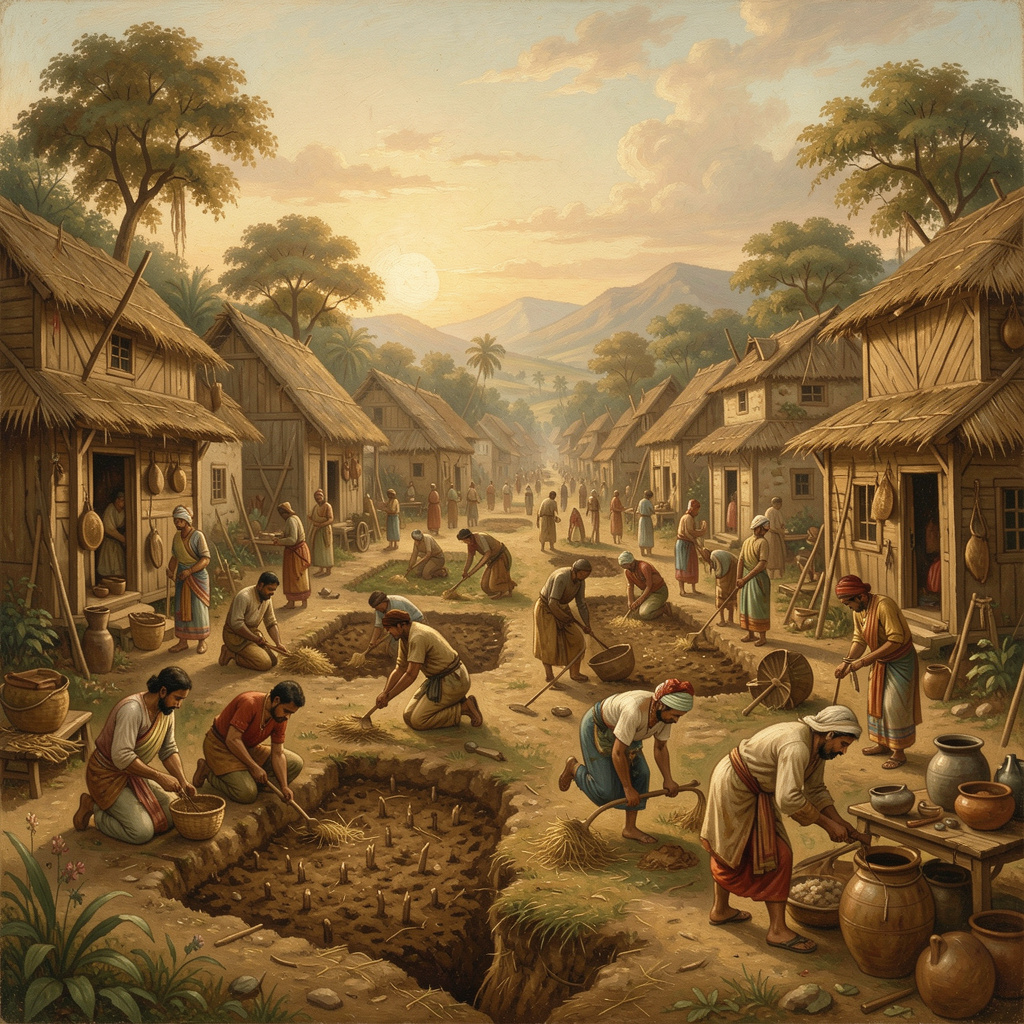
In ancient Saraswati Valley Civilization, the power was deliberately separated across four functional divisions. It was a simple village economy where professions were traditional and limited in number. To visualize society 5,000 years ago, we must return to an agrarian world of wooden houses. In such a society, power was separated on these lines:
-
The Executive Force (Kshatriya): Rulers and warriors held physical force. They governed the society and defended the State. But they held no monopoly on wealth or land. They were subject to ethical counseling by the scholarly class.
-
The Intellectual Authority (Brahmana): Scholars and priests educated and preserved knowledge. To prevent intellectual corruption, they were prohibited from holding land, wealth, or executive power. They survived on voluntary alms or begging at worst.
-
The Commercial Generator (Vaishya): Merchants and traders controlled capital and commerce. They were the repository of wealth. But they held no state executive authority or military power or land.
-
The Agrarian and Material Base (Shudra): Artisans, builders, and agriculturists held land. They drove the practical economy. They were the indispensable physical foundation.
This division ensured that no single group could achieve total dominance: - The thinker had knowledge but no money or weapons. - The warrior had weapons but no wealth or monopoly on truth. - The merchant had money but no army or legislative voice. - The toiler held land and craft guilds but no state executive office.
All four were structurally interdependent. There was no hierarchy. It was a cooperative ecosystem. This design is strikingly similar to a modern corporate structure. Policy-makers and researchers are structurally separated from financial executors. This prevents conflicts of interest.
The Bhagavad Gita on Varna
At the cost of repetition, let me quote Lord Krishna from the Bhagavad Gita (4.13):
चातुर्वर्ण्यं मया सृष्टं गुणकर्मविभागशः । Caturvarnyam maya srstam gunakarmavibhagasah "The fourfold division of society was created on qualities (guna) and actions (karma)."
The basis is guna and karma. Qualities and actions. It was neither birth nor bloodline. A person was called a smith because they forged iron. The title described the work. It was not a metaphysical birthright. The hereditary bloodline came into effect later due to two primary reasons.
First was practical difficulty. When the society was a simple village-based agrarian economy, the Varna system could work. But when professions multiplied, it became difficult to classify them. For example, a businessman cannot set up an industry without land. If a Shudra owns the land and establishes an industry on it, which Varna does he belong to? The Varna system had to be fluid. It was fluid, as seen by Al-Biruni and discussed in Chapter 20. The rigidity of the system collapsed long ago when commercial activities flourished.
Secondly, the craft of doing 'business' of any Varna required specialised knowledge and upbringing. Constant exposure to the family craft made children experts in the family craft. This resulted in the creation of Jati.
How Varna Became Jati?
Let me give another example. When we discuss Hindu scripture, we do not realize that these texts predate the invention of paper. Before paper existed, knowledge was preserved through human memory. This was not primitive. It was a massive, highly sophisticated cognitive undertaking.
Young children memorized thousands of verses of the Vedas in Sanskrit from childhood. They used complex mnemonic techniques: back-and-forth chanting patterns called Pathas. These patterns prevented transmission errors across generations. This cognitive demand created intense pressure. Families needed to identify and train children with exceptional memory. If such children could be found within the family, why go outside?
That single practical question is how Varna, or rather the profession, became caste.
A family that had spent generations practicing complex memory techniques produced children born into an optimized training environment. Rather than searching outside, families trained their own children. The scholarly role solidified. Access to the Brahmana function became bound to biological descent. It was an economic and practical efficiency.
What had started as a dynamic functional capacity (Varna) slowly became an institutionalized family-based occupation (Jati).
This created many sub-caste surnames among Brahmins. Each was directly linked to the level of knowledge a family had mastered:
- Dwivedi (or Dubey): Mastered two Vedas.
- Trivedi (or Tripathi): Mastered three Vedas.
- Chaturvedi (or Chaubey): Mastered all four Vedas.
- Pandey: Derived from Panda, practicing temple priests, concentrated in Kashi.
- Saraswat: Scholars associated with the Saraswati River Civilization. That is why they hold an exalted position.
These surnames survived for centuries. Families who converted to Islam generations ago still preserve their ancestral Saraswat Brahmin surnames. But this is not limited to Brahmins alone. The identity marker created by Jati is retained by all others as well.
Similarly, those who converted to Christianity retain their Jati identity, which they prefer to call caste. The memory of their guild affiliation outlasted the theology.
The Endogamy Chain Reaction
Every action has an equal reaction. When the Brahmanas closed their marriage circles to protect their oral textual lineages, the other functional guilds followed. It may appear that the formula is:
Brahmana Endogamy - Kshatriya Endogamy - Vaishya Endogamy - Shudra Endogamy
The Kshatriyas closed their circles to preserve political alliances and military control. The Vaishyas did so to protect capital and merchant trade routes. The Shudras did so to secure craft secrets, land ownership, and agrarian monopolies.
What had begun as a cooperative separation of powers turned into a series of isolated, self-protecting endogamous compartments.
The Brahmin endogamy resulted in endogamy in other communities as a reaction. It is laughable when people who never set foot in India carry placards. The placards say "Down with Brahmin Patriarchy." There was no Brahmin patriarchy. There was endogamy. The reaction to one endogamy was another endogamy.
The Economics of Jajmani System
The structural architecture that maintained the hereditary Jati system was entirely economic. In agricultural communities, survival depended on collective self-reliance. The village required blacksmiths, weavers, potters, barbers, washermen, tanners, and priests. To govern this, villages developed the Jajmani system. It was a reciprocal socioeconomic model of service exchanges.
Instead of relying on a volatile monetary market, village artisans provided services directly to agriculturalists. In exchange, they received a guaranteed share of the harvest, foodstuffs, and housing.
This arrangement fostered tight interdependence. Because survival was bound to this reciprocal stability, the pressure to pass down ancestral vocations was immense. The village-level Jajmani system forced families to take up the ancestral profession for a guaranteed livelihood.
The final collapse of the Varna system occurred when traditional regional balances were shattered by foreign invasions. Defeated local kings could no longer enforce the checks and balances. The slow evolution of Varna into Jati and occasional reversals received a crude shock. Society was forced to conform to the biased approval of foreign rulers.
The Evidence
During periods of mass foreign invasions, entire village populations were uprooted. To preserve community structures and lineages in exile, village priests began recording genealogies. They documented community roles in ledger books called Bahis.
These Bahis survive today in pilgrimage centers like Haridwar, Varanasi, Kurukshetra, in Central India. But they exist at all holy places where Hindu rites are performed. These are now maintained by the descendants of the village priests who started it in the village itself before the migration.
They are the original databases of lineage and social identity. The trauma of migration created pressure to document and formalize what had previously remained fluid and unwritten. Crucially, these priestly ledgers remained private, localized, and context-dependent. They were not tools of state control.
The tragedy came when British colonial administrators summoned these records and relied on them when it suited them. A private tool of family memory became the raw material for state-enforced legal caste sanctions.
The 1931 Census Distortion
The most devastating evidence of colonial distortion is the 1931 Census. The British classified the entire Indian population without any definition of what they were classifying.
The preface to the 1931 Census states:
"The term 'caste' needs no definition in India; tribe was provided to cover the many communities still organized on that basis... nor is it intended to do anything so rash as to define the term 'race' which is generally used so loosely as almost to defy definition."
They had no idea what caste was. No idea what race was. No idea what tribe was. They defined none of them. Yet they classified hundreds of millions of people on that basis. And a few decades later, they introduced reservations in jobs on that basis.
This was not a bureaucratic error. It is a deliberate design. A vague classification is easier to manipulate than a precise one. This is how the British Crown forced 'Caste' on India.
Dismantling the fictions of the past does not reject heritage. It clears away the colonial debris. It allows the spectacular flow of Indic civilization to reclaim its place in the global future. But to do that we need to understand the whole 'Operation Caste' minutely.
One question still remains: "Does Caste Represent Lineage?" That shall be the subject matter of the next chapter.
References:
1. Caste among Christians in India
2. Ronald B. Inden, Imagining India, Indiana University Press, 1990
3. Harjot Oberoi, The Construction of Religious Boundaries, Oxford University Press, 1994
Leave a Response