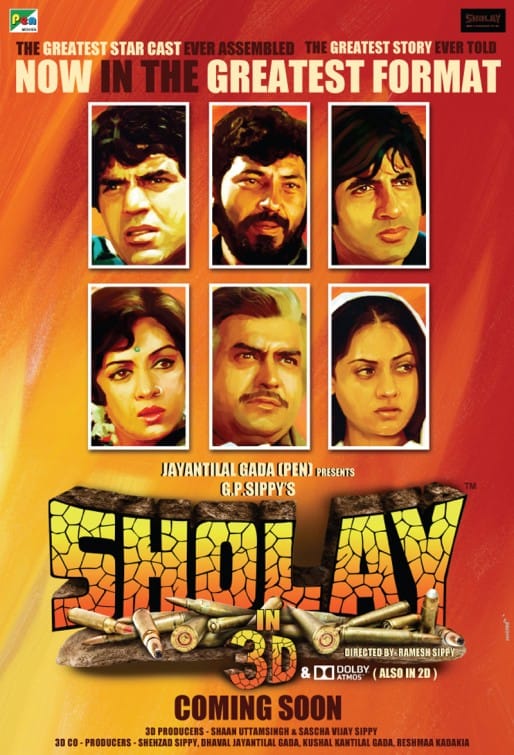
Echoes of Glory, Shadows of Ambition:
A Deconstructed Journey Through Sholay, Shalimar, and Agnipath
Introduction
Hindi cinema presents a rich tapestry of dreams and dramas, witnessing countless narratives rise and fall. As Sholay celebrates its Golden Jubilee today, completing exactly 50 years since its release on August 15, 1975, its enduring legacy provides the perfect lens for analyzing why films achieve vastly different destinies.
Three star-studded films from different era—the epochal Sholay (1975), the ambitious Shalimar (1978), and the stylized Agnipath (1990)—reveal complex relationships between storytelling, audience connection, and cinematic fate. The common thread that runs through these films is their ability to connect with audiences on various levels. Sholay, for instance, has become an iconic character-driven movie that continues to captivate viewers even today due to its well-developed characters, engaging story-line, and memorable dialogue. The film’s themes of friendship, loyalty, and the power of storytelling have resonated deeply with Indian audiences.
While Sholay etched its name in gold, the latter two, despite their potential, faded into relative obscurity. Through examining their narrative choices, character anchoring, and costume schemas, we can understand their disparate journeys.
Sholay: The Eternal Masterpiece
The cinematic landscape of Indian cinema has been enriched by several influential films, with Sholay (1975) being one such masterpiece. This epic tale, directed by Ramesh Sippy , is often regarded as an iconic representation of the genre.
Foundation of Success
Sholay redefined Indian popular culture. While drawing inspiration from various sources, including Spaghetti Westerns and Seven Samurai and Akira Kurosawa ‘s own works like The Hidden Fortress, it appears that Sholay borrowed elements without proper credit or recognition for its influences. A closer examination reveals a striking similarity between these two films in terms of their narrative structures, character development, and cinematic techniques.
by borrowing from Akira Kurosawa’s Seven Samurai The story follows retired police officer Thakur Baldev Singh hiring two small-time crooks, Jai and Veeru, to protect his village from dacoit Gabbar Singh. This simple premise became a cultural phenomenon through meticulous craft rather than mere star power.
The Screenplay Revolution
Salim-Javed’s screenplay elevated Sholay beyond conventional action cinema. Every dialogue became iconic, every character archetypal yet memorable. R.D. Burman’s revolutionary score, featuring the groundbreaking villain song “Mehbooba Mehbooba,” set new musical trends and demonstrated cinema’s power to create cultural touchstones.
Character Innovation and Visual Consistency
Sholay innovated by glamorizing its antagonist, transforming Gabbar Singh (Amjad Khan) into a cult figure. Even minor characters like the jailer (Asrani), Sambha (MacMohan) and Soorma Bhopali (Jagdeep) achieved immortality through careful character development.
The film’s costumes, while simple and realistic, created immediate visual identification for each character. This consistent approach established a visual shorthand that enhanced storytelling within the vast narrative landscape.
The Emotional Anchor
The true anchor in the Story of Sholay wasn’t the plot-driving Thakur, but the silent, suffering Radha (Jaya Bhaduri). Her periodic presence served as a potent emotional reminder of the stakes, unifying all other characters’ actions. This subtle but powerful anchoring gave the film its emotional resonance.
Audience Connection
The film’s connection with audiences was so strong that the ending was changed during production due to censor requirements, not post-release feedback as sometimes claimed. This demonstrates the careful balance between creative vision and practical considerations that contributed to its success.
Shalimar: Ambition Without Foundation
International Aspirations
Shalimar , an ambitious international co-production starring Dharmendra and Zeenat Aman alongside Hollywood veterans Rex Harrison and Sylvia Miles, aimed for global appeal. Directed by Krishna Shah, this heist caper centered on a precious jewel but struggled with identity and execution.
Structural Weaknesses
Despite impressive production values and good music, Shalimar suffered from an ambiguous genre and disjointed tone. The international cast felt mismatched rather than complementary, creating disconnection instead of appeal.
Lack of Emotional Core
The film’s most significant flaw lay in its absence of a clear anchor character. While Rex Harrison’s sophisticated villain Sir John delivered a standout performance, the narrative failed to coalesce around him or any other character. Without this anchor of emotional center, the grand spectacle felt hollow.
Visual Inconsistency
Unlike Sholay’s deliberate costuming, Shalimar’s approach lacked unity. Barring Sir John’s elaborate Bob Mackie-designed outfits, the visual schema felt random and inconsistent, failing to create a cohesive world.
The Burden of Expectation
Following Sholay’s monumental success, Shalimar faced insurmountable expectations. Without strong anchoring or cohesive vision, the film’s grandeur couldn’t compensate for its narrative weaknesses.
Agnipath: The Meta-Cinematic Experiment
Initial Reception and Later Recognition
Agnipath , starring Amitabh Bachchan, emerged as a stylized crime drama that initially failed commercially but later garnered cult following. The film chronicles Vijay Dinanath Chauhan’s descent into the criminal underworld to avenge his father’s death.
Bold Artistic Vision
Mukul S. Anand’s direction was audacious, and Bachchan delivered a powerful, unconventional performance with distinctive vocal styling. The visual approach was striking, featuring vibrant colors and heightened drama, with unparalleled costume work reflecting character transformations through attire.
The Meta-Remake Concept
Agnipath initially faltered for two key reasons. For audiences familiar with Bachchan’s entire filmography, the film cleverly remade many of his previous hits, offering a meta-cinematic experience that felt derivative to contemporary viewers. The mannerisms, intensity, and specific scenes echoed past glories.
Narrative Isolation
Despite Vijay’s powerful presence, the film lacked a unifying anchor character like Radha in Sholay . While his family provided emotional grounding, they didn’t connect with the broader narrative to bind all characters and storylines. Vijay remained emotionally and narratively isolated.
Artistic Achievement
In its self-referential nature and audacious visual style, Agnipath stands as unique cinematic creation—a “remake” of a star’s legacy condensed into one powerful film, initially misunderstood but ultimately appreciated for its bold artistic choices.
Shaan
Shaan (Hindi, 1980) was Directed by Ramesh Sippy, written by Salim–Javed. Shaan , made by the same creative team that delivered Sholay , lacked the essential anchors that ground a story. It had no coherent costume schema, a revenge arc where childhood grievances inexplicably resurfaced in late adulthood, and middle-aged actors awkwardly portraying characters in their thirties. According to interviews—including scriptwriter Javed Akhtar—the film was rushed too soon after Sholay’s historic success. There wasn’t enough freshness in the concept, and the Bond-inspired style didn’t resonate with the masses who were expecting something unique from Sippy again. But the movie had many issues. The makeup could not disguise the age of actors who were misfit in their roles. They were made to wear loose costumes—to conceal bulky frames but it only disrupted the visual coherence further. It was a flop but its villain Shakaal lives on. He was portrayed by actor Kulbhushan Kharbanda . Shakaal is remembered as one of Bollywood’s most menacing and stylish antagonists, inspired by Ernst Stavro Blofeld from the James Bond series. Kulbhushan Kharbanda notably shaved his head for this role, adding to Shakaal’s cold and ruthless persona.
Conclusion: The Architecture of Cinematic Immortality
The journeys of Sholay , Shalimar , Shaan and Agnipath illuminate fundamental truths about cinematic success that transcend conventional wisdom about stars and budgets.
Sholay’s enduring triumph demonstrates that true cinematic immortality requires more than technical excellence or star power—it demands the perfect synthesis of emotional anchoring, visual consistency, and cultural resonance. Its subtle yet powerful emotional core, embodied in Radha’s quiet presence, unified disparate elements into an cohesive experience that continues to captivate audiences fifty years later. Shaan movie serves as an inspiring reminder that achieving greatness requires more than mere talent; it demands a combination of hard work, creativity, dedication, and perseverance.
Shalimar serves as a stark reminder that ambition without emotional foundation creates spectacular failure. Despite international scope and impressive production values, the absence of a unifying anchor and visual consistency left audiences disconnected from its grand aspirations.
Agnipath reveals the complex relationship between artistic innovation and immediate commercial success. Its bold meta-cinematic approach and striking visual language ultimately proved ahead of its time, demonstrating that true artistic achievement sometimes requires audiences to catch up with the creator’s vision.
These three films conclusively prove that cinematic greatness emerges not from formulaic approaches, but from the delicate alchemy of emotional truth, visual coherence, and narrative innovation. In an industry often obsessed with surface elements, they remind us that the films which achieve immortality are those that dare to anchor themselves in authentic human emotion while pushing the boundaries of cinematic expression.
Sholay’s Golden Jubilee stands not merely as a celebration of past achievement, but as an enduring testament to cinema’s power to create lasting cultural impact through the marriage of technical mastery and emotional authenticity—a standard that continues to challenge and inspire filmmakers fifty years later. References: Sholay (Hindi, 1975) – https://www.imdb.com/title/tt0073707/ Shaan (Hindi, 1980) – https://www.imdb.com/title/tt0081556/
Leave a Response