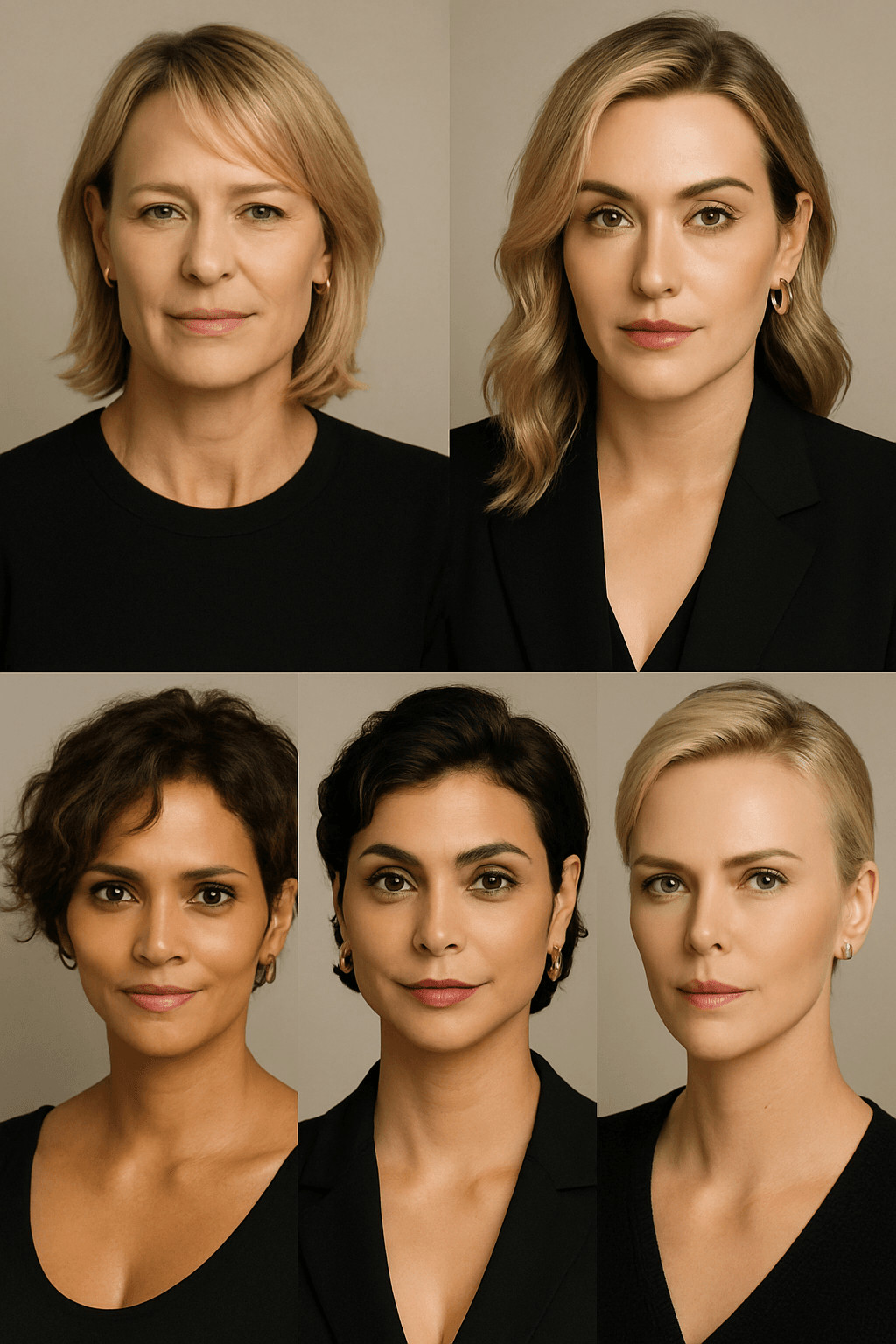
Hollywood’s Aesthetic Cage for Women
Sixty years after the symbolic burning of bras, Hollywood continues to enforce a subtler, visual form of gender essentialism—one rooted not in ideology, but in aesthetics. Women with short hair, especially bobs and pixie cuts, are routinely cast in roles that emphasize control, competence, and emotional restraint. Romantic vulnerability, softness, and narrative centrality are often withheld. This article explores how hairstyle functions as institutional shorthand, shaping the roles actresses are offered and the emotional range they’re allowed to express.
The Visual Code: Hair as Casting Logic
In Hollywood, hair isn’t just style—it’s semiotic. Casting directors use it as a visual cue to signal character traits before a word is spoken. The shorthand looks something like this:
- Long, flowing hair : Romantic, emotionally open, traditionally feminine
- Sleek bob or pixie cut : Controlled, cerebral, enigmatic, “strong but cold”
This binary coding flattens complexity. Actresses with short hair are rarely cast as romantic leads, nurturing figures, or emotionally expressive protagonists. Instead, they’re slotted into roles that require presence, not vulnerability.
Case Studies: The Bob Trap in Action
Robin Wright – House of Cards
As Claire Underwood, Wright’s blunt bob became a symbol of icy resolve and institutional control. Her character was calculating, emotionally sealed, and visually coded as untouchable. Romantic subplots were minimal, and her emotional arc was defined by power, not intimacy.
Kate Winslet – Mare of Easttown and Lee
Winslet’s shift to shorter, practical hairstyles coincided with roles that emphasized trauma, duty, and emotional burden. In Mare of Easttown , she played a gritty detective—maternal but hardened. In Lee , she portrayed a war photojournalist, brave and defiant but emotionally sealed. The romantic softness of her Titanic era was nowhere to be found.
Morena Baccarin – Firefly , V , Deadpool
Despite Juilliard (School of Drama) training, Baccarin is consistently cast as elegant, reactive, and emotionally contained. Her short roles in Good Wife and Mentalist impressed the audience. Her short hair reinforces roles that orbit male leads—never driving the plot, rarely expressing chaos or vulnerability.
Halle Berry – Moonfall , X-Men , Die Another Day
Berry’s iconic pixie cut has long been associated with strength and stoicism. Even after her Oscar win for Monster’s Ball , she was repeatedly cast in roles that emphasized competence over emotional depth. Her hairstyle became a visual cue for action, not intimacy.
Charlize Theron – Mad Max: Fury Road , Atomic Blonde
Theron’s short-haired roles often involve violence, detachment, and emotional suppression. Her transformative performance in Monster required a physical overhaul to “justify” emotional range—highlighting how Hollywood demands aesthetic conformity even in breakout roles.
The Institutional Drift
Hollywood’s aesthetic logic is shaped by marketing algorithms, genre conventions, and risk aversion. Short-haired women are visually branded as “strong,” which paradoxically limits their narrative range. The industry rarely asks, “What can she do?” Instead, it asks, “What does she look like she should do?”
This creates a feedback loop: actresses with short hair are repeatedly cast in similar roles, reinforcing the stereotype . Even when they break through, the system resets—not reforms.
The Emotional Cost
By visually coding short hair as incompatible with softness, Hollywood denies actresses the chance to explore:
- Romantic vulnerability
- Comedic chaos
- Maternal warmth
- Cultural depth outside Western executive tropes
The bob becomes a symbol of containment—not liberation. It’s a cage disguised as empowerment.
Reclaiming the Bob: Toward Aesthetic Reform
To truly honor the legacy of feminist reform, Hollywood must:
- Decouple hairstyle from emotional range
- Cast short-haired women in romantic, comedic, and nurturing roles
- Challenge the binary of “strong vs. soft” by embracing complexity
Imagine Morena Baccarin as a chaotic romantic poet, or Halle Berry as a vulnerable single mother in a rural drama. The hair doesn’t limit the story—the system does.
Hollywood proves the contrary:
Kalinda Sharma: Long Hair, Short Emotional Access
Archie Panjabi as Kalinda a tough in-house investigator at a prestigious Chicago law firm on the CBS drama THE GOOD WIFE, premiering Tuesdays this Fall (10:00-11:00 PM ET/PT) on the CBS Television Network. Photo: Eike Schroter/CBS ©2009 CBS BROADCASTING INC. ALL RIGHTS RESERVED
Archie Panjabi’s role as Kalinda Sharma in The Good Wife defies Hollywood’s usual shorthand: she sports long, sleek hair but is coded as emotionally sealed, sexually ambiguous, and professionally ruthless. Her styling—leather boots, fitted jackets, minimal makeup—signals toughness, not softness.
Despite her hair length, Kalinda’s character is narratively central, appearing in 134 episodes from 2009 to 2015—second only to the lead charector Alicia Florrick. Her emotional range is tightly controlled, her relationships transactional, and her ethnic identity (South Asian, likely Hindu) is never explored onscreen. Apparently her hairs did not interfere with her charecter.
Naming Shift: Kalindi vs. Kalinda
The name Kalinda is a stylized variant of Kalindi , a feminine Sanskrit name meaning “sun” or referring to the Yamuna River. The shift from -i to -a subtly masculinizes the name, aligning with Kalinda’s androgynous persona. It’s a deliberate flattening of cultural specificity—Hindu roots retained, but never acknowledged. In fact as a character, Kalinda Sharma denies any knowledge of her ancestral native language like Hindi or Punjabi. But that is beyond the point. Name Origin Meaning Coding Kalindi Sanskrit Yamuna River; Sun Feminine, mythic Kalinda Pop-cultural Sanskrit Sun; stylized variant Neutral, androgynous
Here is a video clip showing her bad ass role:
Conclusion: Beyond the Surface
*“Kalinda’s Curveball: When Long Hair Doesn’t Mean Softness” *
Kalinda Sharma’s role by Archie Punjabi proves that hair length is not a reliable indicator of character coding . Her arc shows how styling, posture, and narrative framing override visual assumptions. She’s a rare case of long-haired toughness—emotionally inaccessible, narratively dominant, and culturally flattened.
Sixty years after the bra-burning era, it’s absurd that a woman’s haircut still dictates her narrative arc. Hollywood must move beyond surface aesthetics and embrace the full emotional and narrative range of its actresses—regardless of hair length. The bob isn’t the problem. The casting logic is.
“Short hair doesn’t mean short roles. It’s time Hollywood stopped cutting character depth along the hairline.”
Leave a Response