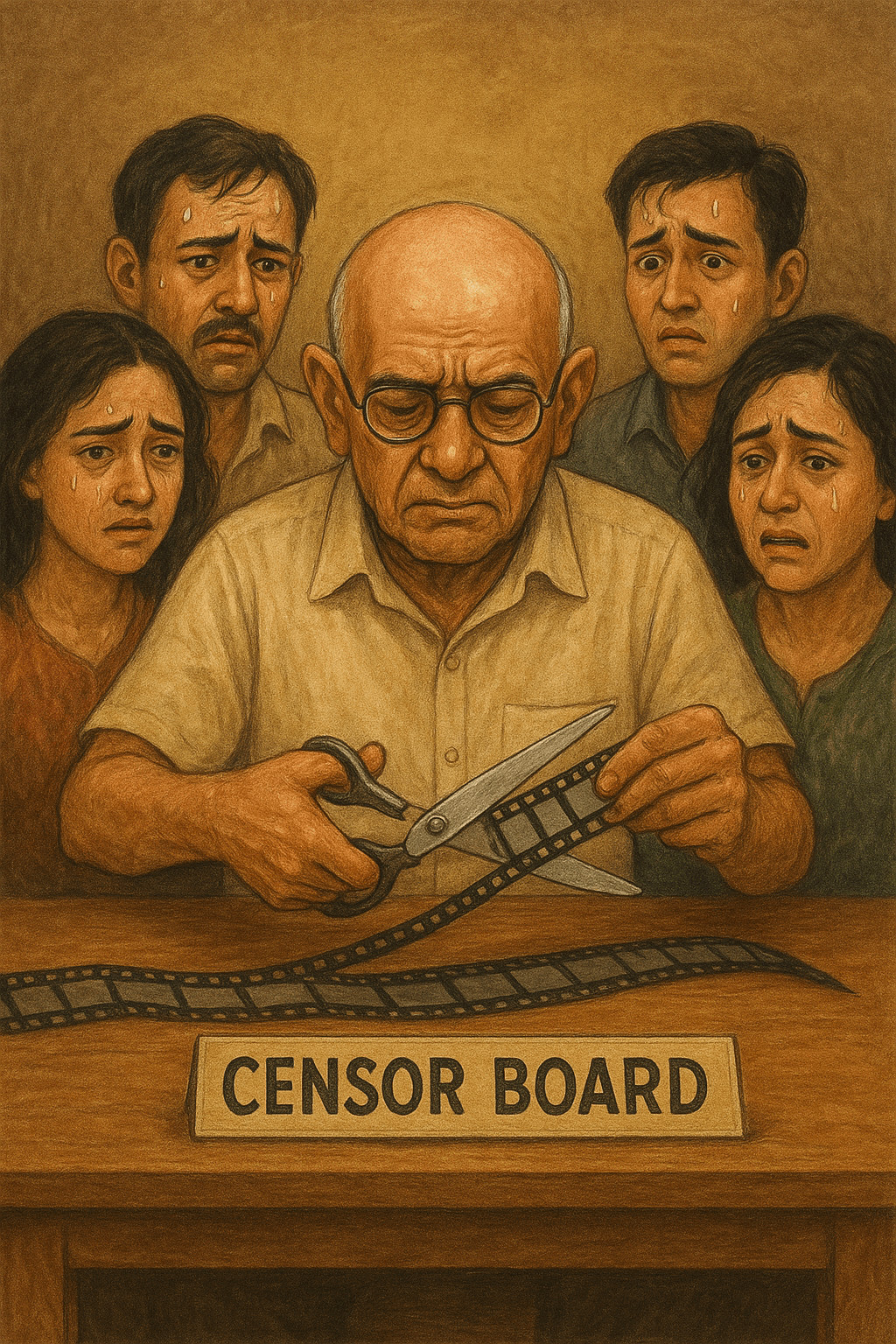
Who Really Decides What You Watch? The Truth About India’s Movie “Censor” Board
I. Introduction:
Are You an Adult—or Still Treated Like a Child?
Censorship of movies often go unnoticed. Have you ever wondered why certain scenes disappear from movies, or why films come with unexpected cuts and disclaimers—even after being “approved”? The answer lies with India’s Central Board of Film Certification (CBFC). Officially, this body certifies films for public viewing, deciding which age groups can watch them. But in reality, it often demands cuts and modifications, censoring stories before they reach you. No wonder everybody calls it Censor Board and not Certification Board. Recent legal battles around films like Udaipur Files , The Kashmir Files , The Kerala Story , and Janaki vs State of Kerala reveal a disturbing truth: this “certification” often hides censorship, suppressing creative freedom and your right to choose what to watch.
At the same time, the Government of India—through Prime Minister Narendra Modi—promises “Minimum Government, Maximum Governance” in nearly every public speech. But how does that square with a censor board acting like the “Censor Board of a Banana Republic,” arbitrarily controlling films in violation of law and democratic principles?
II. What the Law Says—and How It’s Ignored
What the Cinematograph Act, 1952 says:
- p]:pt-0 [&>p]:mb-2 [&>p]:my-0″>
The CBFC’s job is to classify films according to age-appropriateness (U, UA, A, S). - p]:pt-0 [&>p]:mb-2 [&>p]:my-0″>
It can refuse certification only if a film threatens sovereignty, decency, security, or public order. - p]:pt-0 [&>p]:mb-2 [&>p]:my-0″>
The Central Government can issue broad guidelines but cannot instruct the CBFC to censor films for political or moral reasons arbitrarily. - p]:pt-0 [&>p]:mb-2 [&>p]:my-0″>
Once the CBFC certifies a film, its decision should be final. Post-certification interference is unlawful.
What happens in reality:
- p]:pt-0 [&>p]:mb-2 [&>p]:my-0″>
The CBFC frequently demands cuts or alterations before certification—and sometimes the Government pressures post-certification changes. - p]:pt-0 [&>p]:mb-2 [&>p]:my-0″>
Films like Udaipur Files , The Kashmir Files and The Kerala Story faced bans, multiple legal challenges, and official edits after certification. - p]:pt-0 [&>p]:mb-2 [&>p]:my-0″>
This practice overrides the legal protections intended to safeguard free speech and creativity.
III. When Courts Stepped In: Defending Freedom of Expression
India’s courts have consistently held that artistic freedom and free expression are constitutionally protected:
- p]:pt-0 [&>p]:mb-2 [&>p]:my-0″>
In the Kashmir Files cases, the Bombay High Court and others dismissed pleas to ban the film, emphasizing the importance of free speech unless the certification process itself was violated. - p]:pt-0 [&>p]:mb-2 [&>p]:my-0″>
In Janaki vs State of Kerala , the Kerala High Court sharply curtailed the CBFC’s excessive demands—reducing 96 demanded cuts to just two, protecting the film’s integrity. - p]:pt-0 [&>p]:mb-2 [&>p]:my-0″>
The Delhi High Court, in the recent Udaipur Files case, struck down government orders for post-certification cuts, reaffirming that certification decisions must be final.
But these verdicts highlight a sad reality: filmmakers must approach courts repeatedly to safeguard their work from Censor Board —and by extension, your right to choose.
IV. The UK Model vs. India: Trusting Viewers, Respecting Creators
In the UK, films are classified and rated by the British Board of Film Classification (BBFC), which intervenes only when a film clearly breaks laws. After rating, no further government censorship occurs. Guidelines are public and transparent, building trust with artists and audiences alike. Issue India (CBFC) UK (BBFC) Role Often censors under the guise of certification Certifies and classifies honestly Post-certification power Government can order cuts even after approval No interference after rating Transparency Vague, inconsistent Clear, published, consistent Respect for Freedom Frequently compromised Actively respected
India needs to move from secretive censorship to transparent certification, honoring democratic values. It needs to censor the Censor Board.
V. The Political Contradiction: “Minimum Government” vs. Maximum Censorship
Prime Minister Narendra Modi’s widely repeated promise of “Minimum Government, Maximum Governance” sounds empowering. Yet, the CBFC’s heavy-handed regulation contradicts this vision—reflecting a “Banana Republic” style of arbitrary censorship. This mismatch is no harmless irony but a significant democratic failure that silences voices, undermines trust, and restricts creative freedom.
VI. What Needs to Change—and What You Can Demand
- p]:pt-0 [&>p]:mb-2 [&>p]:my-0″>
Clear, public, and fair rules for film certification— not censorship disguised as certification. - p]:pt-0 [&>p]:mb-2 [&>p]:my-0″>
No post-certification cuts or censorship , except in extremely rare, objectively justifiable cases. - p]:pt-0 [&>p]:mb-2 [&>p]:my-0″>
Transparency in decision-making with reasons publicly disclosed. - p]:pt-0 [&>p]:mb-2 [&>p]:my-0″>
Regional panels empowered to understand local contexts better. - p]:pt-0 [&>p]:mb-2 [&>p]:my-0″>
A CBFC that trusts both creators and audiences, living up to India’s constitutional values.
VII. Conclusion: Certification or Censorship—India Must Choose
India’s CBFC currently functions as a censor board dressed in certification’s clothes—trampling constitutional freedoms and ignoring Supreme Court and High Court rulings. The Government promises minimal interference, yet the censor board wields excessive power unchecked by transparency or fairness.
The recent court victories for Udaipur Files , The Kashmir Files , The Kerala Story , and others show the resilience of free speech. But relying on repeated judicial rescues cannot be the norm. India must reform its film certification system and restore trust in democracy, creativity, and your right to decide what stories you want to see.
Until then, the question remains: Are we really citizens entitled to choose freely, or subjects under the control of an overreaching whimsical “Censor Board of a Banana Republic”?
Leave a Response