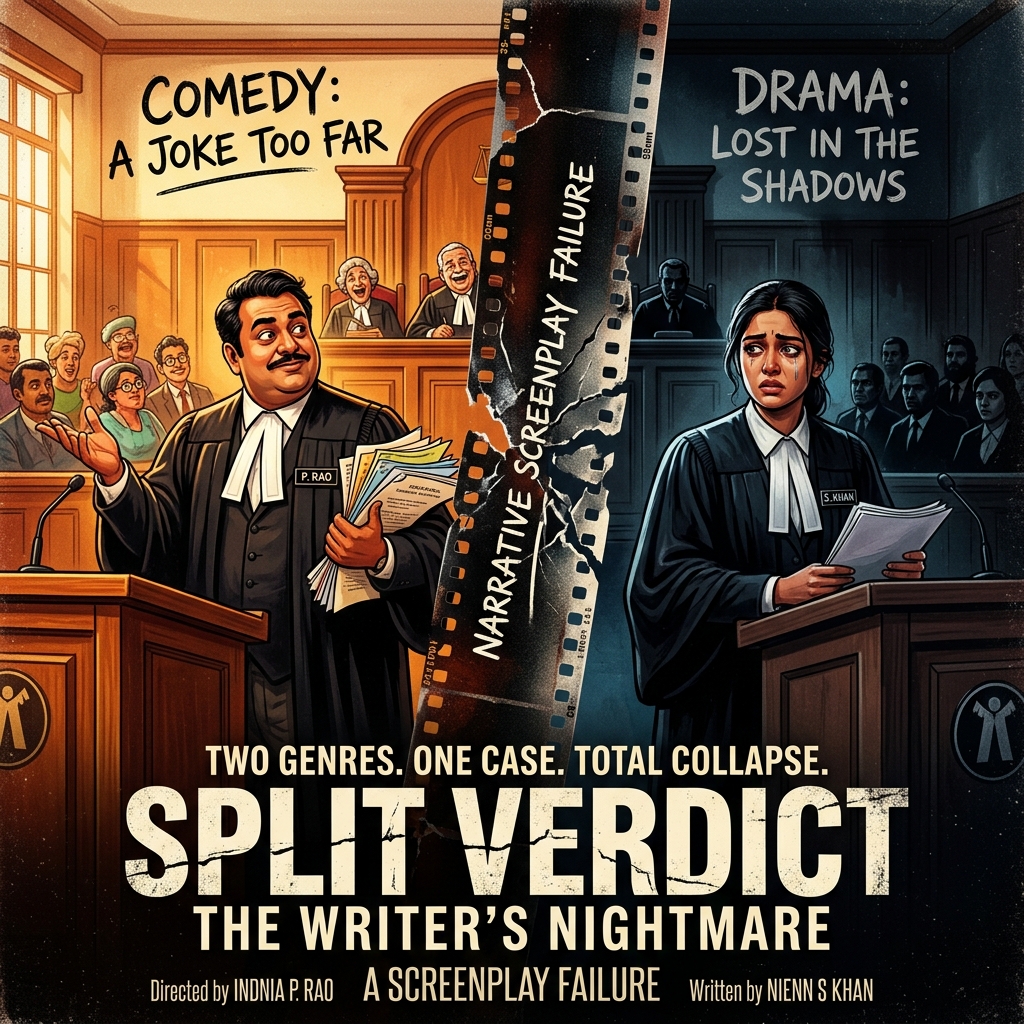
A post-mortem of Jolly LLB 3 in art and screenplay.
(Chapter 2)
In the previous chapter, we examined the economic numbers of Jolly LLB 3. Box office statistics showed how ticket price inflation covered for a collapsing audience. But economics only measures the symptom. The root cause lies in the craft, the screenplay architecture, and legal absurdities. In this chapter, we dissect the creative failure of the film.
The Gimmick Was the Pitch
Every franchise needs a creative engine for each installment. The engine cannot be the franchise name itself.
Jolly LLB 1 had a genuine story structure. An insecure small-town lawyer stumbles into a hit-and-run case. The case forces him to confront legal procedure versus actual justice. The case served as a vehicle for character change.
Jolly LLB 2 introduced a new lead character (Akshay Kumar) and a new city. It tackled a new moral crisis of fake police encounters. It expanded the franchise universe. Its scene of discovering a fake Hindu 'Brahmin' became a reel which is played everywhere to prove a point,
Jolly LLB 3 offered only a different case brief. That was the entirety of its creative proposition. Two characters from earlier films fought each other over a new set of facts.
A new case is not a new story. The case is merely the setting. Drama requires characters to face choices that cost them something. By Part 3, both Jollys were already established heroes. Neither character had room for an internal arc. The courtroom battle carried no psychological stakes. It showed two professionals doing their jobs competently. That is not inherently dramatic.
The central marketing hook ("two Jollys clash") was a visual concept. It was not a narrative concept. Within thirty minutes, the novelty of two men in black coats arguing was exhausted. The script had nothing prepared for the remaining runtime.
The Genre Fraud
The movie sold a false genre. Courtroom franchises operate on an implicit contract with their audience. The marketing establishes the terms. The film either honors those terms or breaches them. Promotions sold a high-spirited comedy. Two underdog lawyers, an eccentric judge, sharp courtroom wit, and comic procedural chaos. That is what ticket buyers paid for.
Within forty-five minutes, the film delivered a different product entirely.
The script introduced an elderly farmer's suicide over forged loan documents. Then a widowed daughter-in-law's suicide following character assassination. Then corporate smear campaigns, a sniper false-flag shooting, and police firings that killed protestors.
These tragedies were stacked without pause. The first two films maintained breathing room between serious catalysts and comic observation. In Part 3, the tragedies accumulated relentlessly. The comedy became an awkward interruption rather than organic satire.
By the midpoint, the protagonist ceased acting like a clever, small-town lawyer. He transformed into a 1970s Angry Young Man crusader. Courtroom arguments turned into political monologues directed at corporate power. The climax featured a camel cart driven into a corporate event alongside sloganeering.
This template had nothing to do with the franchise identity. Viewers felt trapped in a dark hall with a preachy melodrama. That breach of consumer trust generated immediate negative word-of-mouth.
The Script's Legal Problem
The plot pivots on a lawyer switching sides in active litigation. He previously represented one party. He then appears in the same matter arguing for the opponent.
This is not a clever legal trick. It is expressly prohibited under Rule 33, Section II of the Bar Council of India Rules:
"An advocate who has, at any time, advised in connection with the institution of a suit, appeal or other matter or has drawn pleadings, or acted for a party, shall not act, appear or plead for the opposite party."
Section 126 of the Indian Evidence Act reinforces this prohibition. All privileged communications between a lawyer and client are protected. A lawyer cannot use confidential disclosures against a former client.
Violation of these rules constitutes professional misconduct under Section 35 of the Advocates Act, 1961. Penalties include suspension or permanent debarment. In practice, opposing counsel would file a disqualification application on Day 1. Any presiding judge would remove the lawyer from the brief immediately.
In a light farce, procedural shortcuts are forgiven. Audiences grant leeway for whimsical comedy. But Jolly LLB 3 abandoned comedy for serious social drama. When a film demands to be taken seriously, its legal mechanics must hold real-world water.
The protagonist's entire courtroom intervention rests on an act that real courts would dismiss as professional misconduct. The plot at the center of Jolly LLB 3 is a gross violation of professional conduct law. The makers took audience for a ride or tried to do so.
Acting Alone Is Not Enough
The cast delivered competent performances. Each actor delivered its best. The movie is a lesson that good acting alone is not enough to make the movie a success.
Saurabh Shukla inhabited Justice Tripathi with familiar mastery. He captured the judicial weariness and procedural cynicism of a lower-court magistrate. Akshay Kumar and Arshad Warsi brought gravity to their dramatic scenes. The ensemble cast played their roles with earnestness.
However, committed acting cannot repair broken narrative architecture. When a story lacks internal logic, strong performances make structural gaps look more glaring.
The most telling evidence of script failure was the film's comedy highlight. The standout scene was Judge Tripathi's flustered romantic infatuation with a female police officer. Saurabh Shukla delivered a genuinely funny moment in a tangential subplot outside the central trial.
When the highlight of a courtroom drama becomes an irrelevant side-gag, the central theme has failed. When movie is remembered for scene unconnected with main theme, it is not a movie any more. It is an ensemble of comic reels put together with a political narrative.
The Recycled Courtroom
By Part 3, signature courtroom sequences became a formula checklist.
The judge pounds his gavel. He orders both lawyers to sit down. He delivers a closing homily on the letter of the law versus the spirit of justice. The dialogue directly inherited phrases from earlier installments.
In 2013, that speech worked. It was an earned moment culminating from real procedural tension. In 2025, the same speech became a script placeholder. When writers could not construct legal discovery or witty cross-examination turns, they substituted it with social sermons.
Most people, especially this generation called Gen Z, has no patience for a serious advice. The movie makes expectation that they will pay to watch for sermons only betrays their disconnect with consumer reality.
In the final chapter, we shall examine the political subtext, narrative built on repealed laws, electoral realities, and macro industry lessons.
Leave a Response