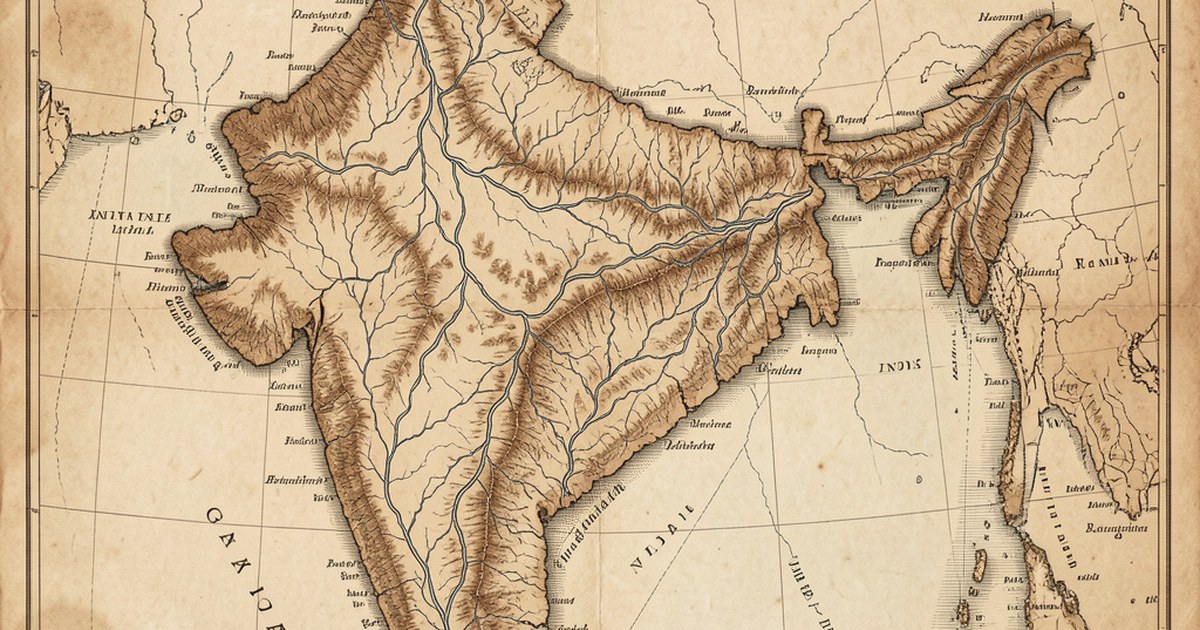
The Compulsion to Deny a Civilization
Western countries in Europe and the USA are accustomed to seeing India from the colonial lens of the British. How reliable are the British in this regard? There is a whole series of articles explaining the British colonial rule and how their behavior makes them failed humans.
The British, to justify their invasion and occupation of India, had to show that India was no civilisation. They named it 'India' and called the people 'Indians', which meant 'barbarians'. Later they changed their dictionaries to deny this historical fact.
To add insult to injury, the British divided all of India into multiple countries. Pakistan was the last division. The continent itself was called India before it was subdivided into different countries. Then the British and later the USA and the entire West started calling the Indian Subcontinent part of 'South Asia.'
It proved to be a fundamental mistake in understanding the ecology of India. Refusing to name the Indian Subcontinent correctly is a major source of Western epistemological problems. Conflating this landmass under the generic umbrella of South Asia creates massive intellectual confusion.
Other Asian regions like the Philippines or Indonesia do not face our specific tectonic and hydrological reality. They do not have weather cycles like India. They certainly do not have the monsoon like India.
Global institutions intentionally popularized South Asia to make India politically insignificant. This deliberate renaming creates bad education, flawed policy, and disastrous civil engineering. Substituting South Asia for the Indian Subcontinent is not neutral administrative language. It is an epistemological distortion that erases physical geography.
Decoupling regional identity from underlying geology destroys civilizational memory.
The Epistemological Consequences of Bad Politics
Erasing the Indian Subcontinent operates as an intellectual cover across three distinct levels.
1. Destruction of Tectonic and Hydrological Realities
The Indian Subcontinent is not an arbitrary political creation. It is an independent tectonic plate. This plate broke from Gondwana, surged northward, and smashed into Eurasia to form the Himalayas. That massive collision created a unique physical amphitheater.
The Himalayan wall traps Indian Ocean monsoon moisture, feeding the Indus, Ganga, and Brahmaputra river basins.
Archipelagos like Indonesia sit along the Pacific Ring of Fire under maritime volcanic regimes.
Lumping both together under generic tags like South Asia ignores basic geology. The Indian Subcontinent functions as a single closed thermodynamic machine.
2. Erasure of Shared River Basin Reality
Calling this region South Asia treats India, Pakistan, Nepal, and Bangladesh as isolated geopolitical boxes. In fact, Tibet and its river systems are also part of the river system. But Chinese occupation of Tibet has appropriated the region politically.
Monsoon rain does not stop at political borders. River sediment does not consult visas before flowing down the Kosi River into the Gangetic plains. The entire drainage network from high snow peaks to the Sundarbans delta is one contiguous basin.
Erasing the singular identity of the Indian landmass allows tourists as well as politicians to ignore their shared physical destiny. Weather experts also take a tongue-in-cheek approach and avoid speaking bluntly about the geographical reality.
3. Epistemic Inversion and Moral Invisibility
International discourse uses South Asia to avoid centering India in regional studies. This administrative neutralization discards centuries of indigenous ecological science.
Traditional hydrology developed specific solutions for subcontinental extremes. Regional systems like Himachal Kul channels, Bihar Ahar-Pyne networks, and Western stepwells managed violent water pulses.
Stripping civilizational names from the land divorces people from their environmental grammar. Global tourists then treat this volatile tectonic plate as just another generic tropical vacation spot.
Bad naming inevitably produces bad policy, incompetent engineering, and blind travelers.
Leave a Response