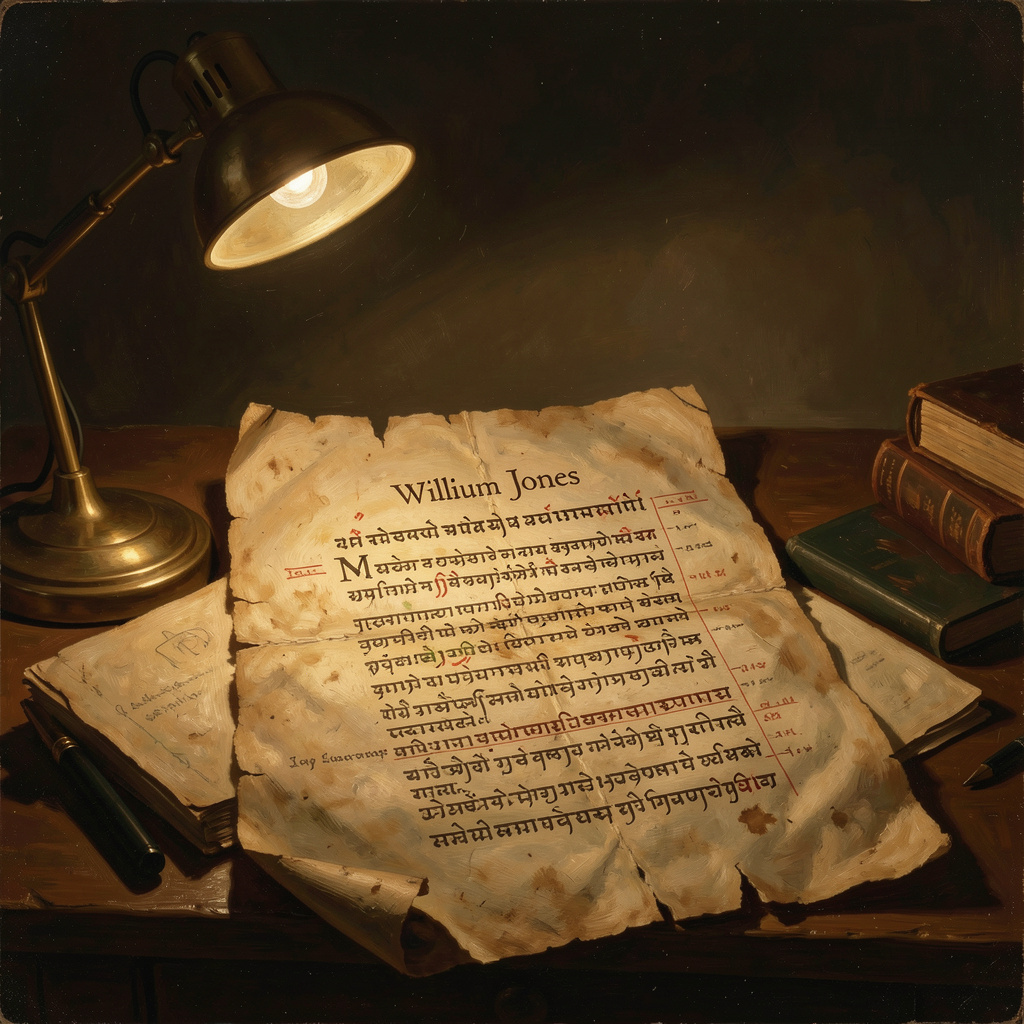
Chapter 6: On Devotion; or on the Third and Fourth Orders
1. HAVING thus remained in the order of a housekeeper, as the law ordains, let the twice-born man, who had before completed his studentship, dwell in a forest, his faith being firm and his organs wholly subdued.
2. When the father of a family, perceives his muscles become flaccid and his hair gray, and sees the child of his child, let him then seek refuge in a forest :
3. ‘ Abandoning all food eaten in towns, and all his household utensils, let him repair to the lonely wood, committing the care of his wife to her sons, or accompanied by her, if she choose to attend him .
4. ‘ Let him take up his consecrated fire, and all his domestic implements of making oblations to it, and, departing from the town to the forest, let him dwell in it with complete power over his organs of sense and of action .
5. ‘ With many sorts of pure food, such as holy sages used to eat, with green herbs, roots, and fruit, let him perform the five great sacraments before mentioned, introducing them with due ceremonies.
6. ‘ Let him wear a black antelope’s hide, or a vesture of bark ; let him bathe evening and morning ; let him suffer the hairs of his head, his beard, and his nails to grow continually.
7. * From such food, as himself may eat, let him, to the utmost of his power, make offerings and give alms ; and % with presents of water, roots, and fruit, let him honor those, who visit his hermitage.
8. ‘Let him be constantly engaged in reading the Vtda; patient of all extremities/ universally benevolent, with a mind lritent on the Supreme Being ; a perpetual giver, but no receiver of gifts ; with tender affection for all animated bodies. 9* ‘ Let him, as the law directs, make oblations on the hearth with three sacred fires ; not omitting in due time the ceremonies to be performed at the conjunction and opposition of the moon.
10. * Let him also perform the sacrifice ordained in honor of the lunar constellations, make the prescribed offering of new grain, and solemnize holy rites every four months, and at the winter and summer solstices.
11. ‘With pure grains, the food of ancient sages, growing in the vernal and autumnal seasons, and brought home by himself, let him severally make, as the law ordains, the oblations of cakes and boiled grain ; ■»
12. ‘And, having presented to the gods, that purest oblation, which the wild woods produced, let him eat what remains, together with some native salt, which himself collected.
13. ‘ Let him eat green herbs, flowers, roots, and fruit, that grow on earth or in water, and the productions of pure trees, and oils formed in fruits.
14. ‘ Honey and fleshmeat he must avoid, and all sorts of mushrooms, the plant bMstrlna , that named sigkruca, and the fruit of the flfchmataca.
15. ‘In the month A'swina let him castaway the food of sages, which he before had laid up, and his vesture, then become old, and his herbs, roots, and fruit.
16. ‘ Let him not eat the produce of ploughed land, though abandoned by any man, who owns it> nor fruit and roots produced in a town, even though hunger oppress him.
17. ‘ He may eat what is mellowed by fire, and he may eat what is ripened by time ; and either let him break, hard fruits witfci a stone, or let his teeth serve as a pestle.
18. ‘Either let him pluck enough for a day, or let him gather enough for a month ; or let him collect enough for six months, or lay up enough for a ^ear. t
19. ‘ Having procured food, as he ?s able, he may cat it at 1 14 ON DEVOTION ; OR ON THE eve or “in the morning or he may take only every fourth, or every eighth , such regular meal ;
20. ‘ Or, by the rules of the lunar penance, he may eat a mouthful less each day of the bright , and a mouthful more each day of the dark, fortnight ; or he may eat only once, at the close of each fortnight, a mess of boiled grains :
21. * Or he may constantly live on flowers and roots, and on fruit matured by time, which has fallen spontaneously, strictly observing the laws ordained for hermits,
22. * Let him slide backwards and forwards on the ground ; or let him stand a whole day on tiptoe ; or let him continue in motion rising and sitting alternately ; but at sunrise, at noon, and at sunett, let him go to the waters and bathe.
23. * In the hot season, let him sit exposed to five fires, four biasing around him with the sun above ; in the rains, let him stand uncovered, without even a mantle , where the clouds pour the heaviest showers ; in the cold season, let him wear humid vesture ; and let him increase by degrees the austerity of his devotion :
24. ‘ Performing his ablution at the three Savanas, let him give satisfaction to the manes and to the gods ; and, enduring harsher and harsher mortifications, let him dry up his bodily frame.
25. ‘ Then, having reposited his holy fires, as the law directs, in his mind, let him live without external fire, without a mansion, wholly silent, feeding on roots and fruit ;
26. ‘ Not solicitous for the means of gratification, chaste as a student, sleeping on the bare earth, in the haunts of pious hermits, without one selfish affection, dwelling at the roots of trees.
27. * From devout Brdhmens let him receive alms to support life, or from other housekeepers of twice-born classes, who dwell in the forest : *
28. * Or the hermit may bring food from a town, having received it in a basket of leaves, in his naked hand, or in a potsherd ; and then let him swallow eight mouthfuls. <
29. ‘ These and other fules must a Brdhmeny who retires to IXS the woods, diligently ptactise ; and, for the purpose of uniting his soul with the divine spirit, let him study the various Upanishads of scripture, or chapters of the essence and attributes of God \
30. 4 Which have been studied with reverence by anchorites versed in theology, and by housekeepers, who dwelt afterwards in forests, for the sake of increasing their sublime knowledge and devotion, and for the purification of their bodies.
31. ‘Or, if he has any incurable disease K let him advance in a straight path, towards the invincible north eastern point, feeding on water and air, till his mortal frame totally decay, and his soul become united with the Supreme.
32. 4 A Brdhmen , having shuffled off his body by any of those modes, which great sages practised, and becoming void of sorrow and fear, rises to exaltation in the divine essence.
33. 4 Having thus performed religious acts in a forest during the third portion of his life, let him become a Sannydsi fur the fourth portion of it, abandoning all sensual affections, and wholly reposing in the Supreme Spirit :
34. 4 The man, who has passed from order to order, has made oblations to fire o?i his respective changes of state} and has kept his members in subjection, but, tired with so long a course of giving alms and making offerings, thus reposes himself entirely on GOD, shall be raised after death to glory.
35. 4 When he has paid his three debts to the sages , the manes , and the gods , let him apply his mind to final beatitude ; but low shall He fall, who presumes to seek beatitude, without having discharged those debts :
36. 4 After he has read the V/das in the form prescribed by law, has legally begotten a son, and has performed sacrifices to the best of his power, he has paid his three debts , and may then apply his heart to eternal bliss ;
137. 4 But if a Brdhmen have not read the V/da, if he have not begotten a son, and if he have not performed sacrifices, yet shall aim at final beatitude, he shall sink to a place of degradation. I
38. 4 Having performed the sacrifice of PrajaTeti, accompanied with # gift of all his wealth,' "and having reposited in his 1136 wind the sacrificial fires, a Brdhmen rrtey proceed from his house, that is , from the second order, or he may proceed even from the first ; to the condition of a Sannydsi.
39. 1 Higher worlds are illuminated with the glory of that man, who passes from his house into the fourth order, giving exemption from fear to all animated beings, and pronouncing the mystic words of the Veda :
40. ‘To the Brdhmen , by whom not even the smallest dread has been occasioned to sentient creatures, there can be no dread from any quarter whatever, when he obtains a release from his mortal body.
41. ‘Departing from his house, taking with him pure implements ; hif waterpot and staff, keeping silence, unallured by desire of the objects near him, let him enter into the fourth order.
42. ‘ Alone let him constantly dwell, for the sake of his own felicity : observing the happiness of a solitary man, who neither forsakes nor is forsaken, let him live without a companion.
43. 4 Let him have no culinary fire, no domicil ; let him, when very hungry , go to the town for food ; let him patiently bear disease ; let his mind be firm ; let him study to know God, and fix his attention on God alone.
44. ‘ An earthen waterpot, the roots of large trees, coarse vesture, total solitude, equanimity toward all creatures, these are the characteristics of a Brdhmen set free.
45. ‘ Let him not wish for death, let him not wish for life, let him expect his appointed time, as a hired servant expects his wages.
46. ‘ Let him advance his foot purified by looking down, lest he touch any thing impure ; let him drink waterf purified by straining with a cloth, lest he hurt some insect ; let him, if he choose to speak, utter words purified by truth ; let him by all means keep his heart purified. 447. ‘ Let him bear a reproachful speech with patience ; let him speak reproachfully to no man; let him not, on account of this frail and serverish body, ehgage in hostility with any one living.
48. * With an angry nlan let him not in his turn be angry ; abused, let him speak mildly ; nor let him utter a word relating to vain illusory things and confined within seven gates, the five organs of sense , the hearty and the intellect ; or this world, with three above and three below it .
49. * Delighted with meditating on the Supreme Spirit sitting fixed in such meditation, without needing any thing earthly, without one sensual desire, without any companion but his own soul, let him live in this world seeking the bliss of the next.
50. ‘ Neither by explaining omens and prodigies, nor by skill in astrology and palmestry, nor by casuistry and expositions of holy texts, let him at any time gain his daily support.
51. ‘Let him not go near a house frequented by hermits, or priests, or birds, or dogs, or other beggars.
52. ‘ His hair, nails, and beard being clipped, bearing with him a dish, a staff, and a waterpot, his whole mind being fixed on God, let him wander about continually, without giving pain to animal or vegetable beings. 53- ‘ His dishes must have no fracture, nor must they be made of bright metals : the purification ordained for them must be with water alone, like that of the vessels for a sacrifice.
54. ‘ A gourd, a wooden bowl, an earthen dish, or a basket made of reeds, has Menu, son of the Self-existing, declared fit vessels to receive the food of Brdhmens devoted to God.
55. ‘Only once a day let him demand food; let him not habituate him to eat much' at a time ; for an anchorite, habituated to eat much, becomes inclined to sensual gratifications.
56. ‘At the time when the smoke of kitchen fires has ceased, when the pestle lies motionless, when the burning charcoal is extinguished, when people have eaten and when dishes arc removed, that is, late in the day, let the Sannydsi always beg food. §7. ‘ For missing it, let him care only for a sufficiency to support life, but let him not be anxious about his utensils.
58. ‘ Let him constantly disdain to receive food after humble reverence ; since, by receiving it in consequence of an humble salutation, a Sannydsi , though free, becomes a captive. ON DEVOTION; OR ON THE
59. * By eating little and by setting in solitary places, let him restrain those organs, which are naturally hurried away by sensual desires.
60. ‘ By the coercion of his members, by the absence of hate and affection, and by giving no pain to sentient creatures, he becomes fit for immortality.
61. ‘ Let him reflect on the transmigrations of men caused by. their sinful deeds, on their downfal in to a region of darkness and their torments in the mansion of Yama ;
62. 1 On their separation from those, whom they love, and their union with those, whom they hate, on their strength overpowered .by old age, and their bodies racked with disease ;
63. * 1 On their agonizing departure from this corporeal frame, their formation again in the womb, and the glidings of this vital spirit through ten thousand millions of uterine passages ;
64. ‘ On the misery attached to embodied spirits from a violation of their duties, and the unperishable bliss attached to them from their abundant performance of all duties, religious and civil.
65. .* Let him reflect also, with exclusive application of mind, on the subtile indivisible essence of the Supreme Spirit, and its complete existence in all beings, whether extremely high or extremely low.
66. * Equalminded towards all creatures, in what order soever he may have been placed, let him fully, discharge his duty, though he bear not the visible marks of his order : the visible mark, or mere name , of his order is by no means an effective discharge of his duty ;
67. 4 As, although the fruit of the tree cataca purify water, yet a man cannot purify water by merely pronouncing the name of that fruit : he must throw it, when pounded , into the jar .
68. * For the sake of preserving minute animals by nighi and by day, let him walk, though with pain to his own body, perpetually looking on the ground. «•
69. * Let a Sannydsi, py way of expiation for the death of those creatures, which he may have destroyed uflkncwingly by day THIRD AND FOURTH ORDERS. II9 or by night, make six suppressions of his breath, having duly bathed ; • » y
70. ‘ Even three suppressions of breath made according to the divine rule, accompanied with the triverbal phrase (bhurbhuvak swak) and the triliteral syllable (Am), may be considered as the highest devotion of a Brdhmen ;
71. * For as the dross and impurities of metallic ores are consumed by fire, thus are the sinful acts of the human organs consumed by suppressions of the breath, while the mystic wordst and the measures of the gayatrl are revolved in the mind ’
72. ‘ Let him thus by such suppressions of breath burn away his offences ; by reflecting intensely on the steps of ascent to beatitude, let him destroy sm / by coercing his members, let him restrain all sensual attachments ; by meditating on the intimate union of his own soul and the divine essence, let him extinguish, all qualities repugnant to the nature of God.
73. * Let him observe, with extreme application of mind, the progress of this internal spirit through various bodies, high and low ; a progress hard to be discerned by men with unimproved intellects.
74. ‘ He, who fully understands the perpetual omnipresence of God, can be led no more captive by criminal acts ; but he, who possesses not that sublime knowledge, shall wander again through the world.
75. ‘ By injuring nothing animated, by subduing all sensual appetites, by devout rites ordained in the Vdda} and by rigorous mortifications, men obtain, even in this life, the state of beatitude.
76. 1 A mansion with bones for its rafters and beams ; with nerves and tendons, for cords ; with muscles and blood, for mortar ; with skin, for its outward covering ; filled with no sweet perfume, tyat loaded with feces and urine ;
77. * A mansion infested by age and by sorrow, the seat of malady, harrassed with pains, haunted with the quality of darkness, and incapable of standing long ; such a mansion of the vital soul let its occupier always cheerfully quit :
78. c As a tree leaves the bank of a river when it fails in, or as a bird leaves the branch of a tree at his pleasure, thus he, who leaves his body necessity or by legal choice , is delivered from the ravening shark, or crocodile, of the world.
79. ‘ Letting his good acts descend (by the law the Vdda) to those, who love him, and his evil deeds, to those, who hate him, he may attain, through devout meditation, the eternal spiriti
80. 4 When, having well considered the nature and consequence of sin, he becomes averse from all sensual delights, he then attains bliss in this world ; bliss, which shall endure after death.
81. 4 Thus, having gradually abandoned all earthly attachments, and indifferent to all pairs of opposite things, as honor and dishonor, and the like, he remains absorbed in the divine essence.
82. 4 All, that has now been declared, is obtained by pious, meditation; but no man, who is ignorant of the Supreme Spirit, can gather the fruit of mere ceremonial acts.
83. 4 Let him constantly study that part of the Vdda, which relates to sacrifice ; that, which treats of subordinate deities ; that, which reveals the nature of the supreme God ; and whatever is declared in the Upanishads.
84. 4 This holy scripture is a sure refuge even for those, who understand not its meaning, and of course for those, who understand it ; this Veda is a sure resource for those, who seek bliss above, this is a stire resource for those, who seek bliss eternal.
85. 4 That Brdhmen, who becomes a Sannydsi by this discipline, announced in due order, shakes off sin here below, and reaches the most high. g6. 4 This general law has been revealed to you for anchorites with subdued minds : now learn the particular discipline of those, who become recluses according to the Vfda, that is, ofvancho* rites in the first of the four degrees .
87. 4 The student, the married man, the hermit, and the anchorite, are the offspring, though in four orders, of married men keeping house ;
88. * And all, or even any, of those orders, assumed in their turn, according to the sacred ordinances, lead the Brahmen , who acts by the preceding rules, to the highest mansion :
89. ‘ But of all those, the housekeeper, observing the regulations of the Sruti and Smrtti , may be called the chief ; since he supports the three other orders .
90. ‘ As all rivers, female and male, run to their determined place in the sea, thus men of all other orders, repair to their fixed place in the mansion of the housekeeper.
91. ‘By Brdhmens , placed in these four orders, a tenfold system of duties must ever be sedulously practised :
92. ‘ Content, returning good for evil, resistance to sensual appetites, abstinence from illicit gain, purification, coercion of the organs, knowledge of scripture, knowledge of the supreme spirit, veracity, and freedom from wrath, from their tenfold system of duties.
93. ‘ Such Brdhmens , as attentively read the ten precepts of duty, and after reading, carefully practise them, attain the most exalted condition.
94. * A Brdhmen , having practised, with organs under command, this tenfold system of duty, having heard the UpanisJiads explained, as the law directs, and who has discharged his three debts, may become an anchorite, in the house of his sony according to the Vthia ;
95. ‘And, having abandoned all ceremonial acts, having expiated all his offences,- having obtained a command over his organs, and having perfectly understood the scripture, he may live at his case, while the household affairs are conducted by his son.
96. ‘ When he thus has relinquished all forms, is intent on his own occupation, and free from every other desire, when, by devoting himself to God, he has effaced sin, he then attains the supreme path of glory.
97. ‘ This fourfold regulation for the sacerdotal class, has thus been made known to you ; adjust regulation, producing endless fruit after death: next, learn the duty of kings, or the military class.1
Leave a Response