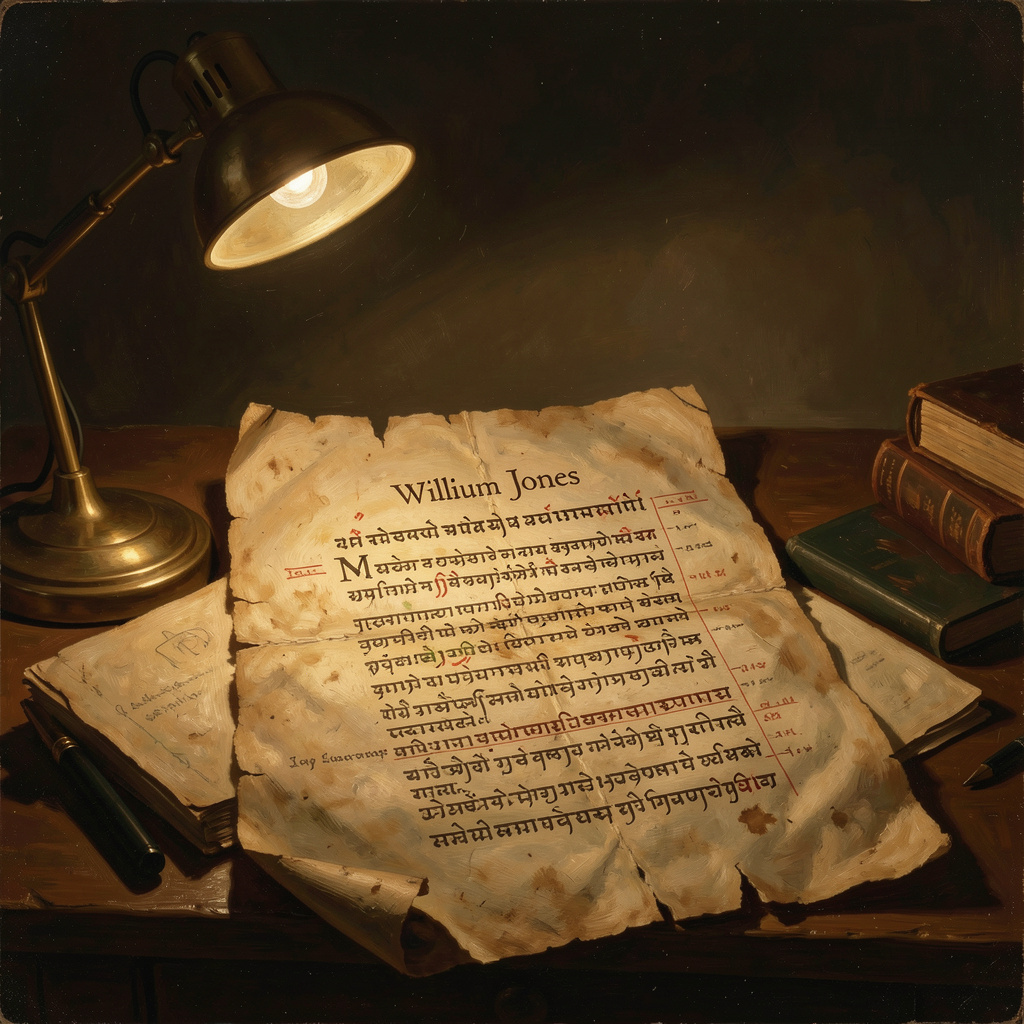
Chapter 2: On Education; or on the Sacerdotal Class, and the First Order
1. -^NOW that system of duties, which is revered by such as are learned in the V/das , and impressed, as the means of attaining beatitude, on the hearts of the just, who are ever exempt from hatred and inordinate affection.
2. 1 Self-love is no laudable motive, yet an exemption from self-love is not to be found in this world : on self-love is grounded the study of scripture, and the practice of actions recommended in it.
3. * Eager desire to act has its root in expectation of sonic advantage ; and with such expectation are sacrifices performed : the rules of religious austerity and abstinence from sin arc all known to arise from hope of remuneration.
4. ‘ Not a single act here below appears ever to be done by a man free from* self-love : whatever he performs, it is wrought from his desire of a reward. • f
5. ‘ He, indeed, who should persist in discharging these duties without any view to their fruit, would attain hereafter the state of the immortals,, and, even irt this life, would enjoy all the virtuous gratifications, that his fancy could suggest* ON THE FIRST ORDER.
216. The roots of law are the whole Vida, the ordinances and moral practice; of su:h as perfectly understand it, the immemorial customs of good men, and, incases quite indifferent , self-satisfaction.
7. ‘ Whatever law has been ordained for any person by Menu, that law is fall/ declared in the Veda: for He was perfect in divine knowledge :
8. ‘A man of true learning, who has viewed this complete system with the eye of sacred wisdom, cannot fail to perform all those duties, which are ordained on the authority of the V£da, .
9. ‘ No doubt, that man, who shall follow the rules prescribed in the Sruti and the Smriti , will acquire fame in this life, and, in the next, inexpressible happiness :
10. ‘*13 y Sruti, ox what was heard from above, is meant the VJda ; and by Smriti , or what zvas remembered from the beginning, the body of law : those two must not be oppugned by heterodox arguments ; since from tho>e two proceeds the whole system of duties.
11. ‘ Whatever man of the three highest classes, having addicted himself to heretic d book-, shall treat with contempt those two roots of law, he mu 4 be driven, as an Atheist and a scorncr of revelation, from the company of the virtuous. *
12. ‘ The scripture, the code; of law, approved usage, and, in all indifferent cases , self-satisfaction, the wise have openly declared to be the quadruple description of the juridical system.
13. * A knowledge of right is a sufficient incentive for men unattached to wealth or to sensuality ; and to those who seek a knowledge of right, th: supreme authority is divine revelation ;
14. ‘ But, when there arc two sacred texts apparently inconsistent, both are held to be law ; for both arc pronounced by the wise to be valid and reconcileable ;
15. 'Thus in the VJda arc these texts: “ let the sacrifice be when the sun has arisen,” and, “ before it has ri$en,” and, “when neither sun nor stars can be seen the sacrifice, therefore, may be performed at any or all of those times. k6. ‘He, whose life is regulated by holy texts, from his conception even tp his funeral pile, has 4 decided right to study this code ; but no other man whatsoever.' \ ^
17. ‘BETWEEN the two divine rivers Saraswa\ wan THE f?AMAKRISH*A MiSfJOM a LitHA nr ON EDUCATION ; OR adwati lies the tract of land, which the sages have named Brahmdverta , because it was frequented by Gods : 1 8. * The custom, preserved by immemorial tradition in that country, among the four pure classes, and among those which are mixed, is called approved usage.
19. 1 Cumcshitra , Matsya , Panchdla, cr Cdnyacubja, and Stirasinay or Mat'hurd , form the region, called Brahmarski , distinguished from Brakmdverta:
20. ‘ From a Brdhmen, who was born in that country, let all men on earth learn their several usages. 2 1. ‘That country, which lies between Himawat and V indhya, to the east of Vinasana , and to the west of Praydga, is celebrated by the title of Medhya - disay or the central region . . .22. ‘ As far as the eastern, and as far as the western, oceans between the two mountains just mentioned, lies the tract, which the wise have named Ary aver tay or inhabited by respectable men.
23. ‘ That land, on which the black antelope naturally grazes, is held . fit for the performance af sacrifices ; but the land of Mlich'has , or those who speak barbarously , differs widely from it.
24. ‘ Let the three first classes invariably dwell in those beforementioned countries ; but a Sudra , distressed for subsistence, may sojourn wherever he chooses.
25. ‘ Thus has the origin of law been succinctly declared to you, together with the formation of this universe : now learn the laws of the several classes.
26. ‘With auspicious acts prescribed by the Vida, must ceremonies on conception and so forth be duly performed, which purify the bodies of the three classes in this life, and qualify them for the next.
27. ‘ By oblations to fire during the mother’s pregnancy, by holy rites on the birth of the child, by the tonsure of his head with a lock of hair left on it, by the ligation of the sacrificial cord, are the feminal and uterine taints of the three classes wholly remoj/ed :
28. ‘ By studying the Vidh, by religious observances, by oblations to fire, by the ceremony of Traividia , by. offering to the Gods and Manesi by the procreation of children, by the five great ON THE FIRST ORDER. sacraments, and by solemn sacrifices, this human body is rendered fit for a divine state. •
29. ‘ Before the section of the naval string a ceremony is ordained on the birth of a male : he must be made, while sacred texts are pronounced, to taste a little honey and clarified butter from a golden spoon.
30. 1 Let the father perform or , if absent , cause to be performed, on the tenth or twelfth day after the birth, , the ceremony of giving a name ; or on some fortunate day of the moon, at a lucky hour, and under the influence of a star with good qualities.
31. ‘ The first part of a Brdhmen's compound name should indicate holiness ; of a Cshatriya's> power ; of a VaiSya's , wealth ; and of a Sudra'sy contempt :
32. ‘Let the second part of the priest’s name imply prosperity ; of the soldier’s, preservation ; of the merchants’ nourishment ; of the servants’, humble attendance.
33. ‘ The names of women should be agreeable, soft, clear, captivating the fancy, auspicious, ending in long vowels, resembling words of benediction.
34. ‘ In the fourth month the child should be carried out of the house to see the sun : in the sixth month, he should be fed with rice ; or that may be done , which, by the custom of the family, is thought most propitious.
35. * By the command of the VJday the ceremony of tonsure should be legally performed by the three first classes in the first or third year after birth .
36. 1 In the eighth year from the conception of a Brdhmeny in the eleventh from that of a Cshatriya , and in the twelfth from that of a Vaisya , let the father invest the child with the mark of his class :
37. * Should a Brdhmen or his father for him , be desirous of his advancement in sacred knowledge, a Cshatriya of extending his pow^r, ora. Vaisya of engaging in mercantile business, the investiture may be made in the fifth, sixtfy or eighth years respectively.
38. ‘The ceremony of investiture hallowed by the gdyatri must not be delayed, in the case of a priest, beyond the sixteenth. *4 ON EDUCATION ; OR year ; nor, in that of a soldier, beyond the twenty-second ; nor in that of a merchant, beyond the twenty-fourth.
39. ‘After that, all youths of these three classes, who have not been invested at the proper time, become ndyas , or outcasts, degraded from the gayatrl, and condemned by the virtuous :
40. ‘With such impure men, let no Brdltmen , even in distress for subsistence, ever form a connexion in law, either by the study of the Veda, or by affinity.
41. * Let students in theology wear for their mantles the hides of black antelopes, of common deer, or of goats with lower vests of woven sana, of eshitmd, and of wool, in the direct order of their classes.
42. ‘Tlfe girdle of a priest must be made of munja , in a triple cord, smooth and soft ; that of a warrior must be' a bow string of miirvd ; that of a merchant, a triple thread of sana .
43. ‘If the munja be not procurable, their zones must be formed respectively of the grasses cusa, asmdntaca, valvaja , in triple strings with one, three, or five knots, according to th: family custom.
44. ‘The sacrificial thread of a Brahmen must be made of cotton, so as to be pijt on over his head, in three strings ; that of a Cshatriya, of sana thread only ; that of a Vaisya of woollen thread.
45. ‘A priest ought by law to carry a staff of Bilva or Pa’dsa , a soldier, of Bata or Chadira ; a merchant of Venn, or Udumhara :
46. ‘ The staff of a priest must be of such a length as to reach his hair ; that of a soldier, to reach his forehead ; and that of a merchant, to reach his nose.
47. ‘ Let all the staves be straight, without fracture, of a handsome appearance, not likely to terrify men, with their bark perfect, unhurt by fire.
48. ‘ Having taken a legal staff to his liking, and standing opposite to the sun, let the student thrice walk round the fire from left to right, and perform, according to law, the ceremony of asking food :
49. ‘The most excellent of the three classes, being girt, with the sacrificial thread, must ask food with the respectful word b’lpy.itr, at the beginning of the phrase /those of the scco:xl class, with that word in the middle ; and those of the third, with that word at the end. ON THE FIRST ORDER.
50. * Let him first beg food of his mother, or of his sister, or of his mother’s whole sister ; and then of some other female who will not disgrace him.
51. ‘ Having collected as much of the desired food as he has occasion for, and having presented it without guile to his preceptor, let him eat some of it, being duly purified, with his face to the cast :
52. ' If he seeks long life, he should eat with his face to the cast ; if exalted same, to the south ; if prosperity, to the west ; if truth and its reward , to the north.
53. 'Let the student, having performed his ablution, always eat his food without distraction of mind ; and, having eaten, let him thrice wash his mouth completely, sprinkling with water the six hollow parts of his head, or his eyes , ears , and nostrils .
54. ' Let him honor all his food, and cat it without contempt ; when he secs it, let him rejoice and be calm, and pray, that he may always obtain it.
55. 'Food, eaten constantly with respect, gives muscular force and generative power ; but, eaten irreverently, destroys them both.
56. ‘ He must beware of giving any man what he leaves ; and of eating any thing between morning and evening: he must also beware of eating too much, and of going any whither with a remnant of his food unswallowed.
57. 'Excessive eating is prejudicial to health, to fame, and to future bliss in heaven ; it is injurious to virtue, and odious among men : he must, for these reasons, by all means avoid it.
58. ' Let a Brdhnicn at all times perform the ablution with the pure part of his hand denominated from the Veda, or with the part sacred to the Lord of creatures, or with that dedicated to the Gods ; but never with the part named from the Pitris :
59. ' The pure part under the root of the thumb is called BrdJima ; that at the root of the little finger, Gaya ; that at the tips of the fingers, Daiva; and the part between the thumb and index, 6c\ 'Let him first sip water thrice; then twice wipe his mouth ; and lastly ^oucli with water tltc sir before mentioned cavities, his breast, and his. head.
61. ‘ He, who knows the law, and-seeks purity, will ever perform ON EDUCATION ; OR *€> his ablution with the pure part of his hand, and with water neither hot nor frothy, standing in a lonely place, and turning to the east or the north.
62. ‘A Brdhmen is purified by water that reaches his bosom ; a Cshatriya , by water descending to his. throat ; a Vaisya , by water barely taken into his mouth ; a Siidra by water touched with the extremity of his lips.
63. ‘A youth of the three highest classes is named upavltl, when his right hand is extended for the cord to pass over his head and be fixed on kis left shoulder ; when his left hand is extended, that the thread may be placed on his right shoulder, he is called prdehlndvltl : and nivitl \ when it is fastened on his neck. *
64. ‘ His girdle, his leathern mantle, his* staff, his sacrificial cord, and his ewer, he must throw into the water, when they are worn out or broken, and receive others hallowed by mystical texts.
65. ‘The ceremony of ctsdnta , or cutting off the hair , is ordained for a priest in the sixteenth year from conception ; for a soldier, in the twenty-second ; for a merchant, two years later than that. •
66. * The same ceremonies, except that of the sacrificial thread, must be duly performed for women at the same age and in the same order, that the body may be made perfect ; but without any texts from the Vida :
67. * The nuptial ceremony is considered as the complete institution of women, ordained for them in* the Veda, together with reverence to their husbands, dwelling first in their fathers’ family, the business of the house, and attention to sacred fire.
68. ‘ Such is the revealed law of institution for the twice born ; an institution, in which their second birth clearly consists, and which causes their advancement in holiness : now learn to what duties they must afterwards apply themselves.
69. 1 The venerable preceptor, having girt his pupil with the thread, must first instruct him in purification, in good customs, in the management of the consecrated fire, and in the holy jjites of morning, noon, and evening. 0 ,
70. 1 When the student is going to read the Vdda , he must perform an ablution, as the law ordains, with his face to the north ; ON THE FIRST ORDER. * 7 and, having paid scriptural homage, he must receive instruction, wearing a clean vest, his members being duly composed : V1- 1 At the beginning and end of the lecture, he must always clasp both the feet of his preceptor ; and he must read with both his hands closed : (this is called scriptural homage.)
72. ‘With crossed hands let him clasp the feet of his tutor, touching the left foot with his left, and the right with his right, hand.
73. 1 When he is prepared for the lecture, the preceptor, constantly attentive, must say : “ hoa ! read ; ” and, at the close of the lesson, he must say : “ take rest”
74. * A Brdhmen , beginning and ending a lecture on the V6da, must always ‘pronounce to himself the syllable 6m; for, unless the syllabic 6m precede, his learning will slip away from him ; and, unless it follow, nothing will be long retained.
75. 1 If he has sitten on culms of cusa with their points toward the cast, and be purified by rubbing that holy grass on both his hands, and be further prepared by three suppressions of breath, each equal in time to five short vowels , he then may fitly pronounce 6m.
76. ‘ Brahma' milked out, as it were , from the three Vedas, the letter A, the letter U, and the letter M, which form , by their coalition , the trilitcral monosyllable , together with three mysterious words, bhur , bh avail, swer , or earth , sky , heaven :
77. ‘ From the three Vddas also the Lord of creatures, incomprehensibly exalted, successively milked out the three measures of that ineffable text, beginning with the word tad , and entitled sdvitri or gay at rl.
78. ‘ A priest who shall know the V6da, and shall pronounce to himself, both morning and evening, that syllable, and that holy text preceded by the three words, shall attain the sanctity which the Vdda confers ;
79. 'And a twice born man, who shall a thousand times repeat those three (or 6m , the vydhifitis , and the gdyatrQ apart from the multitude , shall be released ig a month even from a great offence, as a snake from his slough. ON EDUCATION; OR
80. ‘The priest, the soldier, and the merchant, who shall neglect this mysterious text, and fail to perform in due season his peculiar acts of piety, shall meet with contempt among the virtfious.
81. ‘ The three great immutable words, preceded by the trilitcr syllable, and followed by the gdyatrl , which consists of three measures, must be considered as the mouth, or principal part, of the Veda :
82. ‘ Whoever shall repeat, day by day for three years, without negligence, that sacred text, shall hereafter approach the divine essence, move as freely as air, and assume an ethereal form.
83. ‘The trilateral monosyllable is an emblem of the Supreme; the suppressions of breath with a mind .fixed on Gon, are the highest devotion ; but nothing is more exalted than the gdyatrl : a declaration of truth is more excellent than silence.
84. ‘All rites ordained in the Veda, oblations to fire, and solemn sacrifices, pass away ; but that, which passes not away, is declared to be the syllable 6m, thence called aeshara ; since it is .a symbol of God, the Lord of created Beings.
85. ‘The act( of repeating his Holy Name is ten times better than the appointed sacrifice ; a hundred times better, when it is heard by no man ; and a thousand times better, when it is purely mental :
86. ‘ The four domestic sacraments, which arc accompanied with the appointed sacrifice, are not equal, though all be united, to a sixteenth part of the sacrifice performed by a repetition of the gdyatrl :
87. ‘ By the sole repetition of the gdyatrl, a priest may indubitably attain beatitude, let him perform, or not perform, any other religious act ; if he be Maitra, or a friend to all creatures, he is justly named Brdhmena, or united to the Great One .
88. ‘ In restraining the organs, which run wild among ravishing sensualities, a wise man will apply diligent care, like a charioteer in managing restive horses. f
89. ‘ Those eleven organs, to which the first sages gave names, i-will comprehensibly enumerate, as the Law considers them, in {due ojrder, ON THE FIRST ORDER. *9 go. t The nose is the fifth, after the ears, the skin, the eyes, and the tongue ; and the organs of speech are reckoned the tenth, after th0se of excretion and generation, and the hands and feet :
91. ‘Five of them, the car and the rest in succession, learned men have called organs of sense ; and the others, organs of action :
92. * The heart must be considered as the eleventh ; which, by its natural property, comprises both sense and action ; and which being subdued, the two other sets, with five in each, are also controlled.
93. ‘A man, by the attachment of his organs to sensual pleasure, incurs certain guilt ; but, having wholly subdued them, he thence attains heavenly bliss.
94. ‘ Desire is never satisfied with the enjoyment of desired objects ; as 4hc fire is not appeased with clarified but’tcr : it only, blazes more vehemently.
95. ‘Whatever man may obtain all those gratifications; or whatever man may resign them completely, the resignation of all pleasures is far better than the attainment of them.
96. ‘ The organs, being strongly attached to sensual delights, cannot so effectually be restrained by avoiding incentives to pleasure, as by a constant pursuit of divine knowledge.
97. ‘To a man contaminated by sensuality neither the VSdas, nor liberality, nor sacrifices, nor strict observances, nor pious austerities, ever procure felicity.
98. ‘ He must be considered as really triumphant over his organs, who, on hearing and touching, on seeing and tasting and smelling, what may please or offend the senses , neither greatly rejoices nor greatly repines :
99. ‘ But, when one among all his organs fails, by that single failure his knowledge of Go I) passes away, as water flows through one hole in a leathern bottle.
100. ‘ Having kept all his members of sense and action under control, and obtained also command over his heart, he will enjoy every^ advantage, even though he reduce not his body by religious austerities. ior. ‘At the morning twilight; let him stand repeating the gdyatrl , until he sees the sun ; and, at^vening twilight, let him repeat it sitting, until the stars distinctly appear : 3o ON EDUCATION ; OR
102. 1 He, who stands repeating it at the morning twilight, removes all unknown nocturnal sin ; and he, who repeats it sitting at evening twilight, disperses the taint, that has unknowingly been contracted in the day ;
103. ‘ But he, who stands not repeating it in the morning, and sits not repeating it in the evening, must be precluded, like a Siidra% from every sacred observance of the twice born classes.
104. ‘Near pure water, with his organs holden under control, and retiring with circumspection to some unfrequented place, let him pronounce the gdyatri, performing daily ceremonies.
105. ‘ In reading the V Mangas, or grammar , prosody , mathematics, and so forth, or even such parts of the Veda as ought constantly to be read, there is no prohibition on particular days ; nor in pronouncing the texts appointed for oblations to lire :
106. ‘ Of that, which must constantly be read, and is therefore called Brahmasatra, there can be no such prohibition ; and the oblation to fire, according to the Vida, produces good fruit, though accompanied with the text vasliat , which on other occasio?is must be intermitted on certain days.
107. ‘ For him,' who shall persist a whole year in reading the Vida, his organs being kept in subjection, and his body pure, there will always rise good fruit from his offerings of milk and curds, of clarified butter and honey.
108. ‘ Let the twice born youth who has been girt with the sacrificial cord, collect wood for the holy fire, beg food of his relations, sleep on a low bed, and perform such offices as may please his precejfcor, until his return to the house of his natural father.
109. ‘Ten persons may legallybe instructed in the Vida ; the son of a spiritual teacher ; a boy, who is assiduous ; one who can impart other knowledge ; one who is just ; one who is pure ; one who is friendly ; one who is powerful ; one who can bestow wealth ; one who is honest ; and one who is related by blood. no. ‘Let not a sensible teacher tell an y other what he is not asked, nor what he is asked improperly ; but let him, however intelligent, act in the multitude, as if he were dumb : * «
111. ‘Of the two persons, he, who illegally asks, and he, who illegally answers, one will die, or incur odium. ON THE FIRST ORDER. 3*
112. 'Where virtue, and wealth sufficient to secure it , are not foijpd, or diligent attention, at least proportioned to the holiness of the subject , in that soil divine instruction must not be sown : it would perish, like fine seed in barren land.
113. ‘A teacher of the V/da should rather die with his learning, than sow it in sterile soil, even though he be in grievous distress for subsistence.
114. 1 Sacred Learning, having approached a Brdhmen , said to him : I am thy precious gem ; preserve me with care ; deliver me not to a scorner ; (so preserved I shall become supremely strong)
115. ‘ But communicate me, as to a vigilant depositary of thy gem, to that student, whom thou shalt know to be pure, to have subdued his passions, to perform the duties of his order.
116. ‘ He, who shall acquire knozvledge of the V/da, without the assent of his preceptor, incurs the guilt of stealing the scripture, and shall sink to the region of torment. #II7. ‘From whatever teacher a student has received instruction, either popular, ceremonial, or sacred, let him first salute his instructor, when they meet.
118. A Bi dh men, who* completely governs his passions, though he know the gdyatri only, is more honorable than he, who governs not his passions, who cats all sorts of food \ and sells all sorts of co modities, even though he know the three Vedas. .719. ‘When a superior sits on a couch or bench, let not an inferior sit on it with him ; and, if an inferior be sitting on a couch, let him rise to salute a superior. The vital spirits Of a young man mount upwards to depart from him , when an elder approaches ; but, by rising and salutation, he recovers them.
121. ‘A youth, who habitually greets and constantly reveres the aged, obtains an increase of four things ; life, knowledge, fame, strength. 1I2. ‘After the word of salutation, a Brdhmen must address an elder, saying : “ I am such an one pronouncing his own name. • •
123. ‘ If any persons, through igmrance of the Sanscrit language, understand not the import of his name, to them should a learned 3* ON EDUCATION ; OR man say : “ It is I and in that manner he should address all classes of women.
124. ‘In the salutation he should pronounce, after his own name, the vocative particle bJios ; for the particle bhJs is held by the wise to have the same property with names fully expressed \
125. ‘A Brahmen , should thus be saluted in return : “ May’st thou live long-, excellent man !” and, at the end of his name, the vowel and proceeding consonant should be lengthened, with an acute accent , to three -syllabic moments, or short vowels.
126. ‘That Brdhmcn , who knows not the form of returning a salutation, must not be saluted by a man of learning : as a Sudray even so is hd
127. ‘ Let a learned man ask a priest, when ‘he meets him, if his .devotion prospers ; warrior, if lie is unhurt ; a merchant, if his wealth is secure ; and one of the servile class, if he enjoys good health ; using respectively the words , cus'alam, anamayam, eshemam, and drogyam.
128. ‘He, who has just performed a solemn sacrifice Und ablution, must notf be addressed by his name, even though he be a younger man ; but he, who knows the law, should accost him with the vocative particle, or with bhavat , the pronoun of respect.
129. ‘To the wife of another, and to any woman not related by blood, he must say “ bhavati , and amiable sister.”
130. ‘To his uncles paternal and maternal, to his wife’s father, to performers of the sacrifice, and to spiritual teachers, he must say : ‘ I am such an one” — rising up to salute them, even though younger than himself. 131* The sister of his mother, the wife of his maternal uncle, his own wife’s mother, and the sister of his father, must be saluted like the wife of his father or preceptor : they are equal to his father’s or his preceptor’s wife.
132. The wife of his brother, if she be of the same class, must be saluted every day; but his paternal and internal kins-women need only be greeted on his return from a journpy. 133- With the sister, of 'his father and of his mother, and with his own cider sister, let him demean himself as with his mother; though his mother be more venerable than they. ON THE FIRST ORDER.
134. < Fellow citizens are equal for ten years; dancers and singprs, for five; learned theologians, for less than three; but persons related by blood, for a short time : that is , a greater difference of age destroys their equality .
135. « The student must consider a Brdhmen, though but ten years old, and Cshatriya, though aged a hundred years, as father and son ; as between those two, the young Brdhmen is to be respected as the father.
136. ‘ Wealth, kindred, age, moral conduct, and, fifthly, divine knowledge, entitle men to respect ; but that, which is last mentioned in order, is the most respectable.
137. ‘Whatever man of the three highest classes possesses the most of' those, five, both in number and degree, that man is entitled to most respect ; even a Sudra , if he have entered the tenth decade of his age.
138. ‘Way must be made for a man in a wheeled carriage, or above ninety years old, or afflicted with disease, or carrying a burden ; for a woman ; for a priest just returned from the mansion of his preceptor ; for a prince, and for a bridegroom :
139. ‘Among all those, if they be met at one time, the priest just returned home and the prince are most to be honored ; and of those two, the priest just returned should be treated with more respect than the prince.
140. ‘ That priest, who girds his pupil with the sacrificial cord, and afterwards instructs him in the whole Vtfda, with the law of sacrifice and the sacred Upanishadsy holy sages call an dchdrya :
141. ‘ But he, who, for his livelihood, gives instruction in a part only of the V4day or in grammar, and other VSddngas, is called an upddhydyay or sublecturer.
142. ‘ The father, who performs the ceremonies on conception and the like, according to law, and who nourishes the child with his first r^:e, has the epithet of guru , or venerable.
143. * He, who receives a stipend for preparing the holy fire, for conducting the pdea and agntshtdma , and for performing other sacrifices, is called* in this code the rltwif of his employer.
144. ‘He, who truly and faithfully fills both ears with the V4da» ON EDUCATION ; OR must be considered as equal to a mother ; He must be fevered as a father ; Him the pupil must never grieve. •
145. 1 A mere dchdrya , or a teacher of the gayatrf only, surpasses ten upadhydyas ; a father, a hundred such dchdryas ; and a mother, a thousand natural fathers. 14C. ‘Of him, who gives natural birth, and him, who gives knowledge of tlie whole Vi’day the giver of sacred knowledge is the more vcncr^jlc father ; since the second or divine birth ensures life to the twice born both in this world and hereafter eternally.
147. ‘ Let a man consider that as a mere human birth, which his parents gave him for their mutual gratification, and which he receives after lying in the womb ;
148. ‘But that birth, which his principal’ dchdrya who knows the whole Vida, procures for him by his divine mother the Gdyatrl% is a true birch : that birth is exempt from age and from death.
149. ‘ Him, who confers on a man the benefit of sacred learning, whether it be little or much, let him know to be here named guru, or venerable father , in consequence of that heavenly benefit.
150. ‘A Brahmen , who is the giver of spiritual birth, the teacher of prescribed duty, is by right called the father of an old man, though himself be a child.
151. ‘CAVI, or the learned , child of ANGIRAS, taught his paternal uncles and cousins to read the Vdda, and, excelling them in divine knowledge, said to them “ little sons
152. ‘Ihcy, moved with resentment, asked the Gods the meaning of that expression; and the Gods, being assembled, answered them : “ The child has addressed you properly ;
153. ‘For an unlearned man is in truth a child ; and he, who teaches him the V Ida, is his father : holy sages have always said child to an ignorant man, and father to a teacher of scripture.”
154. ‘ Greatness is not conferred by years, not by gray hairs, not by wealth, not by powerful kindred : the divine sages have established this rule : “ Whoever has read the Vedas an^ their Angasy He among us is great.”
155. ‘The seniority # of * priests is from sacred learning ; of warriors, from valor ; of merchants, from abundance of grain ; of the servile class, only from priority of birth. ON THE FIRST ORDER.
156. * A man is not therefore aged, because his head is gray : him, surely, the Gods considered as aged, who, though young in yeaTs, has read and understands the Vida,
157. ‘As an elephant made of wood, as an antelope made of leather, such is an unlearned Brdhmen : those three have nothing but names.
158. ‘As an eunuch is unproductive with women, as a cow with a cow is unprolific, as liberality to a fool Is fruitless, so is a Brdhmen useless, if he read not the holy texts.
159. ‘Good instruction must be given without pain to the instructed ; and sweet gentle speech must be used by a preceptor, who cherishes virtue.
160. ‘He, whose discourse and heart are pure, and ever perfectly guarded, attains all the fruit arising from his complete course of studying the Vida.
161. ‘ Let not a man be querulous, even though in pain ; let him not injure another in deed or in thought ; let him not even utter a word, by which his fellow creature may suffer uneasiness ; since that will obstruct his own progress to future beatitude.
162. ‘A Brdhmen should constantly shun worldly honor, as he would shun poison ; and rather constantly seek disrespect, as he would seek nectar ;
163. ‘ For though scorned, he may sleep with pleasure ; with pleasure may lie awake ; with pleasure may he pass through this life: but the scorncr utterly perishes.
164. ‘ Let the twice born youth, whose soul has been formed by this regular succession of prescribed acts, collect by degrees, while he dwells with his preceptor, the devout habits proceeding from the study of scripture.
165. ‘ With various modes of devotion, and with austerities ordained by the law, must the whole Vida be read, and above all the ^cred Upanishads , by him, who has received a new birth.
166. ‘ Let the best of the twice born classes, intending to practise devotion, continually repeat#the reading of scripture ; since a repetition of reading the scripture is here styled the highest devotion of a Brdhmen ; ON EDUCATION ; OR
167. 'Yes verily; that student in theology performs the highest act of devotion with his whole body to the extremities of his nails, even though he be so far sensual as to wear a chaplet of sweet flowers, who to the utmost of his ability daily reads the Veda.
168. ‘A twice born man, who, not having studied the V/da, applies diligent attention to a different and worldly study, soon falls, even when living, to the condition of a Sudra ; and his descendants after him.
169. ‘The first birth is from a natural mother ; the second, from the ligation of the zone ; the third, from the due performance of the sacrifice ; such are the births of him, who is usually called twice born, according to the text of the V/da :
170. ‘Xmong them his divine birth is that, which is distinguished by the ligation of the zone and sacrificial cord ; and in that birth the Gdyatrt is his mother, and the A chdry a his father.
171. ‘ Sages call the A' chdry a father from his giving instruction in the V/da : nor can any holy rite be performed by a young man before his investiture.
172. ‘ Till he be invested with the signs of his class , he must not pronounce any ‘ sacred text, except what ought to be used in obsequies to an ancestor ; since he is on a level with a Sudra before his new birth from the revealed scripture :
173. ‘From him, who has been duly invested, are required both the performance of devout acts, and the study of the V/da in order, preceded by stated ceremonies.
174. ‘Whatever sort of leathern mantle, sacrificial thread, and zone, whatever staff, and whatever under-apparel are ordained, as before mentioned , for a youth of each class, the like must also be used in his religious acts.
175. ‘ These following rules must a Brahmachdri} or student in theology , observe, while he dwells with his preceptor ; keeping all his members under control, for the sake of increasing his habitual devotion. ^ , 1 7& * Day by day, having bathed and being purified, let him offer fresh water to the Gods, the Sages, and the Manes ; let him show respect to the imagfcs of the deities, and bring wood for the oblation to fire. ON THE FIRST ORDER.
177. * Let him abstain from honey, from flesh meat, from perfumes, from chaplets of flowers, from sweet vegetable juices, from |romen, from all sweet substances turned acid, and from injury [o animated beings ;
178. ‘From unguents for his limbs, and from black powder fnr his eyes, from wearing sandals and carrying an umbrella, from $ensual desire, from wrath, from covetousness, from dancing, and from vocal and instrumental music ;
179. ‘ From gaming, from disputes, from detraction, and from False-hood, from embracing or wantonly looking at women, and from disservice to other men.
180. ‘Let him sleep constantly alone: let him r^ever waste bis own manhood ; for he, who voluntarily wastes his manhood, ^violates the rule of his order, and becomes an avac/rnf : 1 8 r. ‘ A twice born youth, who has involuntarily wasted his inanly strength during sleep, must repeat with reverence, having bathed and paid homage to the sun, this text of scripture ; “ Again let my strength return to me .”
182. * Let him carry water-pots, flowers, cow-dung, fresh earth, and cusa-g lass, as much as may be useful to his preceptor ; and let bim perform every day the duty of a religious mendicant.
183. ‘Each day must a Brdhmen student receive his food by begging, with due care, from the houses of persons renowned for discharging their duties, and not deficient in performing the sacri flees, which the Veda ordains.
184. ‘ Let him not beg from the cousins of his preceptor ; nor from his own cousins ; nor from other kinsmen by the father’s side, Dr by the mother’s ; but, if other houses be not accessible, let him begin with the last of those in order, avoiding the first ;
185. 4 Or, if none of those houses just mentioned can be found, let him go begging through the whole district round the village, keeping his organs in subjection, and remaining silent : but let him turn a^y from such, as have committed any deadly sin.
186. 4 Having brought logs of wood from a distance, let him place them in the ogen air ; and with them^let him make an oblation to fire, without remissness, both evening«and morning.
187. ‘He, who for seven successive days omits'jthe ceremony . ON EDUCATION ; OR 3» of begging food, and offers not wood to the sacred fire, must perform the penance of an avacirni \ unless he be afflicted with illness. #
188. ‘ Let the student persist constantly in such begging, but let him not eat the food of one person only : the subsistence of a student by begging is held equal to fasting in religious merit.
189. ‘Yet, when he is asked on a solemn act in honor of the Gods or the Manes, he may eat at his pleasure the food of a single person ; observing, however, the laws of abstinence and the austerity of an anchoret : thus the rule of his order is kept inviolate.
190. ‘This duty of a mendicant is ordained by the wife for a Brdhmen only ; but no such act is appointed for a warrior or for a mcrchanf.
191. ‘Let the scholar, when commanded by his preceptor, and even when he has received no command, always exert himself in reading, and in all acts useful to his teacher.
192. ‘Keeping in due subjection his body, his speech, his organs of sense, and his heart, let him stand, with the palms of his hands joined, looking at the face of his preceptor.
193. * Let him always keep his right arm uncovered, be always decently apparelled, and properly composed ; and, when his instructor says “ be seated,” let him sit opposite to his venerable guide.
194. * In the presence of his preceptor let him always eat less, and were a coarser mantle with worse appendages : let him rise before, and go to rest after, his tutor.
195. ‘Let him not answer his teacher’s orders, or converse with him, reclining on a bed ; nor sitting, nor eating, nor standing, nor with an averted face :
196. ‘ But let him both answer and converse , if his preceptor sit, standing up ; if he stand, advancing toward him ; if he advance, meeting him ; if he run, hastening after him ;
197. ‘If his face be averted, going round to front hii^, from left to right ; if he be at a little distance, approaching him ; if reclined, bending to him ; and, if he stand ever so far off, running toward him.
198. ‘ When his teacher is nigh, let his couch or his bench be ON THE FIRST ORDER. always placed low : when his preceptor’s eye can observe him, let hi«n not sit carelessly at ease.
199. cLet him never pronounce the mere name of his tutor, even in his absence ; nor ever mimic his gait, his speech, or his manner.
200. ‘ In whatever place, either true but censorious, or false and defamatory, discourse is held concerning his teacher, let him there cover his ears, or remove to another place.
201. ‘By censuring his preceptor, though justly, he will be born an ass ; by falsely defaming him, a dog ; by using his goods without leave, a small worm ; by envying his merit, a larger insect or reptile.
202. ‘ He must not serve his tutor by the intervention of another, while himself stands aloof ; nor must he attend him in a passion, nor when a woman is near : from a carriage or raised seat he must descend to salute his heavenly director.
203. ‘ Let him not sit with his preceptor to the leeward or to the windward of him ; nor let him say any thing, which the venerable man cannot hear.
204. ‘ He may sit with his teacher in a carriage drawn by bulls, horses, or camels ; on a terrace, on a pavement of stones, or on a mat of woven grass ; on a rock, on a wooden bench, or in a boat.
205. 1 When his tutor’s tutor is near, let him demean himself as if his own wore present ; nor let him, unless ordered by his spiritual father, prostrate himself in his presence before his natural father, or paternal uncle.
206. ‘ This is likewise ordained as his constant behavior toward his other instructors in science ; toward his elder paternal kinsmen ; toward all, who may restrain him from sin, and all, who give him salutary advice. 2^7. ‘Toward men also, who arc truly virtuous, let him always behave as toward his preceptor ; and, in like manner toward the sons of his teacher, who are entitled to respect as older men> and are not students ; and toward the paternal kinsmen of his venerable tutor. ON EDUCATION ; OR
208. 1 The son of his preceptor, whether younger or of equal age, gr a student, if he be capable of teaching the Vida , deserves the same honor with the preceptor himself, when he is present at any sacrificial act :
209. ‘ But he must not perform for the son of his teacher the duty of rubbing his limbs, or of bathing him, or of eating what he leaves, or of washing his feet.
210. * The wives of preceptor, if they be of the same class, must receive equal honor with their venerable husband ; but, if they be of a different class, they must be honored only by rising and salutation.
211. ^For no wife of his teacher must he perforrp the offices of pouring scented oil on them, of attending them while they bathe, of-rubbing their legs and arms, or of decking their hair ;
212. ‘ Nor must a young wife of his preceptor be greeted even by the ceremony of touching her feet, if he have completed his -twentieth year, or can distinguish virtue from vice.
213. * It is the nature of women in this world to cause the seduction of men ; for which reason the wife are never unguarded in the company of females :
214. ‘ A female, indeed, is able to draw from the right path in this life not a fool only, but even a sage, and can lead him in subjection to desire or to wrath.
215. ‘ Let not a man, therefore, sit ih a sequestered place with his nearest female relations : the assemblage of corporeal organs is powerful enough to snatch wisdom from the wife.
216. ‘A young student may, as the law directs, make prostration at his pleasure on the ground before a young wife of his tutor, saying : “ I am such an one
217. * And, on his return from a journey, he must once touch the feet of his preceptor’s aged wife, and salute her each day by prostration, calling to mind the practice of virtuous men,
218. ‘As he, who digs deep with a spade, comes to a spring of water, so the student, who humbly serves his teacher, attains the knowledge which lies deep in his teacher’s mind. ON THE FIRST ORDER.
219. 1 WHETHER his head be shorn, or his hair long, or one lock be bound above in a knot, let not the sun ever set or rise, while he lies asleep in the village.
220. ‘ If the sun should rise or set, while he sleeps through sensual indulgence, and knows it not, he must fast a whole day repeating the gdyatrl :
221. 4 lie, who has been surprised asleep by the setting or by the rising sun, and performs not that penance, incurs great guilt.
222. * Let him adore God both at sun-rise and at sun-set, as the law ordains, having made his ablution and keeping his organs controlled ; and, with fixed attention, let him repeat the text, which he ought to repeat, in a place free from impurity.
223. ‘ If a woman or a Sudra perform any act leading to the chief temporal good, let the student be careful to emulate it ; and he may do whatever gratifies his heart, unless it be forbidden by law :
224. 1 The chief temporal good is by some declared to consist in virtue and wealth ; by some, in wealth and lawful pleasure ; by some, in virtue alone ; by others, in wealth alone ; but the chief good here below is an assemblage of all three : this is a sure decision.
225. ‘A TEACHER of the Vc'da is the image of God ; a natural father, the image of Brahma^; a mother, the image of the earth ; an elder whole brother, the image of the soul :
226. * Therefore, a spiritual and a natural father, a mother, and an elder brother, arc not to be treated with disrespect, especially by a Brahmen , though the student be grievously provoked.
227. ‘That pain and care, which a mother and father undergo in producing and rearing children, cannot be compensated in an hundred years.
228. ‘ Let every man constantly do what may please his paret^te, and on all occasions what may please his preceptor : when those tlirce are satisfied, his whole course of devotion is accomplished. »
229. ‘ Due reverence to those >thrcc is considered as the 1 » highest devotion ; and without their approbation he must perform no other duty. ON EDUCATION ; OR
230. * Since they alone are held equal to the three worlds : they alone, to the three principal orders ; they alone, to the thr^e Vedas ; they alone, to the three fires :
231. ‘The natural father is considered as the gdrhapatya, or nuptial fire ; the mother, as the daeshina , or ceremonial ; the spiritual guide, as the ahavaniya, or sacrificial : this triad of fires is most venerable.
232. ‘ He, who neglects not those three, when he becomes a house-keeper, will ultimately obtain dominion over the three worlds ; and, his body being irradiated like a God, he will enjoy supreme bliss in heaven.
233. ‘ fry honoring his mother he gains this terrestrial world; by honoring his father, the intermediate, or ether idl ; and, by assiduous attention to his preceptor, even the celestial world of Brahma' :
234. * All duties are completely performed by that man, by whom those three are completely honored ; but to him, by whom they are dishonored, all other acts of duty are fruitless.
235. * As long# as those three live, so long he must perform no other duty for his own sake ; but, delighting in what may conciliate tlicir affections and gratify their wishes, he must from day to day assiduously wait on them:
236. ‘ Whatever duty he may perform in thought, word, or deed, with a view to the next world, without derogation from his respect to them, he must declare to them his entire performance of it.
237. 1 By honoring those three, without more, a man effectually does whatever ought to be done : this is the highest duty, appearing before us like Diierma himself, and every other act is an Upadhcrma , or subordinate duty.
238. *A believer in scripture may receive , pure knowledge even h om a Su dm ; a lesson of the highest virtue, even from a Chanddla; and a woman bright as a gem, even from the ^5asest family :
239. ‘ Even from poi?on'may nectar be taken; even from a child, gentleness of speech even from a foe, prudent conduct ; and even from an impure substance, gold. ON THE FIRST ORDER.
240. * From every quarter, therefore, must be selected women bright as gems, knowledge, virtue, purity, gentle speech, and various lTberal arts.
241. ‘ In case of necessity, a student is required to learn the VMa from one who is not a BrdJimen , and, as long as that instruction continues, to honor his instructor with obsequious assiduity ;
242. ‘ But a pupil, who seeks the incomparable path to heaven, should not live to the end of his days in the dwelling of a preceptor, who is no Brdkmen , or who has not read all the Vedas with their A?igas .
243. * If he anxiously desire to pass his whole life in the house of a sacerdotal teacher, he must serve him with assiduous care, till hp be released from his mortal frame : ’
244. ‘That Brdkmen , who has dutifully attended his preceptor till the dissolution of his body, passes directly to the eternal mansion of God.
245. 1 LKT not a student, who knows his duty, present any gift to his preceptor before his return home ; but when, by his tutor’s permission, he is going to perform the ceremony on his return, let him give the venerable man some valuable thing to the best of his power ;
246. ‘ A field, or gold, a jewel, a cow, or a horse, an umbrella, a pair of sandals, a stool, corn, cloths, or even any very excellent vegetable : thus will he gain the affectionate remembrance of his instructor.
247. ‘ The student for life must, if his teacher die, attend on his virtuous son, or his widow, or on one of his paternal kinsmen, with the same respect, which he showed to the living :
248. ‘ Should none of those be alive, he must occupy the station of his preceptor, the scat, and the place of religious exercises ; must continually pay due attention to the fires, which he had consecrated ; and must prepare his own soul for heaven.
249. ‘ The twice born man, who shall thus without intermission have passed the time of his studentship, shall ascend after death to the most exafted of regions, and^ no' more again spring to birth in this lower world.
Leave a Response