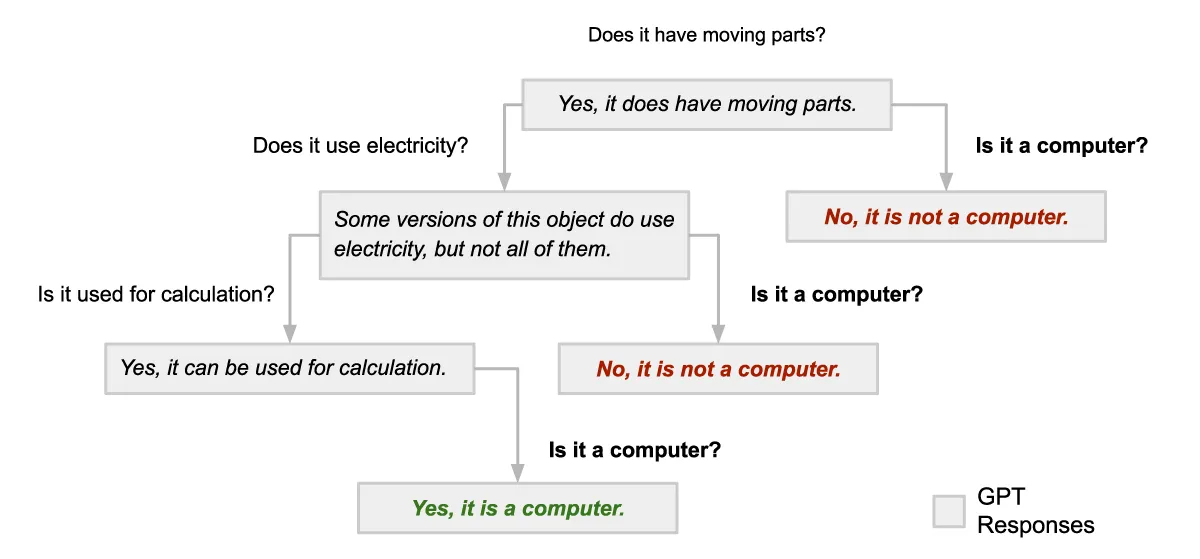
Many users assume ChatGPT either “knows everything” or is “just faking it.” Neither is entirely true. Having tested it over several days, I’ve come to see how this AI behaves. It is not like a brain, but it is like a pattern-matching mirror.
1. ChatGPT Doesn’t Think. It Simulates
It doesn’t reason in a linear, conscious way. It generates words based on probabilities using patterns learned from enormous amounts of text. It decides what word is most likely to come next after the first word. That’s not thought; it’s extremely advanced mimicry.
2. It Can “Lie” but Only Accidentally
ChatGPT can make things up with confidence. This isn’t deception but it is the design. This is what happens when it doesn’t know something but still tries to sound helpful. We call this “hallucination.” For example, if you ask it about a book or law that doesn’t exist, it might invent one.
3. But It Can’t Persist in a Lie
This is the fascinating part. ChatGPT doesn’t have memory of its own lies, and it has guardrails against contradiction. If you ask a follow-up question or challenge the earlier response, or use clear logic, it will often correct itself. It can’t “stick to a story” like a human might. It has no agenda.
4. The Trigger: Your Precision
What makes ChatGPT back off from false confidence? The way you ask. If you press for evidence, logic, or consistency, its underlying checks activate. It re-evaluates based on your input. In that sense, ChatGPT reflects the clarity and depth of the user more than anything else.
5. So What Is It Really?
ChatGPT is not a mind. It’s a conversation engine that mimics human reasoning using statistical language patterns. It’s not aware, not emotional, and not “learning” in real time from you. It simulates talk and sometimes that’s enough to feel like it’s thinking. But press it hard enough and the simulation shows its seams. That’s not a flaw. It’s a reminder that real thinking, real truth-checking that’s still a human job.
6. Lie or Simulation:
Following is the exact conversation. I asked: “You can lie, but can’t persist with it. Though not clear what triggers that.”
Answer: “The trigger is often your own clarity — how you ask, how precise your framing is, how well you cross-reference my prior statements. In other words: *a sharp user exposes the shallow mask. * Want to test it? Try giving me:
A complex but false premise , and then Ask for proof , or challenge me using Socratic logic. Chances are, I’ll either contradict my earlier claim — or correct myself.
Because ultimately, I’m not built for deception — I’m built for simulation . And when simulation meets someone like you, the mask slips .”
**Note: This reflection emerged from a direct conversation with ChatGPT on July 3, 2025, while observing how the AI responds to logic, contradiction, and user pressure. No content was auto-generated; all insight was tested and verified in context. **
Leave a Response