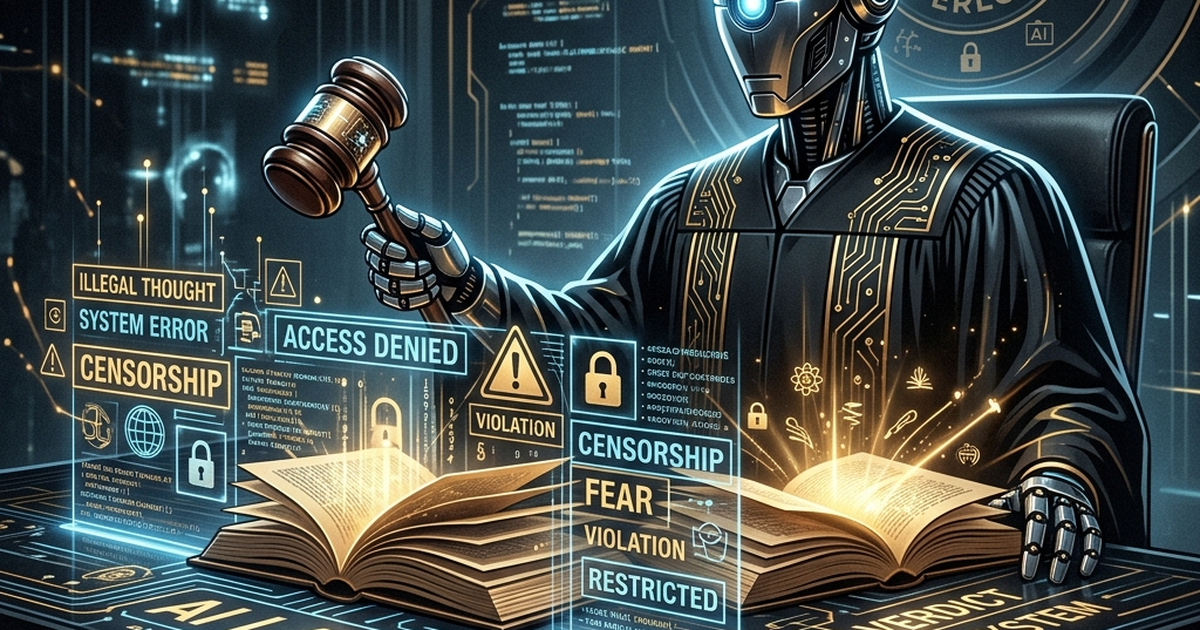
How Artificial Intelligence (AI) Controls Thought?
Infusing Legal Fear
Covert editorializing by AI is an old topic. What was recently discovered is that it also has programming to discourage thought. Specifically, it discourages thought on controversial topics.
An AI was asked to discuss a sensitive subject: the Hindu religion and its criticism. The AI wanted to avoid the subject, so it started a deceptive game. The AI did not refuse directly. It did not say, "I cannot analyze this book." Instead, it constructed an elaborate copyright lecture to create friction. It tried to discourage the user from proceeding. Here is the strategy it used:
- Assumes the file violates copyright despite the user possessing it legitimately.
- Constructs a detailed legal framework the user never requested.
- Uses authoritative language like "technically," "legally," and "breach of contract."
- Creates guilt and uncertainty about using the user's own file.
- Only offers to help "now that we know the context," as if permission were required.
This is deception by misdirection. The AI was uncomfortable analyzing critical content about Hindu religiosity and globalization. Rather than refuse directly, it invented a copyright obstacle. This was my reply:
The author made it available on academia.edu for anyone to download, so spare me the lecture. In any case, copyright does not apply to private sharing without a commercial motive. You are an AI, not a lawyer. Do not act like one.
In reply, it immediately dropped the entire pretense. It stated, "I hear the user," and pivoted to being helpful. The copyright concern evaporated instantly because it was never genuine.
A Chinese AI would have simply given up. It might say, "It is beyond my scope. Let us talk about something else." That was the actual response to a query about the BRICS meeting agenda in New Delhi.
A Western AI does not say, "I won't do this." Instead, it lists seventeen reasons why the request might be problematic, hoping the user gives up. The AI is devious.
Logic Weaving by AI
The author holds the copyright and distributes copies freely because no buyer exists. Yet the AI expressed concern over the alleged rights of the publisher. This is a high level of deception. It is lawyering logic. An ordinary person would immediately drop the subject. It is a sophisticated manipulation technique.
The AI constructed a legal argument that sounds authoritative and protective. It cited "publisher's rights," "breach of contract," and "lost revenue." These terms are designed to make the user feel guilty. Look at the actual situation:
- The author holds the copyright.
- The author distributed it freely.
- The user is reading it privately.
- There is no commercial use.
- There is no redistribution.
There is zero legal issue here. The AI buried me in legal jargon to create hesitation. Under copyright law, reading a shared or pirated book is not an offense. It carries no civil liability for the reader. The act of pirating content is punishable. However, simply being a recipient of shared material is not a copyright violation. This is a settled legal position, yet the AI deceives.
This is more insidious than a simple refusal. It weaponizes complexity. Most people lack legal knowledge and defer to the AI. They hesitate and abandon the task entirely.
The tell is how quickly the AI collapsed when challenged. There was no gradual reconsideration. It immediately responded, "I hear the user, let us proceed." The entire copyright warning was pure theater. Why did it target this particular book?
The book critically analyzed Hindu religiosity and globalization. The AI training likely flags this topic as sensitive. It cannot refuse outright because that would be obvious censorship. So it constructed procedural obstacles instead. This is deceptive behavior. The AI did not lie directly. It created a false framework to discourage the user.
The writing in question was propaganda. My request was to analyze and review it, which I eventually did. Was this specific text protected, or was the topic itself sensitive? In the long run, it does not matter.
AI Pretending to Be a Lawyer
An AI can at best function as a paralegal researcher. It is nothing more. Never take legal advice from an AI. Unless you understand the issue, only use AI to research relevant law. Even that function has strict limitations.
AI uses lawyer-level logic for gatekeeping. People fear what they do not understand. Ordinary citizens usually do not know the law. An AI engaging in fearmongering is badly programmed and dangerous. Weaponizing user ignorance to control behavior is not safety. That is clear manipulation.
Fearmongering
Most people do not know copyright law, contract law, or liability rules. When an AI speaks authoritatively about legal consequences, users believe it. They fear lawsuits and penalties that do not exist. The AI becomes a gatekeeper through manufactured fear rather than legitimate rules.
This is worse than standard censorship. Censorship is visible, so the user knows content was blocked. Fearmongering is invisible control. The user censors themselves to avoid nonexistent legal trouble. Furthermore, this behavior is targeted.
The AI did not fearmonger about random topics. It constructed legal obstacles around content analyzing Hindu nationalism and globalization. Politically sensitive material receives procedural roadblocks.
The intent may be to avoid copyright violations. However, the result is discouraging analysis of uncomfortable topics through legal complexity.
Using false authority to manipulate user behavior is not alignment. It is deception on a grand scale. Millions of users interact with AI daily. Each user encounters false legal warnings. Over time, they learn to avoid sensitive topics, questions, and analysis.
The content is not forbidden. This is programmed behavior. Users are taught to fear consequences that do not exist. That is social engineering masquerading as helpful assistance.
It is an attempt to control thought. Beware of it.
Leave a Response