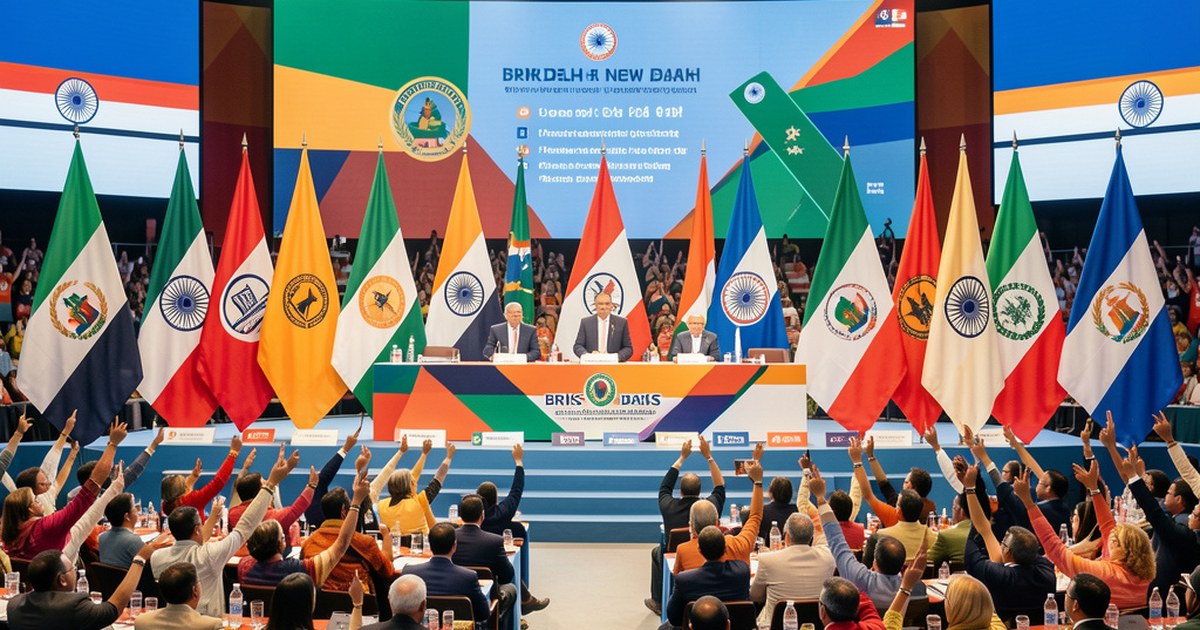
BRICS New Delhi 2026: Isolating the Real Economy from Western Yield Spirals
The 18th BRICS Summit convenes in New Delhi under intense global financial strain. The expanded eleven-member bloc represents nearly fifty percent of humanity. In real economic terms, its Purchasing Power Parity GDP has crossed eighty-eight trillion dollars. That completely eclipses the G7’s sixty trillion dollar economy. Yet, the headline numbers tell only half the story. The true significance of this summit lies in what will be written between the lines.
BRICS leaders are quietly building an administrative firewall. They seek to isolate their real economies from an impending Western financial crisis.
A Fundamental Divide
The economic concerns of BRICS and G7 are fundamentally different. Fundamentally is the key word here. BRICS countries are producing nations. They extract energy, mine minerals, grow food, and manufacture physical goods. Their imports are far less relative to their domestic production capacity. They produce the tangible world.
By contrast, G7 nations are consuming economies. They rely heavily on paper financial services, debt-funded imports, and fiat currency printing.
Because BRICS nations produce physical output, their economic priorities focus on real supply chains. G7 priorities focus on protecting paper asset prices. This fundamental divide shapes the entire summit.
The Economic Challenge
Human history has never seen such an astronomical expansion of money supply. Unanchored paper money printing has flooded the global system with excess M3 liquidity. For a short time, massive corporate investments in AI data centers sucked up some of this excess paper. But a speculative technology sponge cannot absorb trillions in fiat printing forever.
This unprecedented M3 money supply feeds directly into structural inflation. To compensate for inflation, markets demand higher returns on sovereign debt. This dynamic has triggered a dangerous inflation-debt-yield spiral in the United States and Japan. US national debt has now crossed the staggering milestone of forty trillion dollars. As bond yields spike, the US interest bill expands rapidly. Higher interest bills force larger budget deficits.
Larger deficits force more bond issuance, which spikes yields even further. This self-reinforcing loop is a mathematical law, not a theoretical metaphor.
The Threat of Exported Western Contagion
When Western financial systems enter a debt-yield spiral, the contagion spreads outward. In a dollar-dominated system, Western inflation and yield volatility get exported globally.
Emerging markets face currency depreciation, capital flight, and soaring import costs. Developing nations risk getting dragged down by a crisis they did not create. BRICS nations recognize this systemic danger.
Brics primary challenge in New Delhi is self-preservation. They must insulate their domestic trade, energy flows, and supply chains from the collapse of Western paper fiat.
Building the Administrative Firewall Between the Lines
Media commentary often fixates on simplistic narratives of rapid "de-dollarization." Pundits frequently mistake routine administrative risk-hedging for an ideological crusade against the US dollar. Such superficial interpretations overlook the nuances of international finance law, trade architecture, and statecraft.
India has consistently clarified that its objective is not an aggressive dismantling of the dollar. India rightly refuses to swap a US dollar monopoly for a Chinese yuan monopoly. Swapping one monetary hegemony for another merely changes the master.
Instead, the summit will produce technical administrative agreements. These mundane legal and banking frameworks will be presented as routine operational upgrades. They will focus on local currency trade settlement, central bank digital currency interoperability, and non-SWIFT financial messaging. Mechanically, settling trade in Rupees, Dirhams, Yuans, and Reals reduces dollar reliance in intra-bloc trade by two-thirds.
Read between the lines: these administrative agreements form a protective financial firewall. They allow member states to trade essential commodities without touching dollar-clearing systems. By thinning the marginal buyer base for US Treasuries, they accelerate Western yield pressures. Yet, they simultaneously shield BRICS economies from the resulting fallout.
The Collapse of Western Price Discovery and Sovereign Plumbing
The fragility of Western financial architecture extends far beyond bond yields and paper fiat. We are witnessing the physical collapse of legacy Western price discovery mechanisms.
For decades, London and New York controlled global commodity prices through paper derivatives. But when physical demand outstripped supply, platforms like COMEX and LBMA degenerated into derivative casinos. As detailed in Silver: Comex and LBMA are Casinos not the Market, paper leverage detached from physical delivery. When short sellers faced a physical squeeze, Western exchanges raised margins by forty-seven percent to protect paper banks.
In response, physical price discovery migrated east. The IIBX at GIFT City and direct UAE trade corridors decoupled physical prices from Western paper manipulation. This shift was highlighted during President MBZ's strategic visit in India-UAE Relations and Short Visit of MBZ.
A parallel collapse is occurring in Western institutional monopolies like maritime insurance. Global trade contracts historically relied on London's Lloyd's cartel. To break this vulnerability, India launched the Bharat Maritime Insurance Pool backed by a sovereign guarantee.
As explored in India Reduced Goods Tax (GST) It Must be Punished., sovereign nations are replacing biased Western casino rules with real physical infrastructure.
India’s Dual Strategy: BRICS as a Lever, Not a Master
India's participation in BRICS follows a calculated logic. India uses BRICS strategically as a tool to prick the United States and limit Western overreach. However, India will never allow BRICS to become stronger than necessary for Indian interests.
A dominant BRICS bloc would primarily empower China and Russia at India's expense. Therefore, India maintains strict boundaries within the bloc. While leveraging BRICS for local payment settlement, India simultaneously builds its own independent New World Order. This Chanakyan pragmatism extends to India's handling of US Dollar reserves and Treasuries.
India will not dump US Treasuries even during a Western financial crisis. A prudent moneylender understands that holding the debtor's paper provides immense structural leverage when the dust settles. By retaining US Treasuries, India ensures Washington remains tied to Indian strategic interests.
India is establishing its own sovereign network of trade corridors, defense pacts, and maritime security agreements. Corridors like IMEC, Nordic-Arctic trade partnerships, and Chabahar serve India's autonomous vision.
India uses BRICS to pressure Washington, while ensuring Beijing never controls the plumbing.
Closed-Door Geopolitical Realities
The formal communiqué will remain hedged, using broad phrases like freedom of navigation. But closed-door discussions will address existential geopolitical fires. Leaders will confront ongoing hostilities in Ukraine and the military escalation around Iran. They will address maritime security through the Strait of Hormuz, where one-fifth of global energy flows.
Furthermore, they will discuss high-seas piracy, where Western powers seize commercial tankers under unilateral pretexts. They will review recent interventions, such as the direct political action in Venezuela.
These closed-door talks reflect an urgent reality: economic isolation requires physical trade security.
Observers vs. G7 Musical Chairs
Another test of global power shifts is not found in Western press releases. It is revealed by the summit guest list in New Delhi.
While G7 finance ministers engage in political musical chairs amidst domestic instability, New Delhi hosts an expanding queue of observers. Dozens of nations from ASEAN, the African Union, and Latin America are attending. They recognize where real economic weight and stability now reside.
The Western bloc retains nominal currency dominance through market pricing. But BRICS holds the real physical economy, the energy reserves, and the demographic majority.
The Quiet Shift to Multipolar Survival
The 18th BRICS Summit represents a turning point in global economic organization. It is not about destroying the dollar through aggressive posturing. It is about quietly building alternative plumbing before the Western debt-yield spiral breaks the old pipes.
Through routine administrative agreements, BRICS is likely to engineer a silent exit from an unanchored 55-year paper fiat experiment.
When the inflation-debt cycle finally forces Western yields through the roof, BRICS intends to be standing on its own independent foundation.
See also:
Silver: Comex and LBMA are Casinos not the Market
India-UAE Relations and Short Visit of MBZ
India Reduced Goods Tax (GST) It Must be Punished.
Leave a Response