BRICS New Delhi 2026: The Hotel Shortage Myth, Security Bubbles, and Culinary Logistics
During the 18th BRICS Summit, mainstream media reported massive hotel room shortages across New Delhi. Pundits claimed that demand severely outpaced supply in the luxury hospitality sector. However, a closer look at hotel logistics reveals a very different reality. The reported room shortage was an artificial scarcity created by security architecture.
Security Monopolization vs. Actual Room Supply
The National Capital Region possesses over eighty five-star luxury hotels. Properties span New Delhi, Gurgaon, Noida, and Dwarka comfortably. Therefore, hotel capacity was never the true constraint. Instead, strict security protocols systematically removed entire hotels from public circulation.
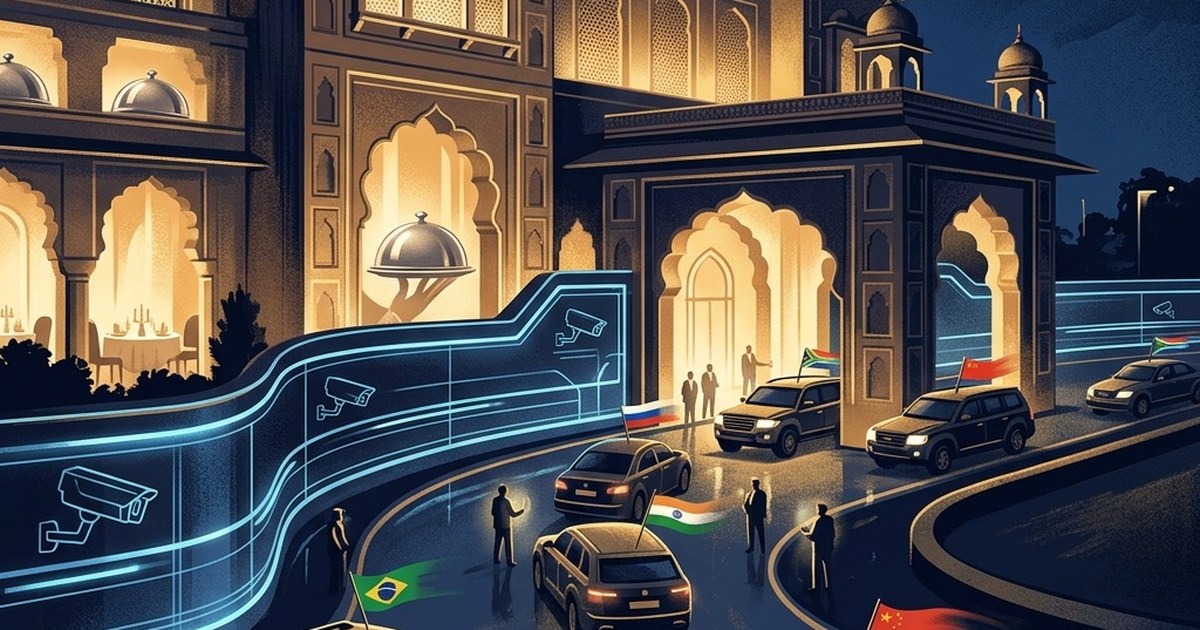
When a head of state arrives, an entire five-star property gets cordoned off. Security sweeps seal entire floors, elevator channels, and perimeter zones. Multiple buffer rooms remain empty for emergency contingencies. Command centers and counter-terrorist teams occupy full wings. Consequently, an empty hotel under lockdown appears fully sold out on booking systems.
Justification for Isolated Hotel Bubbles
This extreme lockdown strategy was driven by recent global security failures. In April 2026, a gunman breached security at the Washington Hilton hotel. President Trump and senior Cabinet officials were evacuated under gunfire. That incident proved the danger of sharing a single venue among multiple leaders. A single checkpoint failure endangers every principal simultaneously.
India's BRICS security model created completely isolated, redundant perimeters. Each major head of state received an entire locked-down hotel bubble. Putin stayed at the ITC Maurya in Chanakyapuri. Xi Jinping occupied the Taj Palace. Delegations from UAE, Iran, Brazil, and South Africa received dedicated hotel properties. If a breach occurs at one venue, it does not endanger other leaders.
The Hidden Logic of Culinary Matching
Hotel assignments also factored in subtle culinary infrastructure and delegation preferences. Chinese President Xi Jinping stayed at the Taj Palace. It has the Spicy Duck, a fine-dining Cantonese and Sichuan restaurant. While Xi's personal food security team may have cooked his meals, the kitchen simplified logistics. The on-site Chinese culinary infrastructure fed his four hundred person delegation seamlessly.
Similarly, Gulf delegations stayed at The Leela Palace hosting Jamavar. Gulf travelers find North Indian and Mughlai cuisine deeply familiar and comforting. Decades of cultural interaction have embedded Indian food across the Gulf region. Furthermore, five-star Indian hotels already operate certified halal kitchens. Thus, Indian cuisine functioned as familiar comfort food rather than a compromise.
Furthermore, the all-vegetarian summit banquet was an optional hospitality gesture from the host. It was never a binding imposition on foreign leaders. Visiting dignitaries enjoyed total freedom in their private dining choices. For instance, President Putin enjoyed Continental dining at the ITC Maurya. President Xi Jinping had authentic Cantonese cuisine at the Taj Palace. The host offered sattvic vegetarian banquets gracefully, while respecting every leader's personal choices.
Bridging the Culinary Gaps
Other visiting delegations faced wider culinary gaps in Delhi's luxury landscape. Delhi lacks dedicated five-star Persian or East African luxury kitchens. Iranian President Pezeshkian and Ethiopian Prime Minister Abiy Ahmed brought traveling chefs. Their entourages relied on private catering layered onto assigned security perimeters. Meanwhile, Latin American and European delegates comfortably adapted to continental options.
The Real Media Headline
The narrative of a room scarcity driven by demand completely misses the point. Delhi did not suffer from a shortage of hotel rooms. Rather, security architecture required unprecedented hotel monopolization. By assigning dedicated hotel bubbles to each leader, India ensured total security. It was a masterclass in administrative discipline and strategic risk management.
The media however, chose to see room shortage. That is a comment about the media itself.
See also:
BRICS New Delhi 2026: Isolating the Real Economy from Western Yield Spirals
BRICS New Delhi 2026: From Declarations to Solutions and the Chinese Baton
BRICS New Delhi 2026: Sideline Diplomacy, Culinary Statecraft, and the Foofa Factor
Leave a Response