What Is Life? (Chapter 21)
Thought is something we are barely aware of, except when we are alone. Unfortunately, solitude rarely happens anymore. In this era of hyper-connectivity, we are never truly alone; we are perpetually tethered to devices, notifications, and chatter.
So, what is thought?
If our outward actions are governed by habits, our inner motivation for action is thought. Sometimes we know we are thinking, but most of the time it simply happens, and we follow the current unquestioningly. It operates automatically, spontaneously, and beneath conscious radar. A sensation of a dry mouth prompts our hand to reach for a glass of water without any conscious deliberation.
We act, and often we regret. The link between thought and reflexive action is so instantaneous that there is rarely a pause to choose a wiser response.
Bill Bryson captured this mystery brilliantly when describing how little science understands the actual material nature of thought:
"…we are in much the same position today with mental processes such as thought and memory. We know that we have them, of course, but we don’t know what, if any, physical form they take. So it was for the longest time with genes. The idea that you could pluck one from your body and take it away for study was as absurd to many of Morgan’s peers as the idea that scientists today might capture a stray thought and examine it under a microscope."
Remember that Bill Bryson was neither a philosopher nor a scientist. He was a college dropout who started as a journalist and ended up running a university long after writing that book about science in which he casually touches upon thought.
The Compulsion of Pain
To think is, so often, to invite pain.
As the English poet John Keats famously put it in Ode to a Nightingale:
"Where but to think is to be full of sorrow / And leaden-eyed despairs."
Whenever the mind is left without an immediate task, where does it wander? It drifts either toward an anxious plan or toward an old sorrow. Worse yet, it manufactures new sorrows by comparison with others.
Like a tongue that cannot stop probing at a molar with food lodged in the gap, the mind compulsively revisits painful memories and grievances. When real grievances are exhausted, it invents fresh ones.
The biological machinery involved is immense. As Bryson points out regarding the astonishing metabolic demand of our cranial hardware:
"“There is simply no compelling reason we know of to explain why human brains got large,” says Tattersall. Huge brains are demanding organs: they make up only 2 percent of the body’s mass, but devour 20 percent of its energy. They are also comparatively picky in what they use as fuel. If you never ate another morsel of fat, your brain would not complain because it won’t touch the stuff. It wants glucose instead, and lots of it, even if it means short-changing other organs. As Guy Brown notes: “The body is in constant danger of being depleted by a greedy brain, but cannot afford to let the brain go hungry as that would rapidly lead to death.” A big brain needs more food and more food means increased risk."
Think about that: one-fifth of all your energy is consumed by an organ resting in a dark skull.
An ordinary person might invent only one or two recipes or practical tricks in an entire lifetime. Yet, biologically, their brain consumes as much metabolic power as a genius like Stephen Hawking while unraveling cosmic physics.
What is the brain of an ordinary person doing with all that relentless wattage all day long? The answer is simple. As John Milton famously wrote in Paradise Lost, the mind "can make a Heav’n of Hell, a Hell of Heav’n."
Look at the cruel irony of human experience: a madman in an asylum cell, stripped of freedom and living in squalor, can smile and hallucinate a heaven from within hell. Meanwhile, a normal person with no physical infirmity, well-fed, comfortable, and sound of limb, is in a self-fashioned hell. All the horsepower of an able body and a powerful intellect is marshaled to construct a private dungeon of misery.
The Fuel of Comparison
There is another incessant habit of thought that burns through our daily calories: comparison.
Thought seems almost incapable of encountering anything simply as it is. It cannot look at a meal, a home, a bank account, or a career and simply say, "This is sufficient; I am here." It must instantly begin measuring: * Is he doing better than I am? * Why is her path smoother? * Did someone else get the credit, the money, or the recognition? * Was I happier ten years ago?
Comparison is the true coal feeding the engine. A person who is completely healthy and secure can be plunged into acute misery the moment they witness someone else's apparent good fortune or effortless success. We rarely suffer from our actual physical reality. We suffer from the fictitious distance between where we are and where we imagine someone else to be.
By constantly comparing, thought manufactures inadequacy, envy, and grievance out of thin air.
The Invention of Pain
Human beings are their own harshest interrogators. We have perfected the art of self-flagellation.
Left to itself, the brain does not use its surplus horsepower to dwell in serene gratitude. Instead, it runs continuous simulations of failure. It questions past choices: Why did I say that? What did they mean by that glance? What if tomorrow brings ruin?
This is the runaway train called Thought and Pain.
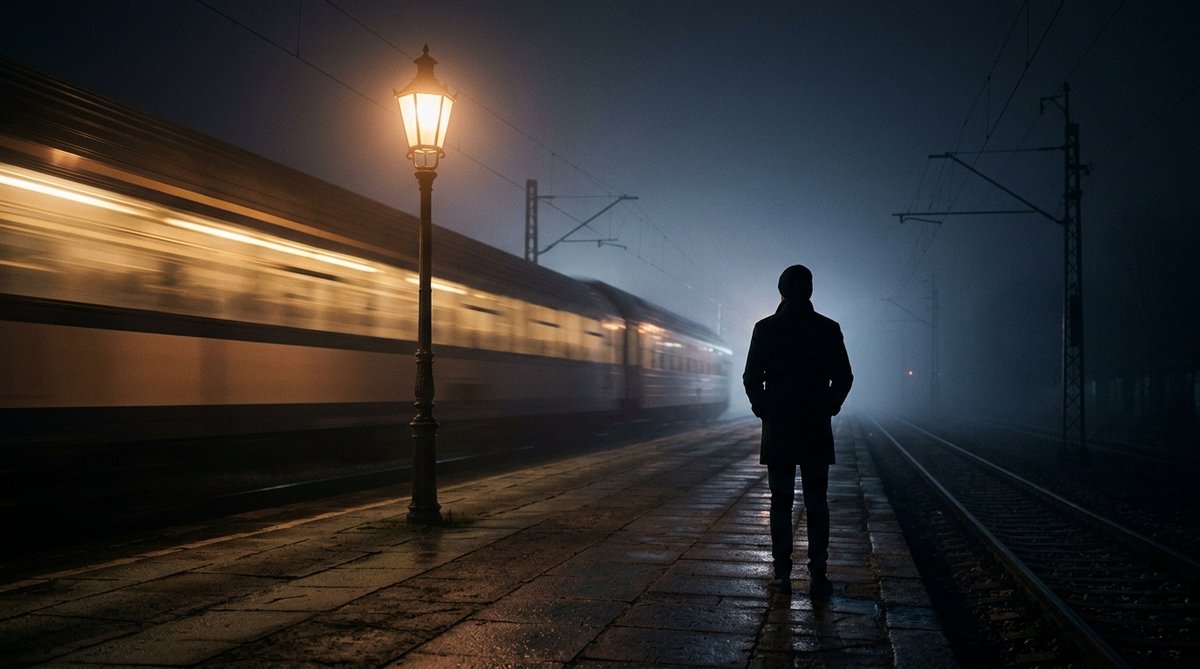
A single phantom thought arrives on the platform, often as insignificant as a passing irritation or a momentary silence. Before we notice, we have boarded the carriage. By the next station, that single thought has linked up with twenty others: old regrets, dormant insecurities, imagined insults. Within minutes, the train is barreling down the tracks at full throttle, and we find ourselves living inside an acute emotional crisis that exists nowhere except inside our own head.
We expend tremendous physical calories fueling an engine whose chief product is distress.
Stepping Off the Platform
In Chapter 18 (Transforming thought transforms the life), we discussed how transforming thought can transform life. But there is a crucial prerequisite that is often overlooked: you cannot redirect a train while you are trapped and unconscious inside its momentum.
Before a train can be steered, it must first be seen.
Compulsive, repetitive thought operates only as long as it remains an unnoticed reflex running in the dark. The moment that train of thought and pain is consciously observed and located, its automatic momentum breaks. It stops.
Only when the noise of that mechanical train ceases does the space open up for a deliberate, constructive chain of thought. That is when we can establish what we examined in Chapter 20 (Anchor in Life): a genuine Anchor in Life.
Thought may be powerful, but we are not helpless unless we choose to act helpless. Thought becomes powerful with attention. If we ignore the thought, it ceases to exist.
References:
1. Bill Bryson, A Short History of Nearly Everything (2003), Chapters 26 & 28.
2. John Keats, Ode to a Nightingale (1819).
3. John Milton, Paradise Lost (1667), Book I, ll. 254–255.
Leave a Response