What Is Life? (Chapter 22)
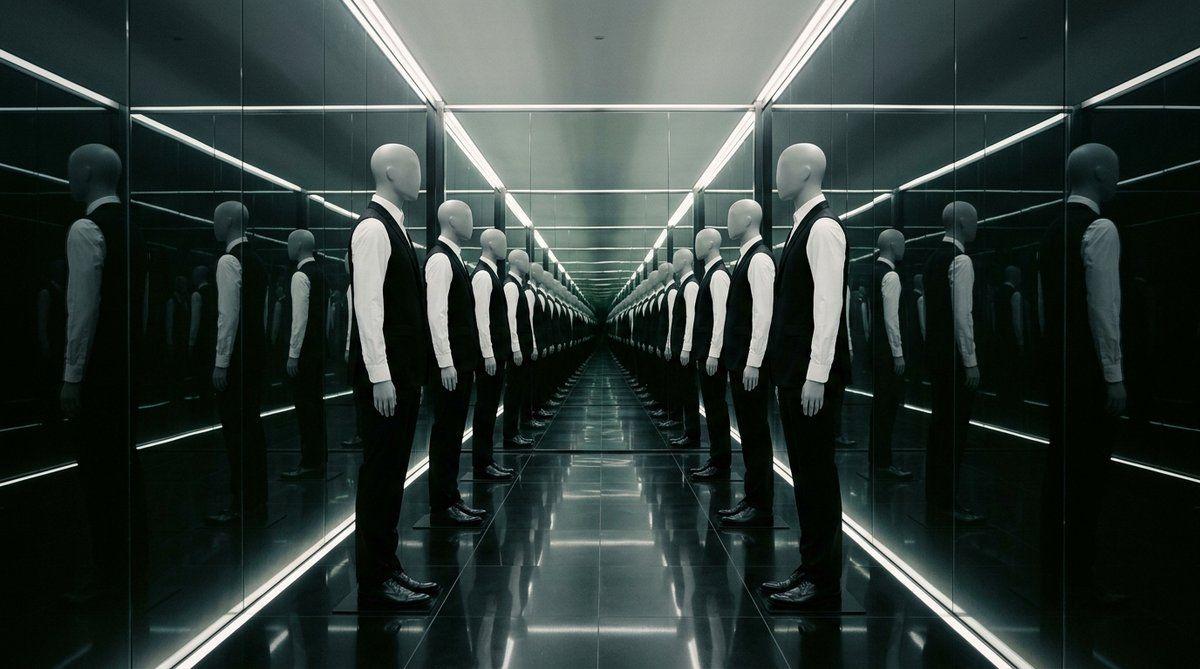
The human mind is like a mirror. It reflects the people around it.
The word "individual" and the celebration of "individuality" are vastly overrated, if not altogether false. A human being is unique, but only in the sense that the combination of people who worked on them forms a unique combination. Human person is not an original creation, but an accidental collage of parents, teachers, childhood friends, peers, and the immediate social circle.
The human mind merely reflects the views, habits, and traits of those in its orbit. There is an old saying: birds of a feather flock together. There is a fundamental truth in it. But another truth is that while a leopard may not change its spots, the human bird changes its feathers all the time to match the flock it wants to fly with.
Fashion: The Uniform of the Herd
There is no better proof of herd behavior and social compliance happening all at once than fashion.
The entire costume industry is built on this psychological insecurity. A human being needs only a few functional clothes to survive the weather. Yet there is relentless pressure to replace an entire wardrobe every decade, if not every single year.
Why? Because fashion gives people two things: 1. Some follow fashion eagerly to conform and gain social approval. 2. Others follow it purely defensively, so they do not look odd or stand out like a sore thumb in the crowd.
Both groups end up wearing the exact same costume.
Look at modern India. Before Narendra Modi came to power, the standard formal attire for Indian men in official and corporate corridors was the Western suit and tie. Today, a bright-colored Kurta-Pyjama paired with a contrast sleeveless jacket has become the new social wear across the country. Shirt and pant with half sleeve jacket is the new formal wear.
That shift was a top-down influence. It did not originate from ordinary peers. But once the political leader set the pattern, the peers immediately caught the reflection, multiplied it, and made it the new benchmark of conformity. Today, anyone attending a high-level function in Delhi without that jacket risks looking out of place. The flock adopted new feathers, and the mirror began reflecting a new image.
Fashion Wall-E
The animated film WALL-E captured this exact dynamic with biting satire.
In the movie, humans live aboard a massive spaceship called the Axiom. Floating passively in automated chairs, everyone wears the exact same jumpsuit day after day. Suddenly, an announcement from the central computer rings through the speakers: "Attention Axiom shoppers: Try blue! It's the new red!"
In a fraction of a second, a digital signal shifts every passenger's suit from red to blue simultaneously. The passengers immediately look at each other with delight, complimenting the fresh look and feeling fashionable. Not a single individual chose red. A centralized system pushed an arbitrary command, and the herd complied in unison without a moment of reflection.
Real-world fashion functions on the exact same premise, but without an express command. The seasonal "color of the year" or the latest fashion trend is sacrosanct for the diligent complier. The human mirror catches the signal, bounces it back to the flock, and compliance is assured.
Forced Submission
It is not just unconscious imitation of habits, views, and dress codes. The peer group actively polices its members and forces submission.
The common belief is that peers only influence casual opinions or political leanings. That is an undersell. The peer group dictates almost every aspect of life: how one talks, where one vacations, what kind of car one buys, what one finds funny, and what moral positions one must publicly support.
Step outside the boundaries of the flock, and the response is swift: subtle mockery, cold shoulders, or outright hostility. To survive in the group, submission is mandatory.
The Illusion of Rebellion
Rebellion is not something that ends with teenage years. It is a lifelong affair.
Society often speaks of "teenage rebellion" as if it were a bold strike for individual freedom. It is nothing of the sort. The teenager is not rejecting conformity; one is simply switching flocks. Teenager rejects the parental peer group in order to surrender completely to the peer group of friends. The rebellion is merely hostility toward non-peers.
Once a person enters adulthood and the mind is "made up," one prefers to stay sealed inside the same peer group forever. Anyone outside that group appears alien, backward, or hostile. The flock becomes a fortress or a prison, depending upon who one asks.
In India, three generations living together in a joint family may seem like an exception to the rule. But it is not. The younger generation may chuckle at the elders in private, but in public they obediently keep up appearances. This is a practical compromise for living under one roof, not an exception. It happens as a habit derived from observing elders. It is rare to see a nuclear family voluntarily turn into a joint family. That only proves the original rule. Without that shared roof, the mirror is left without an immediate pattern to follow. And humans do not tread in a vacuum.
The Regional Mirror
The mirror of the mind is not merely local: it is geographical and generational.
In Punjabi Century, Prakash Tandon documented this regional conditioning with sharp precision. He noted how the temperament of Lahore was combative and argumentative, while nearby Amritsar produced an entirely different personality: diplomatic, smooth-spoken, and eager to please in order to safeguard trade. Generations have passed, borders have shifted, yet these distinct regional traits continue to replicate themselves in descendants who never set foot in pre-partition Punjab.
Malcolm Gladwell documented a similar dynamic in Outliers. He examined how Scottish-Irish herding clans carried their violent "culture of honor" across the Atlantic Ocean into the mountains of Kentucky. Generations later, families who had never set foot in the British Isles were still shooting one another over trivial insults, faithfully mimicking an ancestral script.
A person considers their temper, speech, and worldview to be deeply personal. In reality, one is usually an unconscious ambassador of the soil where the early years were spent. One does not generate a personality: one merely reflects the ancient habits of the town. Even the stubborn, argumentative urge to dissect the herd is often nothing more than a reflection of that same ancestral combative soil.
The Illusion of Genetics
The belief in genetic determinism often mistakes cultural conditioning for biological destiny.
During the colonial era, administrators like Sir Herbert Risley roamed India with calipers, measuring cranial angles, foreheads, and noses to construct elaborate pseudoscientific theories of race. A casual observer looking at a community can easily fall into the same intellectual trap.
Consider a visible physical trait: the noticeably broad, high forehead common among Sikh men and women. A hasty theorist might immediately declare it an inherent genetic marker. The reality is entirely mechanical. From earliest infancy, mothers pull children's hair back with uncompromising daily tightness: tied into a taut topknot for boys and pulled tight into braids for girls. Decades of continuous physical tension pull the hairline backward. Even when a man cuts his hair later in life, that broad forehead remains permanently visible.
There is nothing genetic about it. It is the physical imprint of a mother's daily grooming habit, carved directly onto the hairline.
If a simple childhood routine can physically reshape the forehead of an entire community, how much more thoroughly does societal conditioning shape the invisible corridors of the mind? What is lazily labeled as inborn character, family temperament, or genetic disposition is almost always the scar of early grooming, leaving an artificial shape that one mistakes for nature.
Why People Seek Solitude
Company requires regular processing of cues, information, and trends, along with the constant urge to reflect them. One does everything to keep company for fear of loneliness.
Holding up a mirror all day long to please the flock is utterly exhausting. One must constantly adjust the feathers, laugh on cue, feign interest in despised gossip, and watch every step.
People who prefer solitude often do it for this very reason: they have had enough. Solitude is rarely about mystical enlightenment or some lofty pursuit of "inner peace." It is much more down-to-earth than that.
In solitude, the mirror is finally put down. There is nobody to reflect, nobody to impress, and no flock demanding submission.
Solitude is the end of the journey that starts from loneliness.
References:
1. Prakash Tandon, Punjabi Century (1857–1947) (1961). 2. Malcolm Gladwell, Outliers: The Story of Success (2008), Chapter 6: "Harlan, Kentucky".
Leave a Response