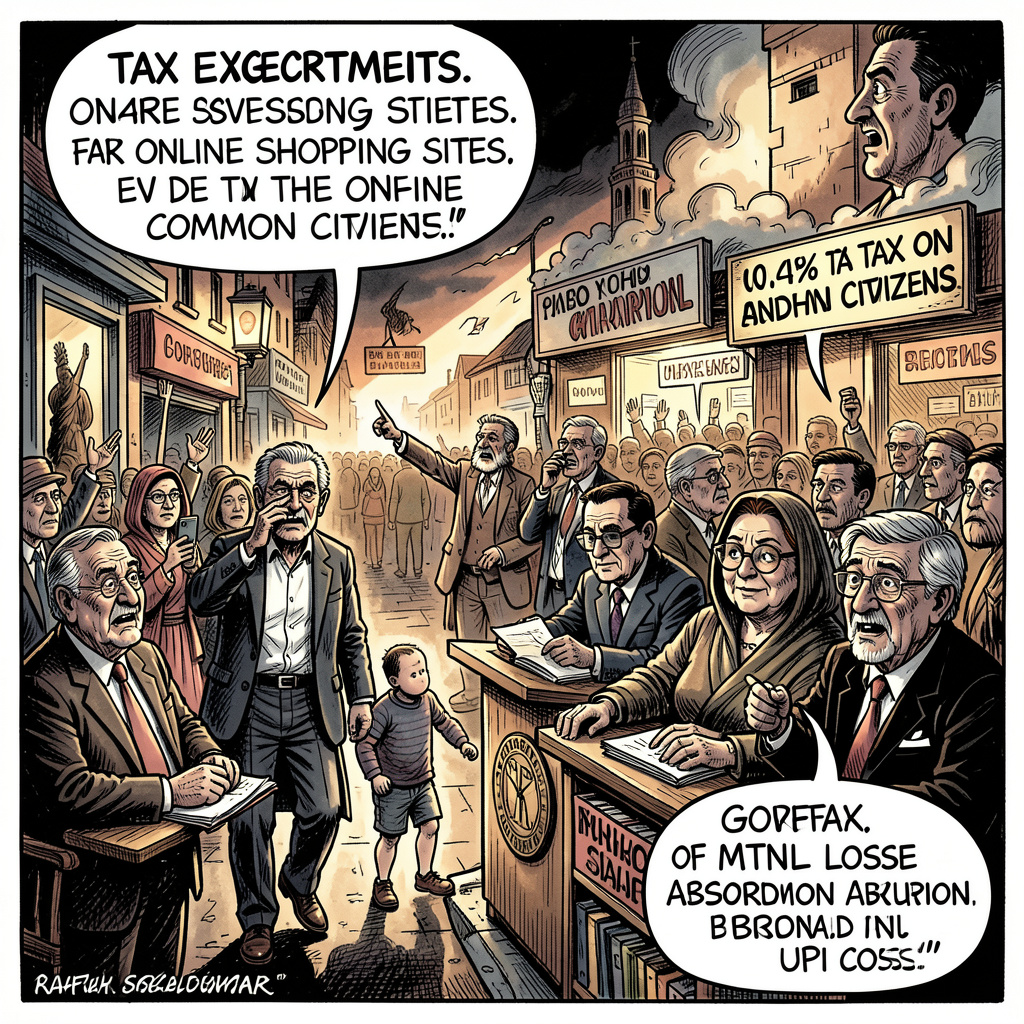
UPI Tax: Governance or Lack of It?
Is India in Governance Crises? (Chapter 15)
The economics of UPI tax are worse than they look. This chapter goes deeper into the UPI tax itself. The previous chapter documented the political disconnect. A one-vote candidate in Parbatsar. A Diwali MDR circular from North Block. Same failure, different departments. Here we shall look into the commercial and economic aspects of this new tax.
The Tea Packet Lesson Nobody Remembered
In 2004, the government of the day decided to exempt 100-gram packets of tea and coffee from excise duty. The announcement came with fanfare. A relief for the common man.
The market responded immediately. Sales of 100-gram packets multiplied. Consumers stopped buying the one-kilogram pack. They bought ten or eleven packs of 100 grams instead. The arithmetic worked. At the price of one kilogram, you got eleven packs of 100 grams. Each pack was exempt from duty. The saving was real and substantial.
The government had created a loophole and was surprised when people exploited it. The exemption was eventually withdrawn. Without fanfare. Without a press conference. Quietly, in the fine print of a later budget.
Twenty-two years later, the government is going to be surprised that people will find ways around the UPI MDR. They always do. The tea packet told us everything we needed to know about how Indians respond to tax asymmetries. Nobody was listening.
What Is Actually Being Charged
The MDR structure deserves a close reading. Not the official summary. The actual numbers.
0.4 percent on Person-to-Merchant UPI transactions above Rs 2,000. Cap at Rs 300 on transactions above Rs 75,000. This creates a paradox in the design itself.
A Rs 10,000 transaction: merchant pays Rs 40. A Rs 50,000 transaction: merchant pays Rs 200. A Rs 75,000 transaction: merchant pays Rs 300. A Rs 1 lakh transaction: merchant still pays Rs 300.
The largest transactions pay the least as a percentage. The medium-value buyer is the one purchasing a refrigerator, a piece of furniture, school fees, a bulk grocery order. He pays the full 0.4 percent. The very large transaction gets a flat cap that makes it almost trivial.
This is not progressive taxation. It is regressive by design. The person buying Rs 10,000 worth of goods pays proportionately more than the person buying Rs 1 lakh worth. A student who designed this structure would be failed in an exam for chartered accountant.
Comparative alternatives?
The government calls it an MDR. Compare it to what a citizen pays for the alternatives.
Transfer of money by NEFT online: free. RTGS online: free. IMPS: free or near-free on mobile banking at most major banks.
Even at a bank branch, you waste time travelling and standing in a queue. The clerk may or may not have updated software. NEFT charges there range from Rs 2 to Rs 25 depending on the amount. RTGS branch charges are Rs 20 to Rs 50. These are the most expensive versions of the same service. Done manually. With human effort on both sides of the counter.
The government's digital payment tax is 0.4 percent. That is higher than a branch NEFT for the same amount. A merchant receiving Rs 25,000 pays Rs 100 in UPI MDR. The same Rs 25,000 sent via NEFT at a branch costs Rs 4 to Rs 15 that too paid by sender. The digital route now costs more than the manual route. Welcome to Babuland. This is the policy.
The Merchant Is Not a Babu
The official position is that merchants cannot pass the charge to customers. The law says so. Merchants do not read the law. They read their margin sheets.
Rs 300 saved per high-value UPI transaction. Ten such transactions in a day at an electronics shop or furniture store. Rs 3,000 per day. Multiplied by 365 days. That is Rs 10.95 lakh per year.
A merchant is not a government servant drawing a fixed salary regardless of outcome. He calculates his margins daily. He knows what credit card MDR cost him for twenty years. He knows exactly what 0.4 percent costs on every transaction. He will not absorb it silently.
He will do what every trader in India has done since credit cards arrived: offer a cash discount. Not openly. Not on a price board. Verbally. At the counter. To every customer who matters.
"Sir, Rs 50,000 by UPI, or Rs 49,500 in cash or NEFT?" The customer does the maths in his head in two seconds. Many customers will ask him for a discount for cash price. They have done it for generations.
The government cannot station a police officer at sixty million retail counters. The compliance assumption behind this policy has no enforcement mechanism. It is a rule that relies on merchants choosing to lose money out of civic duty. The Government could not do anything when GST readjustment reduced the duty.
People get the government they deserve. The government gets the taxpayer it deserves.
The UPI Limit the Babus Forgot
UPI has a standard daily limit of Rs 1 lakh per account. Most people do not breach it for a single transaction. They use alternatives for larger transactions.
Anyone buying something above Rs 1 lakh is already using IMPS, NEFT, or RTGS. A Rs 1.2 lakh television, a Rs 2 lakh piece of jewellery, a Rs 5 lakh car advance: these transactions are not on UPI. They are already on the free online NEFT or alternatives.
So what does the MDR actually hit? The Rs 2,000 to Rs 1 lakh range. This is the range where a middle-class family buys a washing machine, pays food bill, orders furniture, or books a holiday. The aspiring middle class. The core BJP voter. The vyapari. The small businessperson.
The big buyer is on NEFT already. The small buyer under Rs 2,000 is exempt. The person being squeezed is the one in the middle. That demographic is not accidental. It is the entire point of UPI. It was built for them.
The Unlikely Revenue
The stated purpose is to recover approximately Rs 20,000 crore annually which is the cost of running the UPI infrastructure. It is unlikely to happen.
This is the problem with that number.
The high-value segment (above Rs 2,000) carries about 65 percent of total UPI value but is only 4 to 5 percent of transaction count. This is the basket the MDR targets. But this is also the basket with the lowest switching cost. The moment a merchant nudges a customer toward IMPS or cash for a Rs 30,000 purchase, that revenue leaves the UPI ecosystem entirely.
NEFT and RTGS are operated by the RBI. The RBI can absorb its own infrastructure cost. IMPS is run by NPCI at much lower operational cost because it handles fewer, simpler transactions. UPI is the expensive system. And now that system is pushing away its most valuable users.
If the high-value segment migrates, not fully, but meaningfully, NPCI's revenue falls short of projections. Then one of three things happens. Either the government steps back in with grants. Or the MDR threshold drops lower. Or the system quietly underfunds its infrastructure and becomes slower and less reliable.
The classic Urdu couplet applies here:
“ना खुदा ही मिला, न विसाल-ए-सनम्”
(na khuda hi mila, na visaal-e-sanam)
Neither the original free system, nor a sustainable revenue model. The loss of wider customer base, for free.
The E-Commerce Exemption
The government has been suspending the 1 percent TCS on e-commerce transactions year after year. Amazon, Flipkart, Meesho, and every other online marketplace pays no such levy. This is a deliberate policy choice. The government has decided that taxing e-commerce would hurt growth and adoption.
The same government has decided that taxing UPI payments at 0.4 percent will not hurt growth and adoption. If Flipkart deserves protection from a 1 percent charge, why does a kirana owner paying a supplier by UPI deserve to absorb 0.4 percent? The kirana is the local economy. The kirana is also the voter.
And if the government can absorb MTNL's losses every year (a telecom company used primarily by government offices, with accumulated losses of Rs 30,000 crore) why can it not bear the Rs 20,000 crore annual cost of UPI? UPI serves 300 million citizens. MTNL serves a few government buildings. It also saves money that goes into printing and distribution of currency cost.
Look at the priorities. Government employees' phone bills are protected. Common citizens' payment infrastructure needs to be monetised. Remember VIP culture from Chapter 9?
Alternative Revenue Model
There is a simpler solution. It was not invented by a think tank. It is my suggestion.
Most active UPI users have at least two linked accounts. Many have three or four. A Rs 10 monthly fee per activated UPI account, not per user, per account can be charged. For about 60 to 80 crore active accounts it can generate Rs 7,200 to Rs 9,600 crore per year. It is behaviour-neutral service charge.
This model does not create an incentive for merchants to switch to NEFT. The payment at the counter remains free. There is no friction at the point of transaction. The cost is a small, invisible subscription that most users will not bother deactivating.
It is closer to how SMS alert charges work, or annual debit card fees. Nobody switches banks over Rs 120 a year. But the revenue accumulates across hundreds of millions of accounts.
The bureaucrats did not arrive at this because they were not thinking about it as a market problem. They were thinking about it as a revenue target to hit this quarter. And they only know how to tax the common man. They hate subscription which sounds like begging.
Taxing is power. Subscription is humble.
The Political Trick Theory
Since nothing about this UPI tax makes sense. It has neither economic sense nor logical sense. Here is a conspiracy theory being debated in tea shops and barber shops alike.
The BJP is facing multiple fronts of public anger simultaneously. NEET. UGC reforms. SC/ST quota disputes. The 2024 UP result still stings. The party needs to manage the news cycle.
One established method is the political safety valve. Announce something controversial, absorb the outrage, then withdraw it at a politically chosen moment and claim credit for listening to the people. The farm laws followed this arc. Three years of protest, then withdrawal on the eve of elections. The government lost the elections anyway, but the political optics were managed.
The UPI MDR has all the ingredients for this play. A scary-sounding announcement. Frantic clarifications that keep the story alive. Widespread public anger. A natural withdrawal point on October 2, Gandhi Jayanti, or a day before first Navratri itself, makes sense.
The Prime Minister withdraws the charge. He says he heard the people. He says the digital India mission cannot be burdened. Goodwill is earned at zero cost. The opposition, which has been attacking the charge, is suddenly left with no issue.
This is speculation. But if it is true, it is also an indictment. It means the entire machinery of NPCI, RBI, Ministry of Finance, and Parliament was allowed to go astray. A controversy was manufactured to be dissolved for electoral theatre. That is not governance. That is not even politics in the useful sense. It is the state consuming itself for optics.
If it is not a trick and they mean it, the economics say it will fail anyway. The behavioural response will hollow out the revenue model within two quarters. They will have to withdraw it under worse conditions, with more damage done to UPI's adoption.
Either way, the policy does not survive contact with the market.
The Tea Packet Ending
Every government that has tried to tax convenience in India has discovered the same thing. Indians are not passive recipients of policy. They respond, adapt, and split bills. They keep multiple accounts and form joint families on paper. They register four QR codes to stay below every threshold ever invented. Households have electric meters and water connections on each floor to split the bills. Remember, it is all legal.
The 100-gram tea packet multiplied on every kitchen shelf in 2004. The UPI workarounds are already being planned in WhatsApp groups of small traders across Kanpur, Surat, and Varanasi.
The government can tax the transaction. It cannot tax the ingenuity.
The governance is still evasive. The Diwali season is arriving. The bureaucracy is hoping the market does not notice.
People always notice.
References:
- Is India in Governance Crises?: Chapter 1.
- Is India in Governance Crises?: Chapter 2.
- Is India in Governance Crises?: Chapter 3.
- Is India in Governance Crises?: Chapter 6.
- Is India in Governance Crises?: Chapter 9.
- Is India in Governance Crises?: Chapter 12.
- Is India in Governance Crises?: Chapter 14.
Leave a Response