The New World Order: Chapter 20.
On August 29, 2026, The New York Times published a major global report. The title was “Modi Is Hedging Against Trump, One Deal at a Time.”
The article detailed Prime Minister Narendra Modi’s massive diplomatic push over the past year. He visited more than 20 countries and hosted 13 foreign heads of state. He secured high-impact agreements across Europe, the Middle East, and Asia. These included German submarine technology, French AI cooperation, and the UK trade deal. He also deepened strategic economic partnerships with the Nordic bloc. Western media finally acknowledged India's expansive global network of sovereign partnerships.
For six months, our blog series The New World Order documented this exact transformation. My book Accidental Empire, published in September 2025, foretold this shift a year ago. What Western media reports as news was already an established operational reality in our pages.
Yet The New York Times suffers from a fundamental epistemological flaw. They see individual bilateral deals, but remain blind to the grand global architecture.
The Tea Leaves NYT Missed
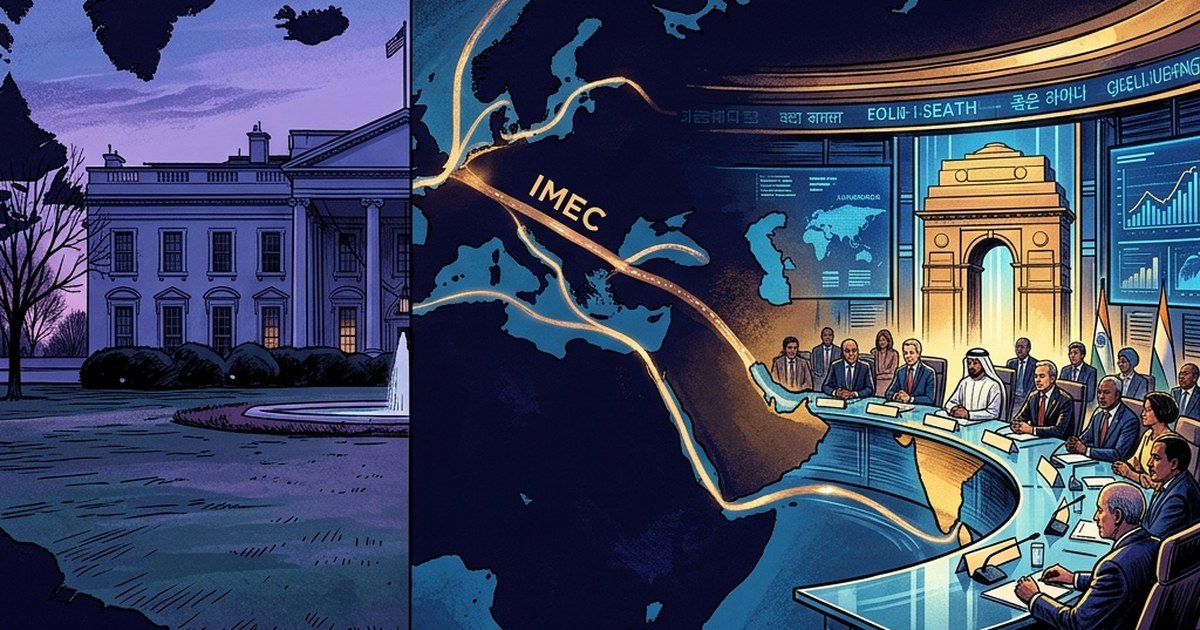
Western political commentators have entirely missed one crucial empirical fact. For eight months, not a single head of state has visited Washington D.C.
This has never happened since the Bretton Woods conference in 1944. For eighty years, Washington was the mandatory pilgrimage site for all world leaders. Today, the White House sits quietly empty of visiting foreign sovereigns. When American officials travel abroad, foreign governments file their invitations without response.
The world did not issue a loud manifesto boycotting Washington. Nations simply stopped traveling to the American capital.
This total absence of foreign state visits is the ultimate proof of World Minus One. We analyzed this concept in Chapter 1 and Chapter 19 of this series. The central landlord turned into a pirate by imposing tariffs and seizing ships. The residents did not argue with the pirate landlord. They packed their belongings and built their own sovereign homes.
The Empty White House
This exact isolation was foretold in Chapter 26 of Accidental Empire. We explained this geopolitical reality through the allegory of The Whiskey Story.
A miserly relative built a massive glass bar rack with expensive scotch bottles on display. He offered no seating and refused to open any bottle for his guest. When partners asked for genuine relationship, he offered cheap whiskey and demanded submission. During lockdown, he sat all alone, drinking his expensive collection in complete isolation.
In Accidental Empire, we drew the direct global parallel:
“America built a glass bar rack of military hardware worth 1.8 trillion dollars. It built 11 aircraft carriers, 13,000 aircraft, and 3,700 nuclear warheads. But there were no glasses and no seating. Just display. When partners asked for help, America offered subordination instead of cooperation. Partners looked around the empty room and left. America had expensive whiskey, but nobody came to drink it. Empires fall one broken promise and one unopened bottle at a time. They sit alone with their treasures in empty rooms, wondering where everybody went. The answer is simple. People went somewhere they could share a drink.”
In September 2026, that allegory has become literal history. Washington sits alone in its empty mansion with its massive military display. America is drinking expensive whiskey in an empty room, wondering where everybody went.
The answer is sitting right across the ocean. World leaders went to New Delhi, because New Delhi is where nations share a drink.
The Epistemological Blind Spot of Western Reporting
Mainstream media claims India’s diplomatic push is merely a tactical reaction. They call it a defensive hedging strategy against American tariffs and changing policies.
This framing reveals an ingrained American-centric provincialism. Western media perhaps believe in the divine destiny of the USA. The fact is the USA is not a superpower for any ideological reasons. It is a superpower because it acts like one. Something it has stopped doing for quite some time. Time is catching up with the USA. Yet Western analysts struggle to imagine a world where Washington is not the primary center. In their view, every trade agreement must be an answer to American actions.
They view Modi's agreements through the narrow prism of short-term risk mitigation. They see tactical transactionism where a structural redesign of Eurasian trade is happening.
What Western media calls hedging is the execution of a new global trade architecture.
The Real Theater of BRICS
India hosts the BRICS Summit in New Delhi next week. President Xi Jinping and President Vladimir Putin are attending in person. What other heads of state will be visiting is a matter we shall discover.
Western journalists will spend the summit parsing the final joint communique. They will search for boilerplate resolutions and debate minor word choices.
They will miss the point entirely. In multipolar statecraft, the formal agenda and final resolution text are bureaucratic noise.
The real story of the New World Order will be revealed by reading who sits at the table as Special Invitees. Heads of state from ASEAN, Latin America, Africa, the Gulf, and Europe are traveling to New Delhi. By snubbing Washington and meeting in New Delhi, the game is already in play. Their presence registers their formal participation in the post-dollar architecture.
The final resolution at BRICS is an anticlimax. The guest list is the resolution.
The Dual Eurasian Trade Spines
In Chapter 16, we explained how Washington walked away from IMEC in 2023. Washington arrogantly assumed no corridor could function without American financing.
Washington was asleep while India, Europe, the Gulf, and Nordics built a Post Office of Goods. This system operates across 30 democratic nations without American permission or sea protection. It runs on existing infrastructure, platform fees, GIFT City, and UPI payment rails.
By combining IMEC with the Arctic Northern Sea Route, Eurasia now has two trade spines. Global transit times shrink from six weeks to under a fortnight.
When delivery times halve, inventory and working capital requirements halve for global manufacturers. The NYT missed the fact that Eurasia was re-wired to bypass American tollbooths.
The Financial Settlement without SWIFT
The NYT report focused on trade deals, leaving financial settlement rails invisible. As analyzed in Chapter 7, the true revolution is happening in cross-border payments.
Over 156 Special Rupee Vostro Accounts now operate across 30 nations. The number would be higher now. Combined with UPI-DPI interoperability, India built a direct Rupee-Euro settlement system.
This hits America at its most vulnerable mathematical node: the debt rollover yield. The $40 trillion debt of the USA needs to be rolled over. Bond yields have hit the roof, indicating lower confidence among financiers. There are talks about a failure to issue bonds in the future. Sovereign financial failure does not occur because of abstract Debt-to-GDP ratios. The U.S. debt fails when it loses the marginal foreign buyer for maturing Treasuries.
When BRICS countries settle trade in local currencies, central banks stop accumulating dollars. This withdraws the marginal buyer of U.S. debt and forces Treasury yields higher. Rising yields expand America's interest bill and trigger an irreversible fiscal crisis.
SWIFT transfers take five days, while UPI settles payments in under two seconds. UPI renders SWIFT and dollar intermediation economically obsolete for Eurasian trade.
Why This Writing Is Necessary?
Mainstream news media operates as a protection racket for toxic economic narratives. They rebrand spectacular prediction failures as evolving perspectives. They report reality as news only a year after it happens. Still, they have not connected all the dots or calculated its implications for the future.
The purpose of serious writing is not to seek validation from mainstream headlines. It matters not who reads it first.
What matters is the discipline of knowing what we know. We maintain empirical rigor, read the tea leaves early, and keep our epistemological calendar clean.
When analysis relies on real-world mechanisms, time performs the quiet work of verification. The record remains clear, uncorrupted, and vindicated by history.
References:
- New York Times: Modi Is Hedging Against Trump, One Deal at a Time
- New World Order (Chapter 1)
- Understanding the ‘Nation First, Duty Above Comfort’ appeal by PM Modi (Chapter 2)
- An Analysis of India-EU Trade Deal of January 2026
- Prime Minister Narendra Modi in Netherlands (Chapter 5)
- PM Modi in Sweden Where Trade Routes Meet the Stars (Chapter 6)
- The Rupee’s Silent Revolution (Chapter 7)
- India and Norway: The Arctic Partnership (Chapter 8)
- The Nordic Summit: The Formation of Middle Power (Chapter 9)
- The Journalist Who Knew Curry and Yoga (Chapter 10)
- European Racism and Antipathy to Russia (Chapter 11)
- PM Modi in Rome Where Two Eternal Cities Met (Chapter 12)
- Understanding a Trade Route in the 21st Century (Chapter 13)
- Cyprus: The Mediterranean Anchor of IMEC (Chapter 14)
- The Arctic Trade Route to Europe (Chapter 15)
- USA Missed the New World Order (Chapter 16)
- United Nations and its Empty Rooms Beyond GDP Report (Chapter 17)
- Why President Donald Trump Picked a Quarrel with PM Giorgia Meloni (Chapter 18)
- Geopolitics: Reading the Tea Leaves of Global Politics (Chapter 19)
- Accidental Empire of USA (Book)
- Accidental Empire (Chapter 26 - The Whiskey Story)
- World Minus One: India is Preparing for Loss of One Nation
- The Real Reasons for USA to Impose Tariffs on India
Leave a Response