Visa Benevolence of USA towards India
(Chapter 17)
American benevolence comes in many guises.
In 1898, President William McKinley christened the annexation and bloody pacification of the Philippines as “Benevolent Assimilation.” In the 1950s and 60s, American benevolence took the shape of eighty billion dollars in military aid to Pakistan, building a terror infrastructure that bled Kashmir in India for four decades, as narrated in Chapter 6 and Chapter 7. In 1971, it dispatched Task Force 74 into the Bay of Bengal while Pakistani generals slaughtered three million Bengalis (Chapter 8 and Chapter 9). In June 2026, it fired missiles into unarmed commercial oil tankers carrying Indian crew in the Gulf of Oman without warning (Chapter 11 and Chapter 16).
Now, another chapter of imperial benevolence has unfolded. This time, the weapon is not a Tomahawk missile or a covert operative slipping across the border (Chapter 14). This time, the weapon is a visa proclamation.
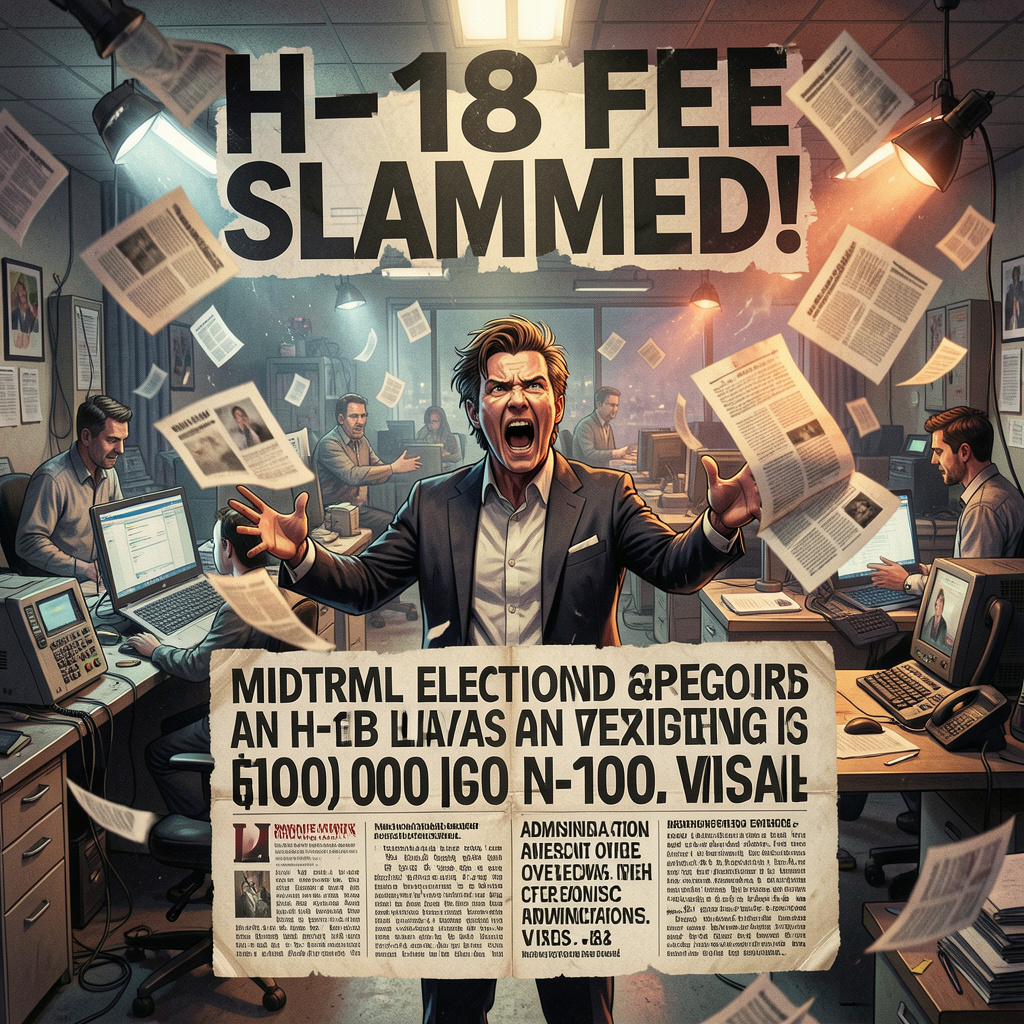
Under Donald Trump and Vice President JD Vance, the United States has launched an all-out administrative war on Indian professionals. Indian engineers, scientists, and researchers make up over 70% of all H-1B specialty occupation visas. They built the infrastructure of Silicon Valley, sustained Wall Street's trading systems, and staffed the research laboratories of American universities.
As a token of gratitude, Washington has slapped them with proposed $100,000 petition fees. They narrowed the definition of specialty occupations. The consulting firms are now subject to draconian audits. There is a threat to revoke work permits for H-4 spouses.The Department of Labor’s permanent labor certification (PERM) program stands suspended.
To add rhetorical venom to administrative assault, JD Vance publicly labelled these high-skilled Indian professionals as corporate America’s “indentured servants.”
The Indentured Servant Slur
When Vance stood before the cameras and accused tech giants like Microsoft and Adobe of firing domestic American workers and replacing them with foreign "indentured servant".
The choice of words was deliberate, as language in statecraft is never casual. For a domestic audience facing white-collar layoffs and corporate fatigue, the term was a perfect populist dog-whistle. It cast Big Tech not as visionary innovators, but as greedy oligarchs trafficking in captive, submissive foreign labor.
To Indian ears, however, the phrase carries a far darker historical stench.
Ministry of External Affairs spokesperson Randhir Jaiswal pointed it out in an uncharacteristically sharp press briefing. The term invokes the painful, exploitative memory of the colonial Girmitiya system. In the nineteenth and early twentieth centuries, the British Empire transported millions of impoverished Indians under coercive, bound contracts to sugar plantations in Fiji, Mauritius, South Africa, and the Caribbean. It was a deceptive slavery.
Now that slur is being applied to graduates of the Indian Institutes of Technology (IITs), data scientists, systems architects, and senior engineers holding master’s degrees and doctorates. These are the individuals who generate billions of dollars in enterprise value and file patents for American corporations.
The slur is another insult born of imperial arrogance. Yet beneath Vance’s political theatre lies an astonishing administrative comedy. Vance argued that foreign workers are "indentured" because their legal status is tied to their corporate employers. It creates a captive labor pool that depresses American wages.
It it was an evil the Vance thought it was the remedy was simple. Grant these workers independent mobility. Expedite their Green Cards. Eliminate the archaic per-country caps that leave Indian applicants stranded in an eighty-year queue.
Instead, what did the Trump-Vance administration do?
They suspended PERM labor certifications. They froze the very mechanism through which an H-1B worker escapes employer dependence and obtains permanent residency.
To "liberate" workers from corporate captivity, the administration locked the prison doors and threw away the key. That alone exposes the move for what it is.
It is a crude electoral theater.
The Real problem is Dollar
Washington politicians want voters to believe that American engineers are unemployed because Indian engineers are willing to work for pennies. That is a convenient lie.
The real reason American labor has priced itself out of global competition lies in macroeconomics. This is a subject Washington policymakers refuse to confront because doing so would expose the rotten foundations of their own financial empire.
The core reality is the "reserve currency curse", formalized decades ago as the Triffin Dilemma. The result is that every country in the world is forced to buy and accumulate US dollar. This inflates the value of dollar.
When a currency is chronically overvalued, domestic labor carries an automatic, crippling currency penalty:
1. The Exchange Rate Chasm: A mid-level software engineer in Austin or Seattle earning a modest $150,000 translates into roughly ₹1.25 crore in India. In Bengaluru, Hyderabad, or Pune, that same budget can comfortably fund an entire engineering pod of two or three senior Engineers who live at the top of their local purchasing power.
2. The Inflexible Domestic Floor: An American worker cannot simply accept a 50% pay cut. Mortgages, private health insurance premiums, auto insurance, and grocery bills are denominated in overvalued dollars and cannot be lowered by executive decree.
3. The Trumpian Contradiction: Economic nationalists in the White House like Robert Lighthizer recognize that a strong dollar strangles domestic manufacturing. Yet their weapon of choice is indiscriminate tariffs to create global panic. This drives international capital into the safe-haven dollar, driving the currency even higher.
The United States cannot afford to crash the dollar without igniting catastrophic domestic inflation. It also cannot structurally lower domestic living costs, which is going up due to inflation. So what it does?
It resorts to administrative roadblocks: visa bans, $100,000 petition fees, and hiring quotas.
The Accounting Fraud: GDP and PPP Illusions
This distortion is masked by an international accounting apparatus designed to validate Western financial hegemony.
As I demonstrated in my paper, Purchasing Power Parity (PPP) Methodology of World Bank is Defective, the World Bank’s International Comparison Program (ICP) under the SNA 2008 framework suffers from a fatal tautological flaw.
The methodology uses retail prices to determine currency values, but those retail prices are already determined by existing currency regimes. Worse still, as expanded in The Myth of Purchasing Power Parity (PPP), the system contains a massive structural bias against developing economies. These have substantial unorganized sectors.
The ICP constructs its price baskets by sampling branded, formal retail goods in air-conditioned supermarkets. In India, where over 50% of economic activity occurs in the unorganized sector, the World Bank captures a branded mixer-grinder at ₹4,000 while ignoring the generic equivalent available at ₹400. It captures branded pharmaceuticals at ₹100 while ignoring generic medicines sold at ₹5.
By over-sampling expensive formal goods, the World Bank artificially inflates India’s measured price level, concealing the colossal purchasing power and cost efficiency of the Indian economy.
Similarly, as argued in Measurement of Gross Domestic Product (GDP) is Misleading, GDP measures gross transactional churn and financialized extraction rather than human welfare:
-
In the United States, an emergency room visit billing $10,000 adds $10,000 to nominal GDP. Administrative bloat, privatized healthcare monopolies, and ballooning debt are registered by Kuznets' broken metric as "economic growth."
-
In India, when Digital Public Infrastructure (JAM Trinity, UPI, Direct Benefit Transfers) collapses transaction costs from thirty dollars to fifteen cents and distributes free grain to 800 million citizens without middlemen, transactional friction is eliminated. Real human welfare doubles, but nominal GDP barely moves.
When you strip away this statistical manipulation and analyze street-smart reality, as shown in Rich Country, Poor People: America’s Reality Hidden in Numbers, the truth is staggering:
Using Food-Price PPP (the cost of eggs, milk, bread, and daily meals), the purchasing power ratio between India and the US is not the official exchange rate of 1:88, but closer to 1:10. An urban domestic worker in India earning ₹30,000 monthly enjoys more real discretionary purchasing power than an American worker earning $25,000 to $30,000.
Eighty percent of Americans are packed into just three percent of the land area, trapped in astronomical urban rents, high transport costs, and multi-layered taxes. Over 60% of Americans live in a state of perpetual financial distress, one medical emergency or missed paycheck away from bankruptcy.
Survival Cost Trap
This brings us to the root of the tech labor standoff: the reservation wage.
A 22-year-old American graduating with a computer science degree does not demand an $85,000 starting salary out of greed. They demand it because their survival overhead leaves no choice:
| Expense Category | Monthly Cost (US Metro Hub) | Annual Reality |
|---|---|---|
| Rent & Utilities | $1,600 – $2,400 | $19,200 – $28,800 |
| Federal, State & FICA Taxes | $1,200 – $1,800 | $14,400 – $21,600 |
| Student Debt Servicing | $500 – $1,000 | $6,000 – $12,000 |
| Healthcare Premiums & Deductibles | $300 – $500 | $3,600 – $6,000 |
| Auto Loan, Fuel & Insurance | $600 – $900 | $7,200 – $10,800 |
| Food & Basic Survival | $500 – $700 | $6,000 – $8,400 |
| Total Non-Discretionary Floor | $4,700 – $7,300/mo | ~$60,000 – $85,000/yr (Gross) |
Debt Trap
An American graduate cannot accept an entry-level offer of $45,000 without entering a debt spiral. Where did this debt trap come from?
It was manufactured by American domestic policy. In the late 1960s, California Governor Ronald Reagan set out to break student anti-war radicalism at UC Berkeley by slashing state funding and ending tuition-free public higher education. When exported nationally in the 1980s, higher education was transformed from a public good into a debt-leveraged financial asset. Under the Bennett Hypothesis, unlimited government-guaranteed student loans allowed universities to inflate tuition at triple the rate of inflation, trapping generations with $1.7 trillion in non-dischargeable debt.
Compare that to an Indian engineering graduate. Educated at public or affordable institutions, entering the market with negligible debt, and supported by affordable transit and low-cost non-tradable goods, an Indian engineer earning ₹10 to ₹15 LPA ($12,000–$18,000) enjoys substantial positive savings and discretionary income.
An executive proclamation cannot wipe out student loan interest, lower California rents, or reform privatized American healthcare. Barring foreign visas does not make American graduates affordable. It simply ensures that American corporations cannot afford to hire anyone inside the United States.
The AI Data Center Mirage
Washington strategists have floated a naive techno-fantasy. Generative AI and automated coding will eliminate the need for foreign engineers, allowing a small domestic cadre to maintain US technological primacy. This fantasy collides with physical reality.
AI models require massive physical compute infrastructure and hyperscale data centers consume gigawatts of electricity. Here too, the United States is running into severe domestic bottlenecks:
-
Regional US power grids (PJM in Northern Virginia, ERCOT in Texas) face interconnection delays of 3 to 7 years.
-
Lead times for utility transformers and high-voltage switchgear is currently at 36 to 48 months.
-
Local communities across Virginia, Georgia, and Ohio are mounting fierce resistance against soaring utility bills, diesel emissions, and water depletion caused by data centers.
Meanwhile, India is undergoing an unprecedented data center supercycle, attracting well over $100 billion in investment commitments from hyperscalers (AWS, Microsoft, Google) and domestic giants (Adani, Reliance, Tata, Yotta). Supported by state-level single-window clearances, rapid green-energy corridors, and sovereign data localization laws, compute capacity is expanding at breakneck speed.
AI tooling is equally available in Bengaluru as it is in Seattle. When an American utility tells Microsoft that a new data center campus will take six years to hook up to the grid, and the Department of Labor freezes its visa filings, the corporation does not wait. It routes its capital, its servers, and its engineering teams to Hyderabad and Pune.
The Midterm Election Farce
Why enact these disruptive measures now?
The answer is crude electoral timing. Midterm elections are looming. The administration faces an electorate anxious over tech layoffs, inflation, and economic stagnation. Deep structural reforms like subsidizing STEM education, reforming zoning laws to lower housing costs, upgrading the national electrical grid, or addressing the overvalued dollar, take a decade of painful legislative work.
A presidential decree slapping a $100,000 fee on H-1B visas produces a front-page headline in twenty-four hours.
Furthermore, executive decrees bypasses legislative scrutiny while setting up an intentional legal trap. They know these unilateral edicts violate the Administrative Procedure Act (APA) and will be struck down by federal courts. That is not a failure of strategy. It is the strategy itself.
The policy is engineered to survive only until election day.
The Involuntary Gift to India
There is a historical irony in this latest display of imperial benevolence. For over half a century, India was drained of its finest technical minds. Generations of Indian taxpayers funded elite tier-1 institutions (IITs, NITs, AIIMS), only for the top quartile of that human capital to board flights to New York and San Francisco. They paid taxes to the US Internal Revenue Service, registered patents under the US Patent and Trademark Office, and built the market capitalizations of American corporations.
It was the classic, debilitating "Brain Drain."
By closing the door, imposing punitive fees, freezing Green Cards, and hurling slurs at Indian talent, the Trump-Vance administration is performing an involuntary miracle for New Delhi.
It is transforming a half-century of Brain Drain into Sovereign Brain Gain:
1. Tax Base and Intellectual Property Retention: When a senior systems architect remains in India, their high-bracket income taxes fund the Indian treasury, and the intellectual property they produce is domiciled in Indian corporate entities.
2. Supercharging the GCC Ecosystem: Over 1,600 multinational Global Capability Centers already operate across Bengaluru, Hyderabad, Pune, Chennai, and Gurugram. They have long ceased to be cheap call centers; they are now the primary product, cloud, and AI engineering hubs of global Fortune 500 firms. When Washington restricts US hiring, multinationals simply expand their Indian GCC campuses.
3. DeepTech and Entrepreneurial Inflow: Engineers who no longer face the indignity of a lifetime in the US visa queue are staying home, building domestic startups, and applying cutting-edge engineering to Indian defense tech, space tech, fintech, and digital public goods.
As argued in Accidental Empire, empires that lose their self-awareness inevitably mistake arrogance for strategy and surprise for statecraft. This is happening in USA now. In its desperate bid to score midterm election points, Washington has launched a premature, unprepared labor war against the very talent pool that kept it ahead. In doing so, it is permanently rerouting global technological infrastructure away from American shores and into the Indian subcontinent.
The United States intended to humiliate and restrict. But its benevolence has handed India the greatest structural gift of the twenty-first century.
References:
1. Purchasing Power Parity Critique: Purchasing Power Parity (PPP) Methodology of World Bank is Defective 2. The Theoretical Illusion: The Myth of Purchasing Power Parity (PPP) 3. GDP & Welfare Measurement: Measurement of Gross Domestic Product (GDP) is Misleading 4. US Living Standards Reality: Rich Country, Poor People: America’s Reality Hidden in Numbers 5. The Fate of Empire: Accidental Empire: A Book Foretelling the Fate of America 6. Bilateral Power Play: The Invisible War of Power Play between India and USA (Chapter 14) 7. American Domestic Justice System: Imperial Benevolence of USA towards American Citizens (Chapter 15) 8. Maritime Piracy and International Law: Understanding the Universal Benevolence of USA (Chapter 16) 9. MEA Press Briefing on JD Vance Remarks: Firstpost / MEA Briefing on Vance Slur 10. Federal Court Enjoining H-1B Fee: Moneycontrol / Judicial Injunction against $100,000 H-1B Fee
Leave a Response