The Royal Family Drama That Changed Jordan Forever
A King Changed His Mind
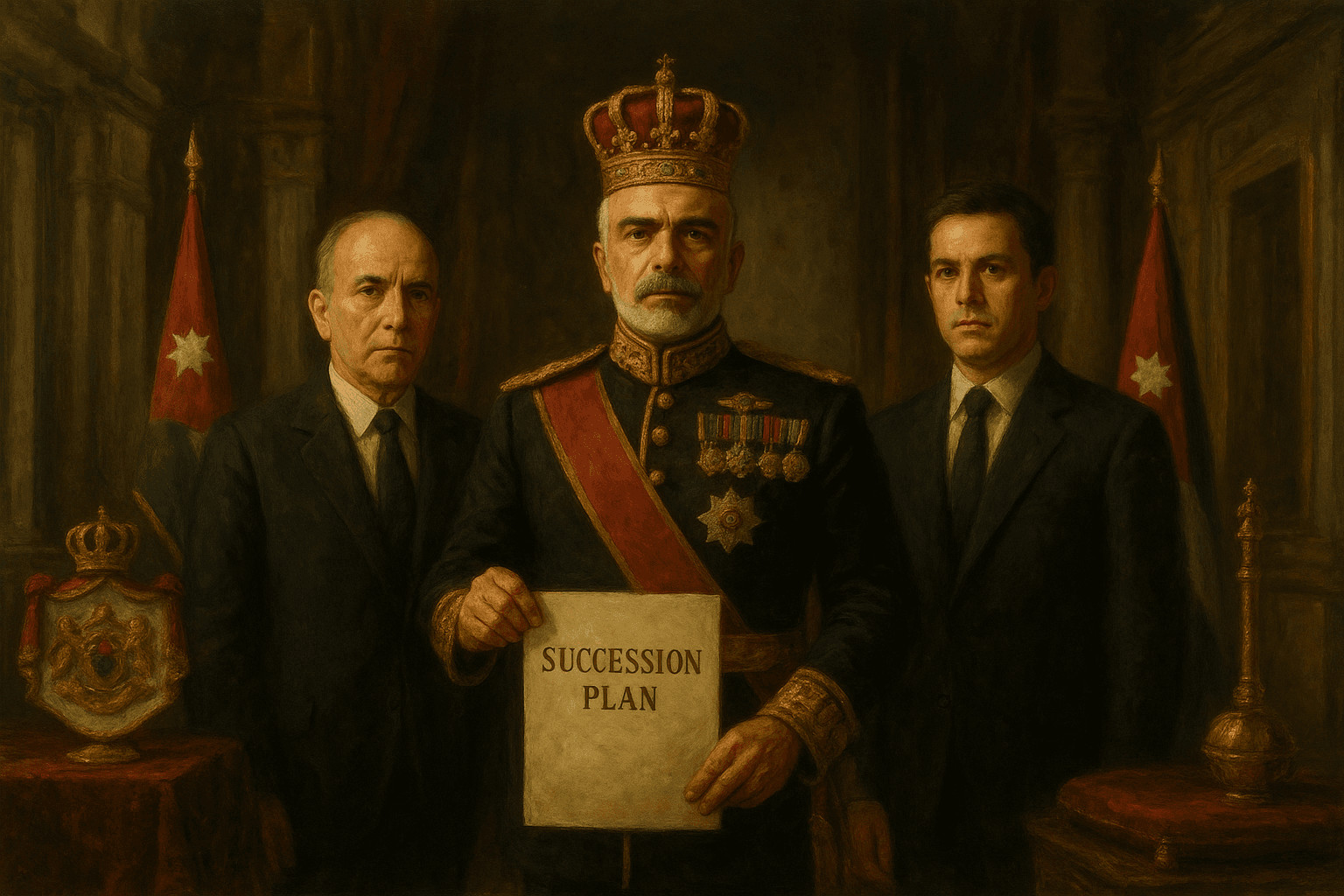
Imagine that you are a King suffering from cancer and about to die, with just a few weeks left to live. For 34 years, your younger brother as crown prince, has been next in line, to rule your kingdom. But suddenly, you decide he’s not the right guy for the job anymore. So you write him a scathing 14-page letter, strip him of his title, and hand the crown to your son instead.
That’s exactly what King Hussein of Jordan did in January 1999, just two weeks before he died. It was one of the most dramatic royal family meltdowns in modern Middle Eastern history. It left everyone asking: What the hell just happened?
Prince Hassan bin Talal had been Crown Prince since 1965. That’s three and a half decades of being the heir apparent, attending state dinners, cutting ribbons, and basically living his entire adult life knowing he’d be king someday. Then, boom. His brother fired him from the family business.
The official story? Hassan messed up while playing king during Hussein’s cancer treatment. But whispers around Amman suggested something else entirely: maybe it wasn’t just about politics. Maybe it was about blood, identity, and what it really means to be an “authentic” Arab ruler in Jordan.
Crown Prince Messed UP
Let’s start with what everyone agrees to have happened. In 1998, while King Hussein was getting cancer treatment in the United States, Crown Prince Hassan was running Jordan as regent. And he took few questionable decisions.
First, he fired the Prime Minister. Now, technically, he had the right to do this. But timing is everything in politics, and doing this while your brother is fighting for his life in a hospital bed? Not great optics. Hassan replaced the PM with his own guy, Fayez al-Tarawneh, which immediately raised eyebrows about whether he was making a power grab.
Then Hassan started cozying up to the Muslim Brotherhood and other opposition groups. In Jordan, where the monarchy’s survival depends on keeping various factions balanced but not too powerful, this was like playing with fire. Brotherhood is a radical outfit with perceived links with militant outfits. The king had spent decades carefully managing these relationships, and here was Hassan seemingly throwing that playbook out the window.
But the real kicker was when Hassan tried to shuffle around military leadership positions. Big mistake. In Jordan, the army isn’t just the military—it’s the backbone of royal power. The Bedouin tribe that make up much of the officer corps have been the Hashemite family’s most loyal supporters since the 1920s. Messing with military appointments without consulting the king? That was crossing a red line.
When Hussein heard about all this from his hospital bed, he was furious. He wrote Hassan that brutal 14-page letter, which in short one line sum up said “You’re undermining everything I’ve built, causing chaos in the family, and I can’t trust you to run this country.”
The Families Flutter Behind Closed Doors
But here’s where it gets really messy. This wasn’t just about Hassan’s political mistakes. This was about a royal family with competing ambitions, jealous wives, and kids whose futures hung in the balance.
King Hussein had actually been having second thoughts about Hassan for years. He’d been floating the idea of a compromise: Let Hassan stay Crown Prince, but make him promise that when he became king, he’d name Hussein’s son Hamzah (Queen Noor’s boy) as his heir, not Hassan’s own son Rashid.
Sounds reasonable, right? Wrong. Princess Sarvath, Hassan’s wife, was having none of it. She basically said, “Hell no, my son is next in line, not some American woman’s kid.” And thus began a royal catfight that would make the British royals’ dramas look tame.
Queen Noor, naturally, was pushing for her son Hamzah. Princess Sarvath was fighting for her son Rashid. Meanwhile, Hussein’s eldest son Abdullah was quietly building relationships with the military and tribal leaders, probably sensing which way the wind was blowing.
The whole thing turned into such a mess that Hussein just threw up his hands and said, “Forget the compromise. Abdullah, you’re the new Crown Prince.”
The Whisper Campaign
Now, the situation takes a fascinating turn, and becomes contentious. Amidst this unfolding family saga within Jordanian high society, rumors circulated about Princess Sarvath’s heritage. Contrary to expectations of an Arab lineage, she was actually born in Kolkata and hailed from a distinguished Bengali-Pakistani family with Persian ancestry. People whispered: > “ Ya Allah, hiya laysat ‘arabiyya .” (Oh God, she is not Arab.)
While all this family drama was playing out, there were whispers in Jordanian high society about Princess Sarvath’s background. She wasn’t Arab. She was born in Kolkata to a prominent Bengali-Pakistani family with Persian roots.
Now, before you roll your eyes and think this is just racism, understand the context. Jordan is a country where tribal identity matters enormously, and the Hashemite royal family’s entire claim to legitimacy rests on being descendants of the Prophet Muhammad and leaders of the Arab Revolt against the Ottoman Empire. In a country that’s still figuring out its identity between Palestinian refugees, Bedouin tribes, and urban elites, having an “authentically Arab” king matters to a lot of people.
Some Jordanian tribal leaders were apparently uncomfortable with the idea of Prince Rashid—Hassan’s son with his Bengali-Pakistani wife—becoming king someday. The thinking went: Sure, he’s technically Hashemite through his father’s line, but his mother isn’t Arab. Does that make him “less legitimate” somehow?
It’s worth noting that this kind of thinking wasn’t exactly consistent. King Abdullah II’s own mother was British, and Queen Noor is American. But somehow, Sarvath’s South Asian background seemed to bother people more. Maybe it was because Britain and America are powerful Western allies, while South Asia doesn’t carry the same geopolitical weight. Or maybe it was just good old-fashioned prejudice.
Was It Really About Race?
Here’s the thing: we’ll probably never know for sure how much these ethnic concerns influenced Hussein’s decision. The king never publicly mentioned Sarvath’s background as a factor. The palace stuck to the story about Hassan’s political mistakes and family succession preferences.
But there are some clues that suggest race might have played a role. The fact that Hussein was willing to skip over Hassan’s son Rashid in favor of his own son Hamzah (whose mother Queen Noor at least claims some Syrian-Arab ancestry) is telling. If it was just about keeping the throne in Hussein’s direct line, why not just go straight to Abdullah?
Also, let’s be real about Jordanian politics. This is a country where Palestinian-Jordanians sometimes face discrimination despite making up half the population, where tribal identity determines access to government jobs, and where being seen as “authentically Jordanian” or “authentically Arab” carries real political weight.
But here’s the counterargument: If bloodline purity was really the issue, why did Abdullah get the nod when his mother was British? Why was Queen Noor accepted as queen when she was born in America? The Hashemite family has a long history of international marriages without constitutional crises.
The most likely explanation is that ethnic concerns, if they existed, were just one factor among many. Hassan’s political mistakes probably would have been enough to disqualify him on their own. But in a culture where image and legitimacy matter enormously, having a future king whose mother wasn’t Arab might have been the icing on the cake of reasons to look elsewhere.
Abdullah’s Perfect Storm
Meanwhile, Prince Abdullah was looking like the ideal choice for all the right reasons. He was a military man with strong connections to the Bedouin tribes that form the backbone of Hashemite support. He’d married a Palestinian-Jordanian woman (Queen Rania), which helped bridge the Palestinian-Jordanian divide that’s always simmering in the kingdom. And he was Hussein’s own son, which satisfied the king’s apparent desire to keep the throne in his direct line.
Abdullah wasn’t the intellectual that Hassan was, and he didn’t have Hassan’s decades of experience in diplomacy and statecraft. But he had something more valuable in Jordanian politics: legitimacy with the people who really mattered for royal survival.
The Aftermath
When Hussein died in February 1999, Abdullah became king without any serious challenges. Hassan gracefully accepted his exile from power (though he reportedly remained bitter about it for years). The transition was smooth, which was probably exactly what Hussein had hoped for.
Looking back, Hussein’s gamble paid off. Abdullah has been king for over 25 years now and has navigated Jordan through the Iraq War, the Arab Spring, the Syrian refugee crisis, and countless other challenges. Whether Hassan would have done better or worse is anyone’s guess.
But the 1999 succession crisis revealed some uncomfortable truths about Jordan and the Middle East more broadly. It showed how much ethnic and tribal identity still matters in modern Arab politics. It demonstrated that even constitutional monarchies with clear succession rules can be also be affected by family drama and political calculations. And it reminded everyone that in the end, kingdoms are still very personal institutions, subject to the whims, prejudices, and preferences of whoever wears the crown.
What It All Means
So what really happened in January 1999? Probably all of the above. Hassan made serious political mistakes that genuinely concerned his brother. There was a messy family fight about succession that turned personal and nasty. And yes, there were probably some people who were uncomfortable with the idea of a future king whose mother wasn’t Arab, even if that wasn’t the main factor.
The beauty and tragedy of royal politics is that we hardly get the full truth. Palace statements give us sanitized versions of events. Leaked letters and insider accounts give us glimpses behind the curtain. But the real conversations—the ones where kings make life-changing decisions—usually stay private forever.
What we do know is that King Hussein changed the course of Jordanian history in his final weeks of life, and the ripple effects are still being felt today. Whether he made the right choice is for historians to debate. But there’s no denying it was one hell of a dramatic way to end a 47-year reign.
Leave a Response