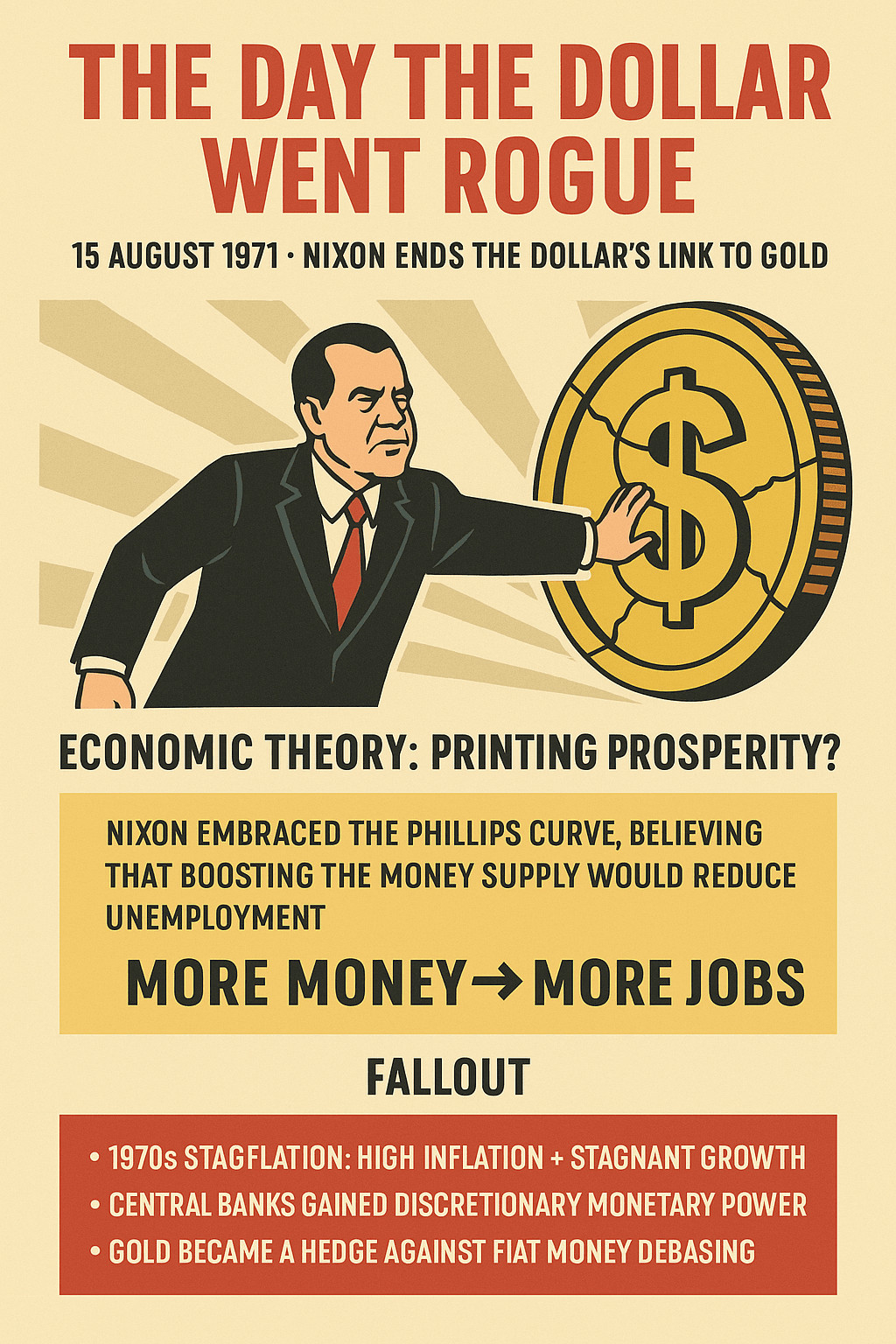
A Mother of All Scams by Nixon
The Day the Dollar Went Rogue
15 August: Independence from Empire in India, and from Accountability in America. Some dates shape history. Others reshape the rules.
On 15 August 1947, India threw off the chains of colonialism and declared independence from British rule. It was a hard-won freedom—fought not with tanks and bombs, but with spinning wheels, salt marches, and steely nonviolence. The empire left, the flag rose, and a billion hopes were lit.
Exactly 24 years later, across the world, another kind of liberation occurred—though far less noble. On 15 August 1971, U.S. President Richard Nixon made a quiet announcement that detonated global finance. With a few sentences, he unhooked the dollar from gold, collapsed the Bretton Woods system, and turned the world’s most trusted currency into what economists call fiat money—which is just a polite term for “because we said so.”
India’s 15 August marked freedom from foreign domination. America’s 15 August marked freedom from monetary discipline.
Nixon’s Gold Disconnect: A Prime-Time Coup
Facing inflation, unemployment, and a looming 1972 re-election campaign, Nixon went on TV and announced that foreign governments could no longer exchange dollars for gold at the fixed rate of $35 per ounce. This ended a 27-year-old system that had kept global currencies stable under the Bretton Woods Agreement, where the dollar served as the world’s reserve currency because it was redeemable in gold.
Nixon called it “temporary.” The world called it the Nixon Shock. And economists now call it the Mother of All Monetary Scams.
Here is the Nixon’s video announcing the decision:
The Economics Behind the Trick: Printing Prosperity?
What drove Nixon’s decision wasn’t just geopolitics or gold—it was Keynesian economics, selectively applied with political flair.
He had become enchanted with the Phillips Curve, a now-contested theory suggesting an inverse relationship between inflation and unemployment. In simpler terms: Print money, lower joblessness.
More money = more spending → more demand → more jobs
Nixon himself was clear on the political stakes:
“I’ve never seen anybody beaten on inflation in the United States. I’ve seen many people beaten on unemployment.” — Richard Nixon, 1971
Translation: “People don’t vote over rising grocery bills. They vote when they lose jobs.”
So he chose to expand the money supply, decouple the dollar from gold, and run the printing presses hot. The U.S. exported inflation, imported votes, and kicked the debt can down the road.
What Is Fiat Currency, Anyway?
When the dollar was backed by gold, it had intrinsic value. It was a promise backed by a tangible asset. After Nixon’s move, the dollar became fiat money—from the Latin fiat, meaning “let it be done” (or, more accurately: “Trust me, bro”). Its value now rested entirely on confidence and central bank credibility.
Fiat currency is basically a shared delusion with legal backing. As long as people believe in it, it works. Until they don’t.
Fallout: Stagflation and Gold’s Revenge
The 1970s saw stagflation—a toxic cocktail of rising prices and stagnant growth. The Phillips Curve wilted. The Fed, under Paul Volcker, eventually slammed the brakes by raising interest rates to nearly 20%, triggering a brutal recession to kill inflation.
But the genie was out of the bottle. Monetary policy was now discretionary, not disciplined. Central banks ruled. Debt soared. Asset bubbles became routine.
And gold? It went from a forgotten relic to a hedge against fiat fantasy.
The 15 August Irony: Liberty vs. Leverage
The symmetry is uncanny:
- India’s 15 August was about gaining freedom through mass struggle and self-determination.
- America’s 15 August was about abandoning restraint in favor of political expediency and short-term gain.
India said: “We shall govern ourselves.” America said: “We shall unpeg ourselves—and print the rest.”
Final Thought: Independence, Redefined
Nixon’s decision didn’t just change monetary policy—it changed the very definition of money. He gave future governments a blank check, turning economic prudence into an optional setting.
Was it necessary? Arguably. Was it wise? Debatable. Was it honest? Absolutely not.
In 1947, India earned sovereignty. In 1971, America printed it. So far it has 38 trillion dollars in debt and is stepping up to print more dollars every year.
Leave a Response