_*]:min-w-0 !gap-3.5″>
Quick Commerce Battlefield in India
The dark stores outnumber ATMs.
The Unprofitable Paradise
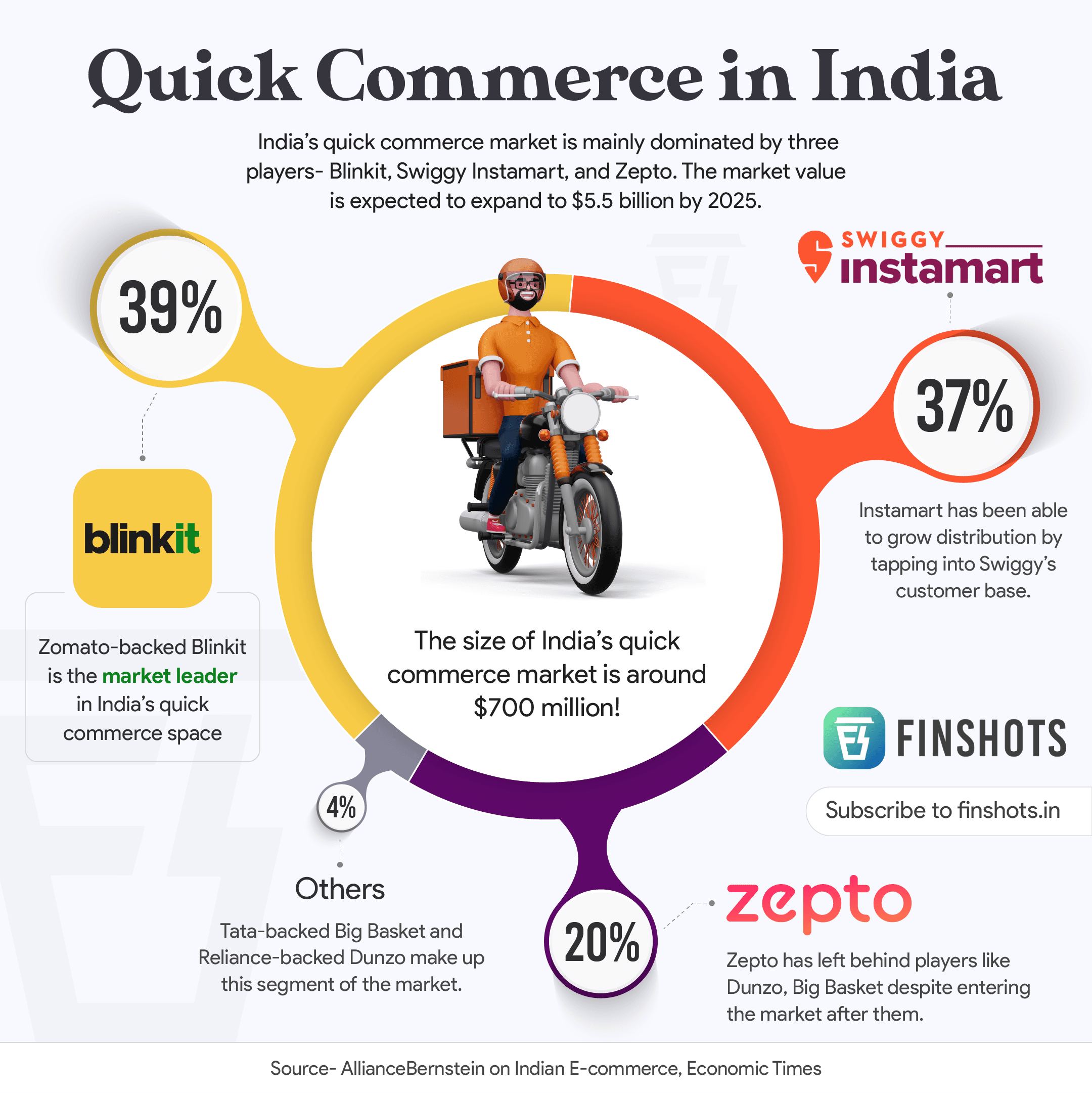
Quick commerce in India promised ten-minute deliveries. It delivered losses instead. The sector hit $3.34 billion in 2024. Projections show $5.38 billion by end of 2025. By 2029, estimates reach $10 billion. Not the explosive growth early investors imagined, but steady. The model works like this. Order vegetables on your phone. A rider picks them from a dark store 500 meters away. Your doorbell rings in twelve minutes. Magic.
Except the math doesn’t work.
The Pricing Paradox
Quick commerce uses a clever trick. Sell some items at a loss. Make money on others. Fresh vegetables cost 50% less than your local vendor. Packaged foods run 5-10% cheaper than printed prices. These are loss leaders. They get you to open the app. The profits hide in fruits sold at premium prices. Exotic imports carry hefty markups. High-margin products subsidize the cheap ones. Average order values climbed 20-30% across platforms. That should fix the economics. Except that it doesn’t.
Dark stores cost ₹6-7 million upfront. Real estate in dense urban areas burns more cash. Then you need riders, technology, marketing. The fixed costs never stop. Last-mile delivery kills profitability. Each order goes separately. No consolidated runs. No efficiency. Just cash bleeding out with every ten-minute promise.
The Numbers Don’t Lie
India now has 1,290 dark stores. Swiggy Instamart leads with 500. Blinkit runs 450. Zepto operates 340. Flipkart Minutes added 300+ since August 2024. Revenue grew. Losses grew faster. Swiggy’s cash dropped from over $1 billion in Q3 FY25 to $620 million in Q1 FY26. That’s not a business. That’s a bonfire. Companies slowed dark store expansion. They had no choice. The land grab ate too much capital.
Platforms tried selling mobile phones and electronics to generate revenue. Premium products, fat margins, higher order values. Perfect, right? Wrong.
Quick commerce means no returns. Buy a ₹50,000 phone, get it in ten minutes, but can’t return it if something’s off. Customers balked. The brand perception didn’t fit either. You buy vegetables on impulse. You research phones for weeks. Different purchase psychology entirely. Blinkit quietly backed away from electronics. The category failed. The lesson stuck.
Entry of Real Players
Here’s what matters now. Quick commerce isn’t for startups anymore. Blinkit started as Grofers in 2013. It couldn’t survive alone. Zomato bought it in 2022 for $570 million. Now Zomato’s profits keep Blinkit alive.
Swiggy Instamart runs on food delivery cash flow. Flipkart Minutes has Walmart’s billions behind it. Tata owns BigBasket, which runs BB Now. Notice the pattern? Every survivor has a wealthy parent.
Zepto is the lone exception. Pure-play quick commerce, no other business. They’ve raised over $1.3 billion. Valuation hit $5 billion recently. Impressive but dangerous. Zepto burns cash with no revenue diversification. They need profitability or acquisition. There’s no third option.
Flipkart’s Blitzkrieg
Flipkart Minutes launched in August 2024. Already 300+ stores operational. Target is 800 by year-end. The expansion targets tier-2 and tier-3 cities. Guwahati, Ambala, Patna. Places where Blinkit and Zepto haven’t penetrated yet. Orders double every 45 days. That’s faster than anyone else.
But here’s the intelligent part. Flipkart uses dynamic cart minimums. Too many orders? Minimum cart value jumps to ₹500. Riders scarce? Same thing happens. Orders slow? Workers idle? Drop the minimum to ₹99.
It’s surge pricing without calling it that. Customers see cart minimums change, not delivery fees. Psychology matters. High minimums filter out low-value orders during peak times. Unit economics improve. Low minimums keep dark stores productive during slack periods. Traditional e-commerce can’t do this. Amazon commits to free delivery thresholds. Flipkart Minutes adjusts in real-time. The system screens customers naturally. Price-sensitive shoppers wait for ₹99 windows. Time-sensitive ones pay ₹500 minimums. Flipkart captures both without cannibalizing itself.
Amazon’s Absence
Amazon tested “Amazon Tez” in Bangalore neighborhoods early 2025. Ten to fifteen minute deliveries, small pilot. It went nowhere. Amazon Fresh still does two-hour slots in most cities. Regular grocery delivery takes three days or more. They can’t even get that right consistently.
Amazon’s logistics advantage in e-commerce means nothing here. Massive fulfillment centers don’t help with ten-minute delivery. You need dense dark store networks. Their DNA is wrong for this game. Build big warehouses, consolidate shipments, optimize truck routes. That’s the Amazon way. Quick commerce needs the opposite.
The Future Model
Quick commerce is evolving into something else. The ten-minute promise survives but as a premium service. Platforms now charge service fees. Handling fees, convenience fees, small cart fees. Customers complain but pay anyway. The real money comes from elsewhere. Retail media is growing fast. Brands pay platforms for advertising and direct-to-consumer channels. D2C brands especially.
Zepto launched a wholesale tab. Deep discounts for bulk purchases, delayed delivery. It’s not quick commerce anymore. It’s slow commerce with better margins. The future company offers both. Premium quick delivery with fees. Budget slow delivery with discounts. Two models, one platform. Blinkit turned contribution margin positive in 2024. First green shoot in the sector. But it took Zomato pumping billions in to get there. Technology helps. AI optimizes delivery routes. Analytics manage inventory. Dynamic pricing maximizes profitability in real-time.
Better store throughput matters more than new stores. Get more orders from each dark store. Reduce fixed cost per delivery.
Reality of Gig Workers
Union Budget 2025 announced health insurance for gig workers. Nearly one crore workers covered under Ayushman Bharat-PMJAY. ₹5 lakh coverage per family annually. Registration happens through e-Shram portal. Workers get identity cards. It’s too little, too late.
The gig workforce will hit 23.5 million by 2030. The insurance covers less than half. Health coverage doesn’t solve the real problems anyway. Delivery partners complain about wage transparency. Platforms don’t provide clear earnings breakdowns. Wage theft happens in the shadows. Blinkit cut minimum compensation from ₹25 to ₹15 per order. Down from ₹50 in 2021. The ₹4 peak-hour incentive disappeared entirely. Metro city delivery partners might net ₹25-30k monthly. Tier-2 and tier-3 cities see ₹12-15k. That’s below minimum wage after fuel and deductions. For twelve-hour shifts, six days a week.
Tips vanish into algorithms. Customers add tips through apps. Riders don’t know if they received them. Zero transparency. The Telangana Gig and Platform Workers Union accused Zepto of advertising ₹40,000-60,000 monthly earnings. Reality is far lower. Most delivery partners don’t know tips exist. The platforms could fix this with one line of code showing tip amounts. They choose not to.
Quick commerce runs on exploited labor. Health insurance is a band-aid on a dislocated shoulder.
The Consolidation
The market is consolidating fast. Deep pockets win. Flipkart has 500 million users and Walmart money. Swiggy has food delivery profits. Blinkit has Zomato backing it. BigBasket has Tata Digital. Standalone quick commerce is dead. You need multiple revenue streams and a wealthy parent.
Zepto is impressive but vulnerable. They raised $350 million recently at $5 billion valuation. The cash won’t last forever. They need profitability or acquisition. The graveyard fills with companies that couldn’t pivot fast enough. Quick commerce in its pure form doesn’t work. The hybrid model is the only survivor.
What Comes Next
Quick commerce isn’t going anywhere. The model may be permanent now. But the business behind it looks different. Successful platforms will offer tiered services. Premium ten-minute delivery with fees. Budget delayed delivery with discounts. Revenue will come from multiple sources. Product sales, retail media, service fees, advertising commissions. No single revenue stream dominates.
Supply chains will get leaner. The “milk run” model for planned orders coexists with on-demand quick delivery. Efficiency matters more than speed alone. Companies still burning cash on pure ten-minute delivery will die. They can’t compete with well-funded hybrids or adapting e-commerce giants.
The battlefield has clear winners emerging. Flipkart Minutes grows fastest. Blinkit turned profitable first. Swiggy has the largest network. Zepto needs to pivot or get acquired. Pure-play quick commerce has no future.
Make a Change
The workers who make this possible get insurance that covers a fraction of them. Tips they don’t know about. Wages that drop every quarter. Transparency that doesn’t exist. Quick commerce works for customers. It works for platforms moving toward profitability. It doesn’t work for the riders delivering in rain and traffic for ₹15 per order. That’s the real cost of ten-minute delivery. Someone always pays. Just not the people ordering groceries from their couch.
Next time you order, hand the delivery partner ₹10 in cash. Don’t use the app’s tip feature. Tips added through apps rarely reach riders. The money vanishes into platform algorithms and payment processing. No transparency exists. Riders don’t know if you tipped or how much. Cash goes directly to the person who rode through traffic to deliver your order. No middleman, no algorithm, no questions.
₹10 won’t fix systemic exploitation. But it puts money in the pocket of someone earning ₹15 per delivery. Someone working twelve-hour shifts for below minimum wage. Someone the platforms pretend to protect with insurance that covers less than half the workforce.
The platforms won’t tell you this. They want you to believe their payment systems are fair and transparent. They’re not.
Keep the cash ready. Hand over ₹10 in cash. It’s the least we can do for the people making ten-minute delivery possible.
References:
- India’s Quick Commerce Market Size and Key Players – India Briefing (July 2025) https://www.india-briefing.com/news/quick-commerce-market-in-india-and-key-players-35348.html/
- Quick Commerce Market In India Size, Share, Trends & Industry Outlook – Mordor Intelligence (June 2025) https://www.mordorintelligence.com/industry-reports/q-commerce-industry-in-india
- Quick Commerce – India | Statista Market Forecast https://www.statista.com/outlook/emo/online-food-delivery/grocery-delivery/quick-commerce/india
- India Quick Commerce Market Report – Nexdigm (July 2025) https://www.nexdigm.com/market-research/report-store/india-quick-commerce-market-report/
- Quick Commerce Statistics For 2025 (Market Size & Trends) – ShopTrial (May 2025) https://www.shoptrial.in/quick-commerce-statistics/
- 10 Quick Commerce Trends Reshaping Indian Retail in 2025 – Mukund Mohan (May 2025) https://mukundmohan.blog/2025/05/19/10-quick-commerce-trends-reshaping-indian-retail-in-2025/
- India’s Quick Commerce Market Set to Grow 40% Annually Until 2030 – Outlook Business (March 2025) https://www.outlookbusiness.com/start-up/news/indias-quick-commerce-market-set-to-grow-40-annually-until-2030-says-report
- Quick commerce sector to grow 75-85% in 2025, reach $5 billion GMV – Business Standard (March 2025) https://www.business-standard.com/industry/news/quick-commerce-sector-to-grow-75-85-in-2025-reach-5-billion-gmv-125031300389_1.html
- Flipkart Minutes expands footprint with 200 dark stores in 14 cities – Business Standard (April 2025) https://www.business-standard.com/companies/news/flipkart-minutes-expands-footprint-with-200-dark-stores-in-14-cities-125040401270_1.html
- Flipkart Minutes plans 800 dark stores by 2025-end – Retail4Growth https://www.retail4growth.com/news/flipkart-minutes-plans-800-dark-stores-by-2025-end-7236
- Flipkart expands quick commerce footprint with 200 dark stores – Indian Startup News (April 2025) https://indianstartupnews.com/news/flipkart-expands-quick-commerce-footprint-with-200-dark-stores-in-14-cities-8929619
- Flipkart ramps up quick commerce: 500 dark stores before Big Billion Days – Business Standard (February 2025) https://www.business-standard.com/companies/news/flipkart-expands-quick-commerce-500-dark-stores-big-billion-days-2025-125020701179_1.html
- Flipkart’s Quick Commerce Arm Plans 800 Dark Stores by End of 2025 – Angel One (April 2025) https://www.angelone.in/news/flipkarts-quick-commerce-arm-plans-800-dark-stores-by-end-of-2025
- Flipkart To Double Down On Quick Commerce In 2025 – Inc42 (April 2025) https://inc42.com/buzz/flipkart-to-double-down-on-quick-commerce-in-2025/
- Budget 2025: Gig Workers Health Insurance Announced Under Govt Scheme – HDFC Bank https://www.hdfcbank.com/personal/resources/learning-centre/union-budget/budget-2025-gig-workers-health-insurance-announced-under-govt-scheme
- Union Budget 2025: Health Insurance Updates for Gig Workers – PolicyX (August 2025) https://www.policyx.com/health-insurance/articles/union-budget-health-insurance-for-gig-workers-ayushman-bharat-updates
- Budget 2025-26: Government expands health insurance coverage to gig workers – Business Today (February 2025) https://www.businesstoday.in/union-budget/story/budget-2025-26-government-expands-health-insurance-coverage-to-gig-workers-463109-2025-02-02
- Government announces social security measures for India’s gig workers – British Safety Council India (March 2025) https://www.britsafe.in/safety-management-news/2025/government-announces-long-awaited-social-security-and-health-insurance-measures-for-india-s-gig-workers
- India Gears Up To Launch Landmark Social Security Scheme For Gig Workers – Pension Policy International (June 2025) https://www.pensionpolicyinternational.com/india-gears-up-to-launch-landmark-social-security-scheme-for-gig-workers/
- Gig workers to be covered under Ayushman Bharat – ANI News (March 2025) https://www.aninews.in/news/business/gig-workers-to-be-covered-under-ayushman-bharat-preparations-for-scheme-rollout-almost-complete-labour-secretary20250325194600/
- Delivery Worker Wages and Transparency Issues:
- Kunal Kamra questions Blinkit CEO over gig worker wages – Social Samosa (January 2025) https://www.socialsamosa.com/industry-updates/kunal-kamra-targets-blinkit-ceo-gig-worker-wages-8585139
- How Much Do Blinkit, Zepto, Zomato & Swiggy Delivery Partners Really Earn? – Bitveen (September 2025) https://www.bitveen.com/how-much-do-blinkit-zepto-zomato-swiggy-delivery-partners-really-earn-the-harsh-reality/
- Zepto Faces Workers’ Backlash In Telangana – MediaNama (May 2025) https://www.medianama.com/2025/05/223-zepto-workers-backlash-telangana/
- Why Blinkit Delivery Workers Are Protesting in Varanasi? – Outlook Business (April 2025) https://www.outlookbusiness.com/start-up/e-commerce/why-blinkit-delivery-workers-are-protesting-in-varanasi-the-latest-gig-workers-debate-explained
- Kunal Kamra begins 2025 by targeting blinkit CEO – afaqs! (January 2025) https://www.afaqs.com/news/social-media/kunal-kamra-begins-2025-by-targeting-blinkit-ceo-over-delivery-partner-wages-8584096
- Blinkit Delivery Gig Workers’ Issue – Law Wire (May 2023) https://lawwire.in/blinkit-delivery-gig-workers-issue/
- Sweat, surveillance, and silence: Lives at the margins of India’s quick e-commerce sector – Newslaundry (May 2025) https://www.newslaundry.com/2025/05/01/sweat-surveillance-and-silence-lives-at-the-margins-of-indias-quick-e-commerce-boom
- India’s E-commerce Boom: Growth, Trends & Future Prospects – IBEF https://ibef.org/industry/ecommerce
Leave a Response