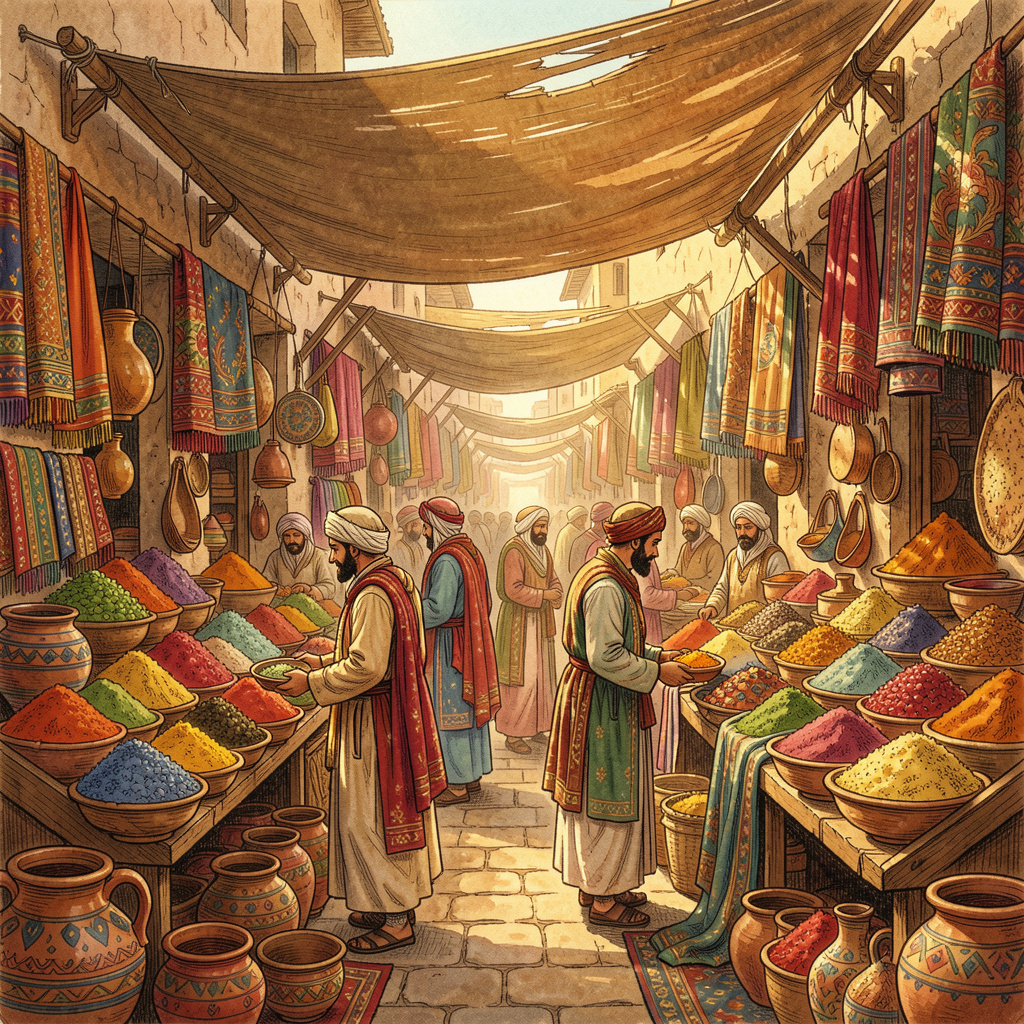
The Pre-Mughal Persian-Indian Cuisine
When Mughal food-attribution defenders are pressed, they often retreat to a secondary position. They concede the antiquity argument but claim: "The Mughals brought Persian culinary technique and vocabulary to India." This argument also fails.
The Persian-Indian cultural and culinary exchange is ancient and real. But it predates the Mughals by over a thousand years.
The Periplus of the Erythraean Sea (circa 50-100 CE)
The Periplus of the Erythraean Sea (Latin: Periplus Maris Erythraei) is a short, anonymous Greek merchant's guide from the mid-1st century CE (commonly dated to 40–70 CE) that describes navigation and trading opportunities from Roman Egypt down the Red Sea, along the Horn of Africa, and across to the western coast of India
These ports include Barbarikon (near modern Karachi) and Barygaza (near modern Bharuch in Gujarat). Wine moved east from Persia into India. Spices (cardamom, pepper, turmeric) moved west from India into Persia. The food vocabulary exchange began here, fifteen centuries before any Mughal was born.
Achaemenid Control of Gandhara (518 BCE Onward)
Under Darius I, the Achaemenid Persian Empire controlled Gandhara (modern northwest Pakistan) and the lower Indus region for two centuries. Persian court culture was embedded in northwestern Indian life for 200 years before Alexander arrived. This is where the Persian-Indian lexical overlap begins, not in Akbar's court.
Persian influence is evident in Mauryan court ceremonials, Asokan architecture (particularly the bell-shaped capitals with Persian parallels), and the use of the title "Satrap" by later Saka rulers of northwestern India.
H.G. Rawlinson is Hugh George Rawlinson (1880–1957), a British historian and scholar of Indian history. He was a prolific writer on ancient India and its connections with the Western world, best known for his 1916 book "Intercourse between India and the Western World from the Earliest Times to the Fall of Rome."
King Chach of Sindh (7th Century CE)
The Chachnama, is an Arabic narrative. It begins with the rise of Chach, a Brahmin who became the ruler of Sindh after the decline of the Rai dynasty. It then details the Arab invasion led by Muhammad bin Qasim under the orders of the Umayyad governor Hajjaj bin Yusuf. The text concludes with a dramatic epilogue about the tragic end of Muhammad bin Qasim, featuring a story where the daughters of the defeated King Dahir trick the Caliph into ordering Qasim's death as revenge.
The dating of Chachnama whether it is a translation of 8th century text or 12th centurey original narrative is debatable. But it documents that King Chach maintained matrimonial and diplomatic alliances with Persian courts in the 7th century CE. This is nine hundred years before Babur was born. Persian queens brought court customs, vocabulary, and food traditions into Sindh through these alliances.
Words like sabzi (vegetables), kofta (kufta: pounded meat), and pulao (polow) entered the Indian culinary lexicon through these ancient pre-Islamic, pre-Mughal corridors. Attributing these Persian-loan words to the Mughal court is like saying English borrowed "algorithm" and "internet" from Americans because Americans use them today.
Contemporary Europeans at the Mughal Court
There is another category of primary source that food experts appear entirely unfamiliar with: 17th-century European eyewitness accounts. These were written by travelers who actually attended the Mughal court. They had no incentive to flatter either the Mughal dynasty or later nationalist sentiment. Their accounts provide a cold corrective to romantic mythology.
Niccolao Manucci - Storia do Mogor (1653-1708)
Niccolao Manucci was a Venetian adventurer. He arrived in India as a teenager, served in the Mughal military and medical establishment, and spent over fifty years in India. His memoir Storia do Mogor ("History of the Mughal Empire"), written in Italian and Portuguese, is one of the most detailed contemporary accounts of Mughal court life in existence.
Manucci's descriptions of the Uzbek (Osbeque/Uzbak) soldiers and delegations at the Mughal court are illuminating. He records Uzbek women serving as armed guards: "strong-limbed," skilled with matchlocks, swords, and arrows. He documents Uzbek delegations bringing gifts of dried fruits, horses, and leather goods - the typical produce of a nomadic pastoral economy. Uzbek attendees are described throughout in purely martial and political terms.
There is no suggestion of culinary sophistication or gastronomic contribution anywhere in his account. Rather Manucci deprecated their dining habits.
François Bernier - Travels in the Mogul Empire (1656-1668)
François Bernier was a French physician. He spent twelve years at the Mughal court in Delhi and Agra, serving as physician to Prince Dara Shikoh and later at Aurangzeb's court. His Travels in the Mogul Empire is considered one of the most reliable European primary accounts of 17th-century Mughal India.
Bernier's descriptions of Central Asian visitors at the Mughal court document three things:
- Coarse dietary habits: Central Asian delegations consumed boiled, heavily salted meat with no refined spicing or presentation.
- Absence of dining etiquette: They ate greedily, handled food carelessly, and wiped grease on their clothing.
- Conspicuous lack of hygiene: Bernier noted they were markedly unwashed by the standards of both Indian and European court observers. Their clothing was stained with animal fat and smelled of horse grease and salted meat.
These witnesses saw who brought what to the table, literally. Their accounts document that the Central Asian visitors were observed by contemporaries as crude, These were the people who were from the same region as Mughals. They were pastoralist who entirely lacked culinary culture. The food mythology credits them with inventing India's most sophisticated dishes without any historical basis.
The 20th-Century Commercial Fiction of "Mughlai Cuisine"
If the Mughals did not invent Indian food, where did the "Mughlai cuisine" brand come from? The answer is the mid-20th century restaurant industry of Delhi, specifically the period following Partition in 1947.
After Partition, large numbers of Punjabi, Kashmiri, and western UP migrants arrived in Delhi. Many were skilled cooks and food entrepreneurs. They opened restaurants in Old Delhi, Karol Bagh, and Connaught Place. To differentiate their establishments and command premium prices, they gave their dishes royal names:
- Shahi Paneer ("Royal Cottage Cheese")
- Mughlai Paratha ("Mughal-style Flatbread")
- Nawabi Biryani ("Nawab's Rice")
- Sultani Dal ("Sultan's Lentils")
Moti Mahal in Daryaganj is arguably the most famous of these establishments. It is credited for popularising tandoori chicken in its mass-market form. It is a 1947 Partition-era restaurant, opened by Kundan Lal Gujral, a Hindu Punjabi from Peshawar. The tandoor is an ancient northwestern Indian cooking vessel. The marinades Gujral used were traditional Punjabi curd-spice preparations. Their roots predate any Mughal emperor by centuries. Moti Mahal's genius was to brand this as "Mughal-style" cooking. Delhi's newly urbanising population, hungry for romance and royal prestige, accepted it completely.
This post-Partition restaurant branding created "Mughlai cuisine" as a commercially recognizable category. Prior to 1947, no Delhi restaurant menu, food guide, or newspaper food column used the term "Mughlai cuisine" as a distinct commercial category.
When Food Writers arrive in Delhi to write the travelogue, they interviewed these restaurant owners and their descendants. They repeat the marketing myths their grandfathers had invented to sell food. Writers publish those myths as history.
Duty of Honest Historians
A genuine food historian researching the origin of kulfi or pulao would be required to do five things.
1. Read primary sources in their original languages (or consult specialists who have). For Indian food history, this means Sanskrit, Prakrit, Pali, Tamil, Kannada, and regional vernacular texts alongside Persian court chronicles.
2. Apply source criticism (Quellenkritik): asking who wrote a document, for whom, and what it omits. An imperial propaganda text like the Ain-i-Akbari must be cross-referenced against non-courtly, non-Mughal, regional sources.
3. Test claims against empirical reality. The kulfi vendor-density test makes this simple: if kulfi were a centuries-old Mughal imperial staple, it should be as ubiquitous as kheer in Delhi today. It is not. Material reality contradicts the origin myth.
4. Acknowledge the pre-Islamic, pre-Mughal record: the Manasollasa (1130 CE), the Pakadarpana, the Lokopakara (1025 CE), the Kshirapaka dairy tradition, and two thousand years of documented Persian-Indian trade all predate the Mughal dynasty comprehensively.
5. Cross-reference with contemporary eyewitness accounts: Bernier's and Manucci's documentation of Central Asian visitors at the Mughal court provides first-hand evidence of their pastoralist, non-gastronomic food culture.
The food of the Gangetic plains is the product of a civilisation at least three thousand years old. It is continuously documented in Sanskrit and regional primary sources. It was shaped by ancient trade corridors with Persia, Greece, and Southeast Asia. It was refined through centuries of agricultural wealth and culinary innovation. None of it needed a Central Asian pastoralist warlord arriving in 1526 to invent it.
The myth of Mughal culinary invention is a 20th-century commercial fiction. It was laundered into pseudo-history by unqualified food writers. It was amplified by Wikipedia's citation mechanics. It is repeated uncritically by media and popular culture.
It is time to retire the myth of Muglai cusine.
References:
- Anonymous. Periplus of the Erythraean Sea. Greek, circa 50-100 CE. Trans. W.H. Schoff. New York: Longmans, Green and Co., 1912.
- https://archive.org/details/periplusoferythr00schouoft
- Alternate copy: https://archive.org/details/in.ernet.dli.2015.148197
- Gutenberg Copy: https://www.gutenberg.org/files/55054/old/55054-h/55054-h.htm#1
2. HISTORY OF INDIA BY Narendra Krishna Sinha
3. Intercourse between India and the Western World from the Earliest Times to the Fall of Rome by H.G.Rawlinson 4. Manucci, Niccolao. Storia do Mogor (History of the Mughal Empire). Italian/Portuguese, 1653-1708. Trans. William Irvine. London: John Murray, 1907. - Vol. 1: https://archive.org/details/storiadomogororm01manuuoft - Vol. 2: https://archive.org/details/storiadomogororm02manuuoft - Vol. 3: https://archive.org/details/dli.ernet.16513
4. Bernier, François. Travels in the Mogul Empire, 1656-1668. French, 1670. Trans. Archibald Constable; rev. Vincent Smith. Oxford: Oxford University Press, 1916. - https://archive.org/details/travelsinmogulem00bernuoft - IGNCA copy: https://archive.org/details/in.gov.ignca.5104
Leave a Response