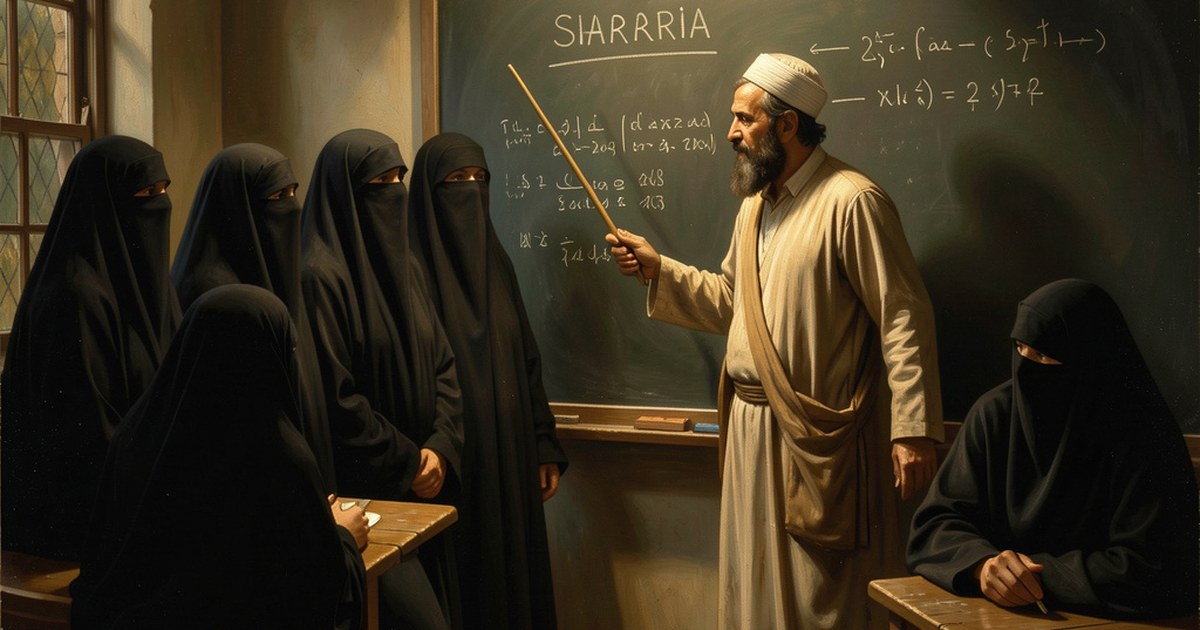
Modern Jihad: Demand of Sharia for All of India
Background
Before 1937, most Muslims in British India were governed by local customs in family matters. This position was changed by the government headed by Congress Party in 1937. The Muslim Personal Law (Shariat) Application Act, 19371 is the legal source that makes Sharia applicable to Muslims in India. Section 2 of the Act states that for a list of personal matters, the "rule of decision" for Muslims shall be the Muslim Personal Law (Shariat).
The question arises: what is Sharia?
Islamic Law in India
Sir Dinshah Fardunji Mulla (1868-1934) was not a Muslim. He was a Zoroastrian Parsi and a distinguished judge of the Bombay High Court. He was the scholar of Islamic law in the academic and professional sense. He was mostly called D.F. Mulla, in short.
Mulla dedicated his legal career to mastering, systematizing, and expounding Islamic jurisprudence (fiqh) as it applied in British India. He did not just compile rules. He analyzed Hanafi and Shafi'i legal texts, reconciled them with judicial precedents, and presented them in a logical, accessible format for common law courts. His life's work was the study and teaching of Islamic law.
D.F. Mulla's book, Principles of Mahomedan Law,3 is not a statute passed by Parliament. But over time, it has acquired such authority that courts frequently cite it by section numbers, almost as if it were a codified law.2 When Indian courts need to determine a rule of Muslim Personal Law (on matters like marriage, inheritance, or gifts), they routinely turn to Mulla's text. It is so frequently cited and followed that it functions as a "quasi-statute."
A person does not need to be a follower of a religion to be an authoritative scholar of its legal system. In fact, many of the greatest scholars of Hindu law, Islamic law, and comparative religion have been academics and jurists from outside the faith. Mulla's authority came from his rigorous legal scholarship, not from his personal religious identity.
Thus, Muslims in India follow a law interpreted by a non-Muslim. But to the credit of book publishers, this book has been revised and edited by Muslims as well. M. Hidaytullah, former Chief Justice of India, edited and revised the book from 1968 to 1990.
Demand for Sharia
Islamic scholar from Kerala, Kanthapuram A.P. Aboobacker Musliyar, describes himself as the Grand Mufti of India. Speaking at a conference in Kochi, he argued that women should remain within their homes and not enter the public sphere. He controversially compared women to "gold ornaments" that should be kept "safely inside a box," claiming that exposing them to the public could lead to "great destruction."4
He has now declared that Sharia will be proclaimed "no matter who opposes it." He announced plans to hold Sharia conferences across all districts of Kerala. His call was subsequently endorsed by Maulana Sajid Rashidi, the president of the All India Imam Association. The Association claims to represent imams across the country. His endorsement signals that this is not a fringe demand.
For the moment we leave aside the question whether Sharia can at all be applied to India. India is governed by the Constitution. That is a separate legal matter. But is it even practicable?
Which Sharia?
There is no single "Sharia law" to simply copy-paste. It is a legal tradition interpreted and applied differently in every country and in every century. What operates in Saudi Arabia does not match what operates in Malaysia. What one school of thought accepts, another rejects. Sharia is not just a penal code. It is an all-encompassing guide to life, covering everything from personal hygiene to commerce to statecraft.
The honest answer to "which Sharia?" comes from history itself.
The Sharia of Aurangzeb
In the late 17th century, the Mughal Emperor Aurangzeb set out to answer this question for his empire. He commissioned a monumental legal project. He gathered around 500 Islamic scholars from across the subcontinent, Iraq, and the Hejaz. Their task was to compile one authoritative code of Islamic law based on the Hanafi school of jurisprudence. The project took about eight years to complete.
The result was the Fatawa-e-Alamgiri, also known as Al-Fatawa al-Hindiyya.5 It became the state law of the Mughal Empire, covering personal law, family law, property, commerce, and penal matters. It was the "official Sharia" of its time.
When the British East India Company took control, it needed a legal framework for Muslim subjects. It defaulted to the Hanafi Sharia as codified by Aurangzeb. This gave one narrow, state-sponsored interpretation of Islamic law an outsized influence that has never been corrected.
Thus, the Fatawa-e-Alamgiri became the unacknowledged ancestor of what we call Muslim Personal Law in India today. Its contents are deeply contentious. The Fatawa formalized the office of the Muhtasib, a censor of public morals empowered to enforce religious doctrine. It contained provisions on the legal rights of a Muslim man over captive women taken in war. These are the most decent subjects worth mentioning here. Read the Fatawa in full to understand the extent of contention.
These are not abstract historical footnotes. They represent a state-sanctioned legal framework with a documented lineage running directly into modern Indian courts.
When Kanthapuram Musliyar demands Sharia, which Sharia does he mean? In India, the answer, by default, is Aurangzeb's Sharia. That is the version sitting inside the legal system.
The Laws that Contradict the Quran
The very laws passed in the 1930s to apply Sharia are themselves considered un-Quranic by many Islamic scholars.
The Dissolution of Muslim Marriages Act, 1939 allows a Muslim wife to seek divorce from a court on specific grounds: the husband being missing for four years, failing to provide maintenance for two years, or cruelty.6 Critics point out that this contradicts Quranic principles. The Quran (verses 4:35, 4:128, 4:130) permits separation when reconciliation fails.
The Quran does not make the wife's freedom conditional on proving a specific fault in a court. The Act imposes exactly that burden on women regarding their right of divorce. Meanwhile, a Muslim husband retains the unilateral right to divorce his wife at will. This asymmetry is being challenged in the Supreme Court as a violation of constitutional equality.
Inheritance under the 1937 Act applies classical Hanafi law. A daughter inherits half the share of a son. A widow inherits a fraction of what a widower would.6 Many legal scholars argue that the Quranic verses on inheritance (4:11) describe shares for heirs as a civil right, not as an "essential religious practice" protected under Article 25 of the Constitution. On that reading, these inheritance rules should be struck down under Article 14 (equality) and Article 15 (non-discrimination).
The Supreme Court has acknowledged this discrimination. It has described the Uniform Civil Code as a "constitutional ambition." But it has also declined to strike down the laws outright, preferring a legislative solution over creating a legal vacuum.
The result is this: the laws described as "Sharia" in India were written by a Zoroastrian judge, codified by a Mughal emperor, adopted by British colonizers, and are now held to violate both the Quran and the Constitution. Yet this is what is being defended as sacred law.
A Power Grab Disguised As Piety
The demand for Sharia is a demand for power. It is not a demand for legal clarity. The clerics making this demand do not agree among themselves on what Sharia requires. No two countries that apply Sharia apply it in the same way. No two schools of Islamic jurisprudence reach the same conclusions on contested questions.
The Maulana who demands Sharia implicitly holds the power to define what Sharia is. That is the real game. In the name of Sharia, it is the word of a Maulana. He will call it interpretation or fiqh or some other Arabic word to justify it.
In any case, the Indian Constitution does not permit a parallel legal sovereign. No religious authority can override fundamental rights. No community can opt out of constitutional protections for its women and children. No one can run a parallel legislative body speaking from his mouth. But that is what is being sponsored here.
It is not Sharia. It is sovereignty for the Maulana in the guise of Sharia. That is Jihad.
References:
Leave a Response