Protest Call by the Cockroach Janta Party.
The Cockroach Janta Party called a protest at Jantar Mantar on 10 October 2026. They demanded the resignation of Chief Election Commissioner Gyanesh Kumar. The Government of India sent a clear message. Delhi is not Dhaka or Kathmandu. India will not be toppled from the streets.
At 5:00 AM on October 10, 2026, police arrived in Sector 56, Gurugram. They knocked on the door of Dhruv Rathee. The AAP influencer was taken into preventive custody. With millions of followers, he thought he was invincible.
Simultaneously, police acted at Delhi's airports and railway stations. They detained Abhijeet Dipke, Saurav Das, and Ashutosh Ranka. All three lead the Cockroach Janta Party (CJP). Over one hundred and fifty field coordinators were rounded up before sunrise.
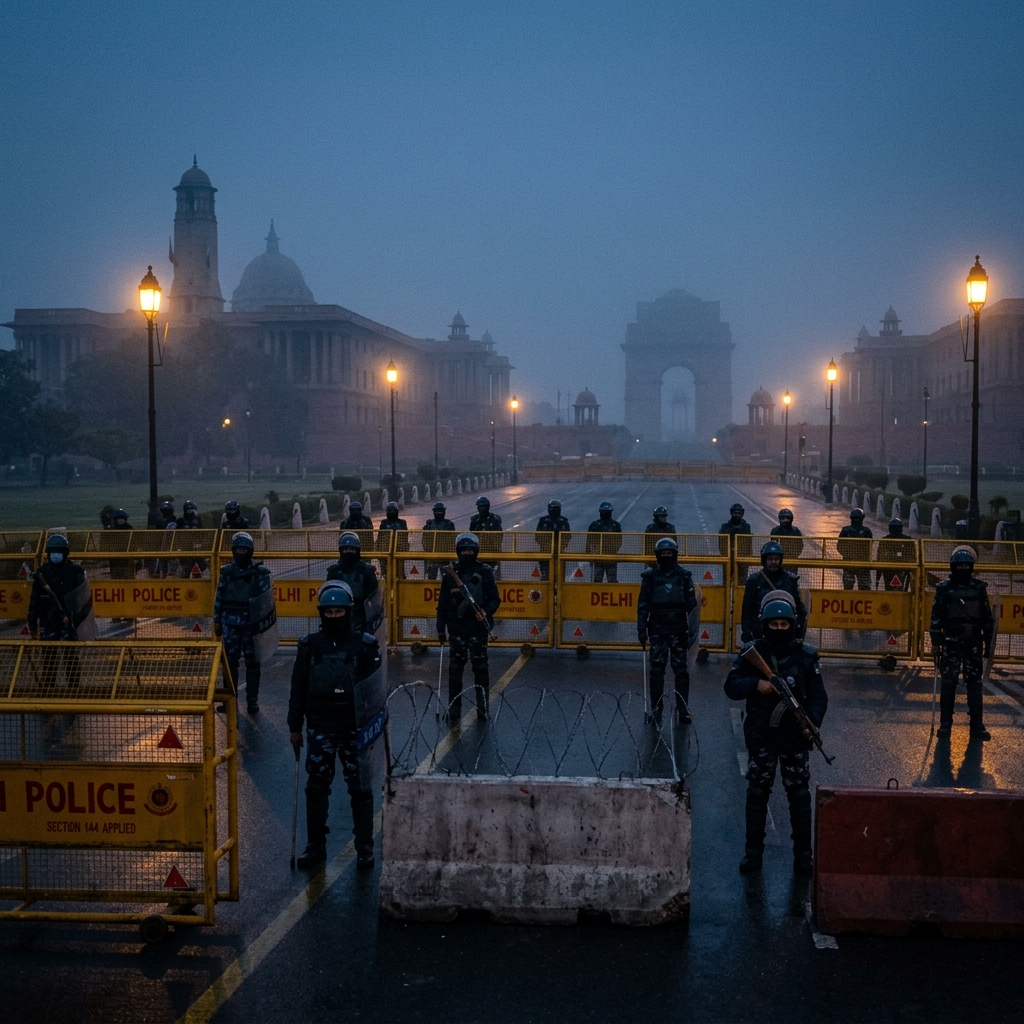
By dawn, Central Delhi was a fortress. Thirty-five thousand security personnel choked the capital. Twenty-six thousand paramilitary troops in riot gear took up positions. They were deployed to enforce Section 163 of the Bharatiya Nagarik Suraksha Sanhita. It prohibits the assembly of more than four persons. Notices were posted at Jantar Mantar, the proposed venue.
Barricades, razor wire, and jersey barriers sealed all borders. Multiple central metro stations were completely shut. Student hostels and coaching hubs were placed under strict perimeter watch. Mosques were warned, and they advised followers not to join illegal protests.
The Western press immediately cried foul. They called it authoritarian paranoia and administrative panic. They accused the government of fearing a satirical student movement. If they have not yet, they certainly will.
They misunderstand what they are looking at. This is not panic. It is the active preemption of an engineered Color Revolution. The state is drawing a line in concrete and steel. The message to external actors is clear.
Delhi is not Dhaka. India is not Nepal. This state will not be toppled from the street.
The Front and the Hurriyat Playbook
In modern hybrid warfare, front organizations are essential. In 1993, US diplomat Robin Raphel arrived in New Delhi. Her mission was simple: consolidate fragmented militant factions in Kashmir. The result was the All Parties Hurriyat Conference. Terrorists with guns invite state retaliation. A political front in waistcoats provides plausible deniability. It spoke the language of human rights at foreign embassies. Read about it here.
The Cockroach Janta Party serves the exact same purpose. It emerged after casual remarks by Chief Justice Surya Kant. Abhijeet Dipke founded the outfit after returning from Boston. Allegations are that he is motivated by those inimical towards India. CJP claimed twenty million Instagram followers in days through bot farms. On June 6, they held their first protest in brutal heat. Only two hundred confused people showed up. They chanted "Baith jao". The crowd was so naive that it thought it was a revolutionary slogan. Dipke fainted and rested in an air-conditioned car. Read about it here.
They looked like clowns. Yet clowns are useful shock troops in color revolutions. This is how the Maidan protests started in Ukraine. An unregistered, satirical group gives plausible deniability. Unsuspecting youth become human shields for political operators. Any police action is then branded as fascism crushing students.
My research paper on The Mechanics of Cultural Socialism decoded this operational pipeline. It follows Saul Alinsky's Rules for Radicals. Rule 1 manufactures the illusion of mass power through bot followers. Rule 5 deploys ridicule as a potent weapon to disarm opponents. Rule 11 picks, freezes, and polarizes a personal target. Modern street agitators do not practice Gandhi's disciplined dialogue. They execute Gene Sharp's coercive regime-change manual instead. When legacy media loses credibility, digital influencers become the new transmission line.
CJP leaders Abhijeet Dipke, Saurav Das and Ashutosh Ranka were arrested in the aircraft itself. People posted the videos on social media. The video exposed the professional transactional reality. True ideological activists display raw emotion and argue their constitutional rights passionately. Dipke, Ranka, and Das showed no such fire. They surrendered coolly, remarking that they had come to be arrested. The police dryly informed them that they were not under arrest. For these organizers, detention was simply a deliverable on an invoice. It manufactured the headline of victimhood without the discomfort of the street. From June's air-conditioned car to October's aircraft cabin, this revolution remains strictly climate-controlled.
The Cost of Paralysis and July 20
In December 2025, I warned about this paralysis. The state loses power when it fears foreign criticism. It falls into the Image Trap and hesitates to enforce law.
On July 20, 2026, that warning came true. The CJP escalated its month-long sit-in over NEET exam leaks. They launched a march titled "Sansad Chalo" toward Parliament. The government hesitated, hoping it would fade away. Instead, thousands clashed with police on Parliament Street. Tear gas, water cannons, and lathis filled the avenue. Dozens were injured on the opening day of Parliament.
Later, facial recognition cameras revealed a startling fact. Over 2,500 individuals with criminal records had moved through the crowd. The surveillance caught the crime after the fact. It failed completely to prevent the riot.
Then the government surrendered. Education Minister Dharmendra Pradhan resigned within five days. FIRs were dropped and compensation was promised. In street warfare, concession to violence invites further escalation. The organizers learned that disorder forces state capitulation. The government was left with egg on its face.
The Constitutional Ploy
Having removed a minister, the organizers escalated their demands. They targeted the Chief Election Commissioner, Gyanesh Kumar. The pretext was the revision of electoral rolls. He is a Constitutional Authority. He can only be removed by an impeachment vote in Parliament.
This demand is also blatantly dishonest. A petition on this revision is already before the Supreme Court. If justice is the goal, the forum is the courtroom. Instead, they demanded his resignation on the street. This is an attempt to enforce a mob veto. It replaces constitutional law with street intimidation.
This follows the Dhaka playbook to the hilt. In August 2024, Bangladesh began with student quota protests. External handlers and street mobs soon stormed state institutions. The Chief Justice was forced out at gunpoint. Sheikh Hasina fled by helicopter. Muhammad Yunus, a close Western ally, was installed in power.
Nepal lives under similar manufactured fragility. The plan for Delhi was identical. Paralyze Central Delhi, delegitimize the Election Commission, and force regime change. This time, the government moved first.
It appears it had anticipated the move. The relationship with the US is at an all-time low. The American playbook on regime change is well known. When diplomatic pressure fails, the empire resorts to covert friction.

The Lonely Power and the Whiskey Story
In Munich, S. Jaishankar rejected Western pressure on Russian oil. He noted that having multiple options is smart statecraft, not a problem. This domestic firmness mirrors India's geopolitical posture.
Yesterday, the US entered into an agreement with Russia to purchase diesel. It will buy petroleum products directly from Moscow. The hypocrisy is palpable.
In October 2026, Jaishankar went further in New Delhi. He stated that the United States has become a "lonely power." This reflects what I wrote in January 2026: "World Minus One." India is preparing for a world with diminished American reliability.
It also matches Chapter 26 of my book, Accidental Empire of USA. The story of the miser and his whiskey illustrates the USA today. He displayed expensive scotch bottles in a glass cabinet. There were no glasses and no hospitality. During lockdown, he had to drink his collection alone in an empty house.
America is that miser today. It has aircraft carriers, bombers, and nuclear missiles on display. Yet it offers subordination instead of genuine partnership. Allies and partners are turning elsewhere. Resources without authentic relationships create isolation.
The Economic Wall and the Invisible War
Finance Minister Nirmala Sitharaman delivered the same message this week. She announced that US-India trade talks have hit a plateau. She condemned the weaponization of tariffs under the Graham Bill. India will not sacrifice economic growth to obey American sanctions.
In March 2026, the NIA arrested Matthew VanDyke and six Ukrainians. They were training insurgent groups in drone warfare near Myanmar. On July 11, 2026, former US Special Forces operative Jordan Brown was caught at Sonauli. He carried a Chinese passport and tried to slip into Nepal. Local UP farmers tied him with ropes and handed him over.
The US weaponizes indictments: Gupta, Adani, and Bishnoi. When indictments fail to bend Delhi, they activate domestic fault lines. They fund fronts, push influencers, and seek street agitation. The Benevolence of USA is no secret now.
Ground Clashes and the Sacrilege Trap
By afternoon, the mask of peaceful student satire slipped away. Near Regal Theatre in Connaught Place, an aggressive crowd pelted stones. They directly targeted police barricades at the entrance to Parliament Street. Four police officers were injured in the clash. One policeman suffered a fractured arm in a plaster cast. Anarchy and violent confrontation were the operational intent from the beginning.
Another calculated provocation occurred at Gurdwara Bangla Sahib. A contingent from Malerkotla in Punjab took shelter inside the historic shrine. I analyzed Malerkotla's unique geography in a movie review. They carried placards written in Gurmukhi, claiming to be supporters of AAP Punjab. The shrine is traditionally an area of influence for the Akali Dal. This suggests an emerging tactical alignment between AAP and Akalis. Alternatively, it was a raw display of leverage against the center.
The shrine management barred police from entering. The organizers clearly hoped for a police raid inside a Sikh shrine. That would have ignited communal rage across Punjab. Delhi Police displayed commendable tactical patience. They waited outside the gates and arrested the protesters when they exited to head toward Jantar Mantar.
The political patrons moved in to exploit the planned chaos. Mamata Banerjee alongwith other TMC leaders, rushed to Delhi and was promptly detained. AAP leader Manish Sisodia was also arrested in Delhi. The state demonstrated zero tolerance for political arson.
The ruling party openly called out the domestic conspiracy. Nitin Nabin publicly warned Arvind Kejriwal and Rahul Gandhi against spreading anarchy. He cautioned them not to act at the behest of foreign powers. Watch his warning here. This stripped away the pretense of a spontaneous student movement.
The evening ended with calculated political theater from Arvind Kejriwal. The previous day, he promised on video to march to Jantar Mantar with his family. Instead, he remained safely indoors for the entire day. He emerged only at five in the evening outside his Lodhi Estate residence. Saurabh Bhardwaj and Sanjay Singh accompanied him, but his family was nowhere in sight.
The timing was entirely transactional. Preventive custody routinely lapses around sunset. Stepping out at the fag end of the day minimized his time in detention. It secured prime-time television visuals without the discomfort of hours in police lockup. Delhi Police bodily lifted him into a detention bus, delivering the exact photo-op he craved.
In Trumpian English, the message to foreign meddlers is simple: f**k off.
The Line in the Sand
Critics initially branded the massive deployment as administrative overreaction. In reality, the opposition, and its digital proxies fatally underestimated the state. Thirty-five thousand personnel on the streets were not a panic response. They were an uncompromising sovereign statement.
Dhruv Rathee was detained at dawn. Frontline organizers were intercepted before they could reach the venue. Border checkpoints held firm and transit nodes remained tightly controlled. In 2020, the state hesitated and suffered a grueling year-long blockade. On July 20, it hesitated and lost both its minister and its authority.
Today, Delhi executed Kautilyan preemption. The street was firmly denied. The spark was extinguished before it could ignite. Dhaka collapsed because its leaders wavered and lost popular support. Nepal suffers under the same chronic paralysis.
Delhi did not waver. India will not be toppled from the street.
References:
1. All About Cockroach Janta Party and its Protest (June 2026) 2. Is India in Governance Crisis? Chapter 1: The Paralysis in Governance of India (Dec 2025) 3. Imperial Benevolence of USA towards India - Chapter 1: India's Spy Trap (Matthew VanDyke) 4. Robin Raphel - The Architect of Separatism in Kashmir (Chapter 6) 5. Why USA is so Benevolent towards India (Chapter 10) 6. The Invisible War of Power Play between India and USA (Chapter 14, Jordan Brown) 7. India is Preparing for Loss of One Nation (Jan 2026) 8. Accidental Empire of USA - Chapter 26: The Whiskey Story & Military Superpower 9. The Mechanics of Cultural Socialism (August 2026) 10. S. Jaishankar remarks at Munich Security Conference (2024) and Munich Leaders Meeting, New Delhi (October 2026). 11. Nirmala Sitharaman statements on US-India Trade Plateau and Weaponization of Tariffs (October 2026). 12. Nitin Nabin, the President of BJP warning Arvind Kejriwal and Rahul Gandhi not to spread anarchy at the behest of foreign powers 13. Review of Gustaakh Ishq: A Beautiful Anachronism (February 2026)
Leave a Response