Laws relating to Street Protests
Laws are dynamic. Land and revenue laws change from city to city. Penal laws change from State to State. Constitutional laws change from country to country. The problem is no more about ignorance of law. The problem is wrong application of law. With Google search and AI around it is very easy to ask the wrong question and get wrong answers. This article is aimed at addressing this legal misgiving about protests in India and elsewhere.
Laws of India and Europe differ vastly. Their histories also differ. Constitutional provisions also differ. Therefore, the laws relating to street protests also differ. The end result is that the manner of handling the protest and likely eruption of street violence also differs.
Comparison Between the Laws of Europe and India
In Europe, the European Convention on Human Rights (ECHR) dominates policing. Article 11 guarantees unrestricted freedom of assembly.
The European Court of Human Rights has established a strict ban on prior restraint. Authorities cannot ban a demonstration simply because it threatens traffic or lacks permits. European police forces possess no legal power of preventive detention. They must watch mobs assemble and wait for laws to be broken.
The Indian Constitution strikes a far more mature balance. Article 19(1)(b) guarantees the right to assemble peaceably and without arms. However, Article 19(3) subjects that right to reasonable restrictions in the interest of public order. These restrictions include preventive detention which is supported by BNSS (the new procedural crime law). More about this later. But first take a look at the problem.
Protests and Street Riots in Europe and India
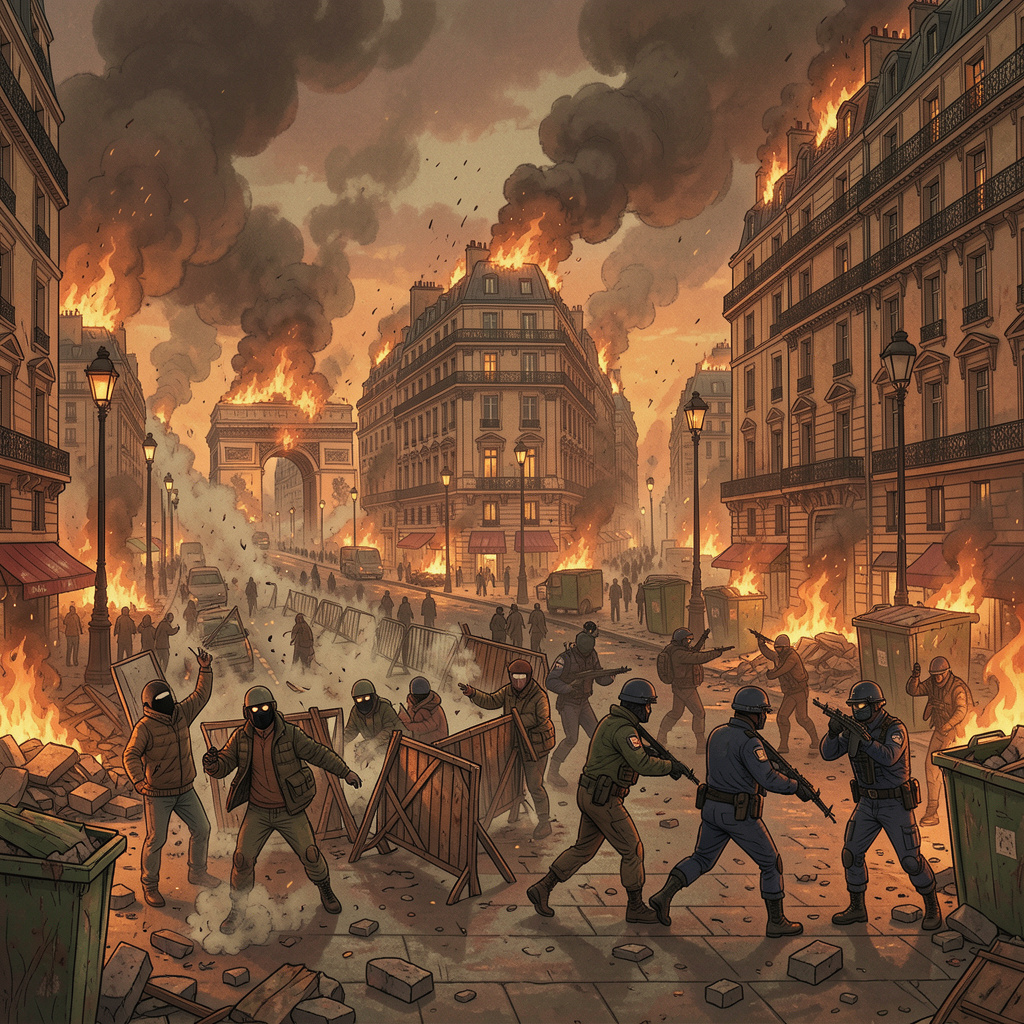
Every few months, European capitals erupt into predictable flames. In Paris, the Champs-Élysées fills with choking tear gas and burning barricades. In Barcelona, masked protesters pelt police with paving stones and set dumpsters ablaze. Despite advanced equipment, European police forces seem perpetually helpless. They cannot prevent their historic streets from descending into war zones.
In sharp contrast, New Delhi presented a very different picture on October 10, 2026. Facing an engineered mass confrontation, the Indian state executed a textbook lockdown. Thirty-five thousand security personnel established total perimeter control before dawn. Metro stations closed, borders sealed, and key instigators were detained in their beds. Not a single bus was burned. The street squatting was denied.
Western critics frequently decry Indian crowd management as draconian overreach. Yet this comparison reveals a deeper truth. India has mastered the tactical and constitutional science of public order. Europe remains paralyzed by an outdated ideological dogma.
The Democratic Ballot vs. The Mob Veto
In a genuine democracy, supreme sovereignty belongs to the voters. Hundreds of millions cast their ballots to elect representative governments. A small minority on a city boulevard cannot claim sovereign supremacy over that mandate. A crowd of ten thousand people does not equal the will of a nation. This position is the same for India and Europe.
My research paper on The Mechanics of Cultural Socialism decoded this operational deception. Street movements exploit Saul Alinsky's Rules for Radicals. They use algorithmic bot farms and digital theatrics to manufacture the illusion of mass power. It is a blueprint for color revolutions like the 'Arab Spring' by which democratic governments were removed and stooges were installed. Dhaka and Nepal are recent examples.
In reality, ordinary working people feel zero sympathy for these disruptions. When organizers of the Cockroach Party protest were arrested from the aircraft, people cheered their arrest and posted the videos on social media. On October 10, most ordinary citizens went about their daily routines as usual. Life in Central Delhi was affected for a few kilometers due to barricading but more due to disruption in mobile internet. Only a few hundred committed party workers showed up to court arrest.
European states treat vocal street minorities as sacred democratic arbiters. Europe forgot a foundational truth. When a civilization prioritizes procedural dogmas over its own survival, it disarms itself from within. They allow tiny radical factions to paralyze national infrastructure and override the voting majority. This is not democratic expression. It is an extortionist mob veto.
The problem of Europe is not its law but the history behind it. It had a long history of autocratic rulers like Hitler and Mussolini. Street dissent was the only way left for people to protest and even that was suppressed under those regimes. Hence, the sensitivity to street protests. The noose that pulled down old tyrants is now strangling public order.
The 100-Year-Old Noose
Europe is currently choking on the very noose that liberated it a century ago. After two world wars, European nations grew terrified of their own state power. To prevent a return of totalitarian tyranny, they systematically dismantled sovereign authority.
They elevated individual procedural rights into sacred, untouchable dogmas. In doing so, the European state voluntarily disarmed its capacity for decisive preemption. As US Supreme Court Justice Robert Jackson warned in 1949, a constitution cannot be treated as a suicide pact. Europe forgot this vital warning.
This intellectual paralysis produces Karl Popper's famous Paradox of Tolerance. If a society extends unlimited tolerance, the intolerant will eventually destroy it. Europe now applies secular, liberal rights to ideological enclaves that reject the secular republic itself. The problem of Europe is compounded by Muslim migrants.
The Theocratic Enclave
Europe wanted cheap labor for reconstruction after the destruction in the world wars. It turned to fair-skinned Middle Eastern Muslim migrants. It avoided Chinese, African, and Indian people as their appearance was not palatable. Though they will never admit their racist decision, it is so apparent that it cannot be denied. This position was further compounded by recent migration due to wars in West Asia in countries like Iraq, Syria, and Libya.
The result is that they are now stuck with millions of Muslims who do not recognize the writ of sovereign governments of Europe. Secular constitutions assume a shared social contract. They assume that every citizen accepts the basic legitimacy of the nation-state. That assumption collapses completely against theological supremacism.
Under Islamic law the supreme authority is the clergy, called Amir-ul-Ummah, which can be translated as Commander of the Faithful. Thus, theocratic street protest movements recognize only divine law and allegiance to the Ummah. To them, a secular democratic constitution is an illegitimate construct. They exploit free speech to preach subversion and assembly rights to carve out autonomous enclaves.
This dynamic created parallel societies in the French banlieues, Molenbeek in Belgium, and Swedish suburbs. National police forces hesitate to enter these enclaves because intervention triggers coordinated riots. State authority ceases at the neighborhood border.
On October 10, New Delhi witnessed a calculated attempt to replicate this tactic at Gurdwara Bangla Sahib. A contingent from Malerkotla[^9] took shelter inside the shrine with Gurmukhi placards. They hoped to provoke a police raid that would ignite communal unrest across Punjab. Delhi Police avoided the trap with tactical patience. They waited outside and arrested the agitators when they exited.
The Demographic Scale in India
There is another decisive factor that Western commentators completely ignore: sheer demographic scale.
The National Capital Region (NCR) of Delhi houses nearly three crore people. That single urban cluster has a larger population than Sweden, Greece, or Portugal. In low-density European cities, riots burn cars and smash shop windows. In an Indian mega-city with dense neighborhoods, disorder quickly turns lethal.
India cannot afford the luxury of administrative hesitation. When rioters are given leeway in densely populated Indian cities, innocent people die.
In February 2020, administrative hesitation allowed street blockades to fester in Northeast Delhi. The resulting riots claimed fifty-three lives and injured hundreds. That tragedy proved an unforgiving lesson: in India, street permissiveness is not tolerance. It is a fatal failure of governance.
A city of thirty million cannot risk stampedes, arson, or communal violence. Daily-wage earners and working families pay the ultimate price for middle-class activist vanity. Preemptive containment is not authoritarian paranoia. It is an urgent duty to protect human life.
Distinction between Dissent and Anarchy
The Indian state does not reject the right to peaceful protest. The handling of Leader of Opposition Rahul Gandhi over the past week proves this point. For three consecutive days, he picketed across Central Delhi without seeking formal permission. Delhi Police did not seal the capital or deploy razor wire.
Instead, police officers engaged him with institutional courtesy. They detained him and his colleagues for a few hours. By evening, they released everyone without incident. Why was his protest accommodated while radical groups were crushed?
Rahul Gandhi is an elected constitutional representative. His gatherings remain peaceful and disciplined. Crucially, his protests do not carry a track record of violent infiltration.
This establishes the foundational Indian rule of public order. The right to protest remains protected so long as leaders maintain control of their crowd. That right is immediately forfeited when a movement invites criminal infiltrators or seeks violent escalation.
On July 20, the Cockroach Janta Party unleashed 2,500 criminal infiltrators on Parliament Street. When organizers lose control of the street, the state must take it back. They were denied permission to protest. The stated reason was that permission was not sought ten days in advance, as legally required.
The Tactical Illusion of Europe
The tactical failure of European policing stems from a flawed doctrine: reactive dispersal. French CRS and Spanish Mossos wait until crowds assemble into dense masses. Only when stones and Molotov cocktails fly do police charge.
They fire tear gas canisters and drive water cannon trucks down broad avenues. The crowd inevitably scatters into surrounding residential neighborhoods. This transforms a single gathering into dozens of mobile, autonomous guerrilla cells.
Dispersed rioters find ready concealment in narrow alleys. They set fires, smash storefronts, and ambush isolated police units from blind corners. Dispersal does not end the violence. It merely relocates and diffuses it into vulnerable civilian spaces.
Military Science of the Street
Military science approaches urban unrest very differently through area domination. Urban combat manuals have long understood that terrain dictates outcome.
The US Army Field Manual FM 3-19.15 (Civil Disturbance Operations) outlines this approach. It prioritizes isolation and cordoning over kinetic dispersal. Troops secure high ground, transit choke points, and avenues of approach before crowds arrive. Denying physical sanctuary prevents agitators from organizing or retreating.
A landmark study by the RAND Corporation (Street Smart: Tactical Intelligence in Urban Operations) confirms this reality. Urban architecture provides natural cover for violent mobs. Clearing a mob once it secures an urban foothold requires overwhelming, lethal force. The only bloodless solution is preemptive spatial saturation.
This aligns with classical crowd psychology established by Gustave Le Bon in 1895. In his treatise The Crowd: A Study of the Popular Mind, Le Bon explained the phenomenon of de-individuation. Once an assembly crosses a critical density, personal accountability vanishes. Collective hysteria takes over the mob mind. Stopping recruitment pipelines before aggregation occurs is mathematically the only way to avert violence.
Jurisprudence in India
In Mazdoor Kisan Shakti Sangathan (MKSS) vs. Union of India (2018), the Supreme Court codified this balance. The Court ruled that the right to protest is a regulated right, not an unconditional entitlement. The rights of demonstrators cannot extinguish the fundamental rights of ordinary citizens.
The Supreme Court mandated strict regulatory guidelines: - Organizers must submit applications at least ten days in advance. - Organizers must specify the exact estimated number of participants. - Jantar Mantar is legally capped at one thousand people. - Larger gatherings must relocate to Ramlila Maidan or Burari Ground.
In the 2020 Shaheen Bagh judgment (Amit Sahni vs. Commissioner of Police), the Court went further. It ruled that public ways cannot be blocked indefinitely. Demonstrations must be confined to designated zones alone. Indian statutory law empowers this with Section 163 and Section 170 of the Bharatiya Nagarik Suraksha Sanhita (BNSS). Preventive custody halts chaos before it erupts.
The Sovereign Responsibility
The modern street is no longer just a forum for democratic speech. In an era of hybrid warfare and foreign interference, it is an operational battleground.
Europe permits uncontrolled street gatherings out of ideological guilt, and then watches its historic cities burn. It sacrifices the rights of the voting majority to appease violent street minorities.
India has chosen a wiser, Kautilyan path. It respects disciplined constitutional dissent while ruthlessly denying the mob veto. It understands that when leadership loses control of a crowd, liberty degenerates into anarchy. By enforcing spatial domination and regulated rights, the Indian state protects democratic sovereignty.
The ballot box must always prevail over the barricade.
References:
1. Mazdoor Kisan Shakti Sangathan vs. Union of India (2018) 10 SCC 380 - Right to Protest Guidelines 2. Amit Sahni vs. Commissioner of Police (2020) 10 SCC 439 - Shaheen Bagh Judgment 3. US Army Field Manual FM 3-19.15: Civil Disturbance Operations 4. RAND Corporation: Street Smart - Tactical Intelligence in Urban Operations (MR-1287) 5. Gustave Le Bon: The Crowd - A Study of the Popular Mind (1895) 6. The Mechanics of Cultural Socialism (August 2026) 7. Delhi is not Dhaka, and India will not be toppled from the street (October 2026) 8. Is India in Governance Crisis? Chapter 1: The Paralysis in Governance of India (Dec 2025) 9. Review of Gustaakh Ishq: A Beautiful Anachronism (February 2026) 10. European Convention on Human Rights (ECHR), Article 11 (Freedom of Assembly and Association).
Leave a Response