Implications of India-EU Trade Deal
India and the European Union officially announced the conclusion of negotiations for their long-awaited Free Trade Agreement (FTA) on 27 January 2026. It is being hailed as the mother of all deals. The agreement creates a massive free-trade zone covering roughly 2 billion people and aims to double bilateral trade by 2032. Three major announcements accompanied the deal:
- Immediate zero-duty access to the EU market, which is expected to significantly boost exports for Indian garment and footwear manufacturers . This sector was in stress due to 50% tariff imposed by the USA.
- A landmark Mobility Pact was signed to ease visas and movement for Indian students and skilled professionals (like IT and engineering graduates).
- The EU pledged €500 million to support India’s green transition and emissions-cutting efforts.
French Blanks
In typography, “French spacing” refers to the removal of the extra space after a period. While the English/American style insisted on two spaces to create a clear “stop,” the French style was to keep everything tight and uniform with a single space everywhere.
Americans left the EU with its WTO but forgot to carry the extra space. Now the EU wants India to fill the extra space created by the USA. It states that India will:
- Slash high import duties on European cars from 110% down to 10% over five years (within specific quotas)
- Slash tariffs on European wines and spirits from present 150% to 20% and 40%
- Slash duties on olive oil, chocolates, and pasta to zero
- Reduce or eliminate tariffs on chemicals, pharmaceuticals, and industrial machinery drastically.
A Beginning
The deal is a beginning of establishing a large mutual market. We are now entering a phase of “legal scrubbing,” where lawyers from both sides go through thousands of pages of text to ensure there are no loopholes. First, the deal must be approved by the Indian Cabinet and ratified by the European Parliament. It will take a little time.
India and the EU are essentially creating a unified economic corridor for about 2 billion people. Prime Minister Modi and European Commission President Ursula von der Leyen aren’t exaggerating much when they call it the “ mother of all deals ,” especially given how much global trade has been shaken up by recent tariff wars elsewhere.
Europe is currently feeling the squeeze of being caught between a protectionist U.S. and a dominant China. By locking this in now, they’ve secured a “first-mover advantage” in the world’s fastest-growing major market.
The EU is desperate to “de-risk” from China without crashing their economy. India is the only partner with the scale to act as a credible alternative for their manufacturing and supply chains.
In the fiscal year that just ended (2024–25), the total goods trade between the two was roughly $136.5 billion. Surprisingly, India exported about $75.9 billion to the EU while importing around $60.7 billion. This leaves India with a healthy trade surplus of roughly $15.2 billion.
These are the explanations given by newspapers and columnists alike. There is more to it than meets the eye.
Currency Independence
By bypassing the US Dollar (USD), both sides are insulating their trade from “third-party help.” It means they no longer have to worry about the volatility of the Federal Reserve’s interest rates or the political strings that often come with the dollar-dominated financial system. By trading directly in INR-EUR, businesses on both sides save billions annually in conversion fees and “middleman” banking costs that were previously paid to US-based clearinghouses.
It means that if a future US administration decides to use the dollar as a “weapon” in a trade dispute, the India-EU corridor remains open and operational. It is a step towards World Minus One.
Jubilation for Security
At the time of formal signing of the deal, which happened on live TV, the delegation of the EU was unusually jubilant. It was something more than a mere trade deal. The delegation looked so genuinely thrilled for a reason. The clue was given away by Ursula von der Leyen’s use of three words in her speech. These words were “Reciprocal Maritime Security.”
Here “reciprocal” means they are no longer just “customers” in the Indian Ocean. They are partners. They are looking to India to help secure the vital sea lanes (especially through the Bab-el-Mandeb and the Malacca Strait) that keep European shelves stocked. In return, India gets high-end European naval tech and a “force multiplier” in the Indo-Pacific. The delegation realized they weren’t just signing a receipt for goods. They were signing a geopolitical insurance policy. The EU is finally treating India as a security peer.
Naval Imbalance
France’s Charles de Gaulle is the only nuclear-powered super-carrier in the EU. Italy is currently the quiet heavyweight here. They operate two active carriers: the ITS Cavour (their flagship) and the ITS Trieste , which just entered service last year (2025). Spain also has the Juan Carlos I , which functions as a multi-purpose carrier/assault ship.
Most EU nations have “Green Water” navies, which are great for protecting their own coasts, but they lack the “Blue Water” muscle to sustain long-term operations in the Indian Ocean or the South China Sea.
Europe’s economy is entirely dependent on the sea lanes passing through the Indian Ocean. Without a massive fleet of their own stationed there, they are effectively hitching their wagon to the Indian Navy. By calling it “reciprocal,” the EU is acknowledging that India is now the senior partner in that specific geography. India has the carriers ( Vikrant and Vikramaditya ), the regional bases, and the local knowledge. The Indian Navy has effectively tamed pirates from Somalia to Yemen. Ships with the flag of India travel without fear.
The joy in the delegation likely stems from the fact that they just secured a “Security and Defense Partnership” (signed yesterday by Vice President Kaja Kallas). It essentially guarantees Indian protection for European trade interests in the Indo-Pacific. The EU is not just trading wine for textiles anymore. It is trading market access for maritime protection.
The recent U.S. move against Maduro and the high-seas ship seizure was a loud, clear signal of “extraterritorial reach.” It told the world that if you use the U.S. financial system or global shipping lanes, your sovereignty is conditional.
The EU realized that if they stayed tied solely to U.S.-policed routes and the Dollar, they were essentially vassals. The EU started looking for a partner that won’t bow to Washington’s every whim. India has proven it can maintain its own “strategic autonomy” even under pressure. It has been chosen by the UAE, a few days back, for its security. The pivot to India was natural. India had declared its security independence when it hit Kirana Hills in Pakistan during Operation Sindoor last year.
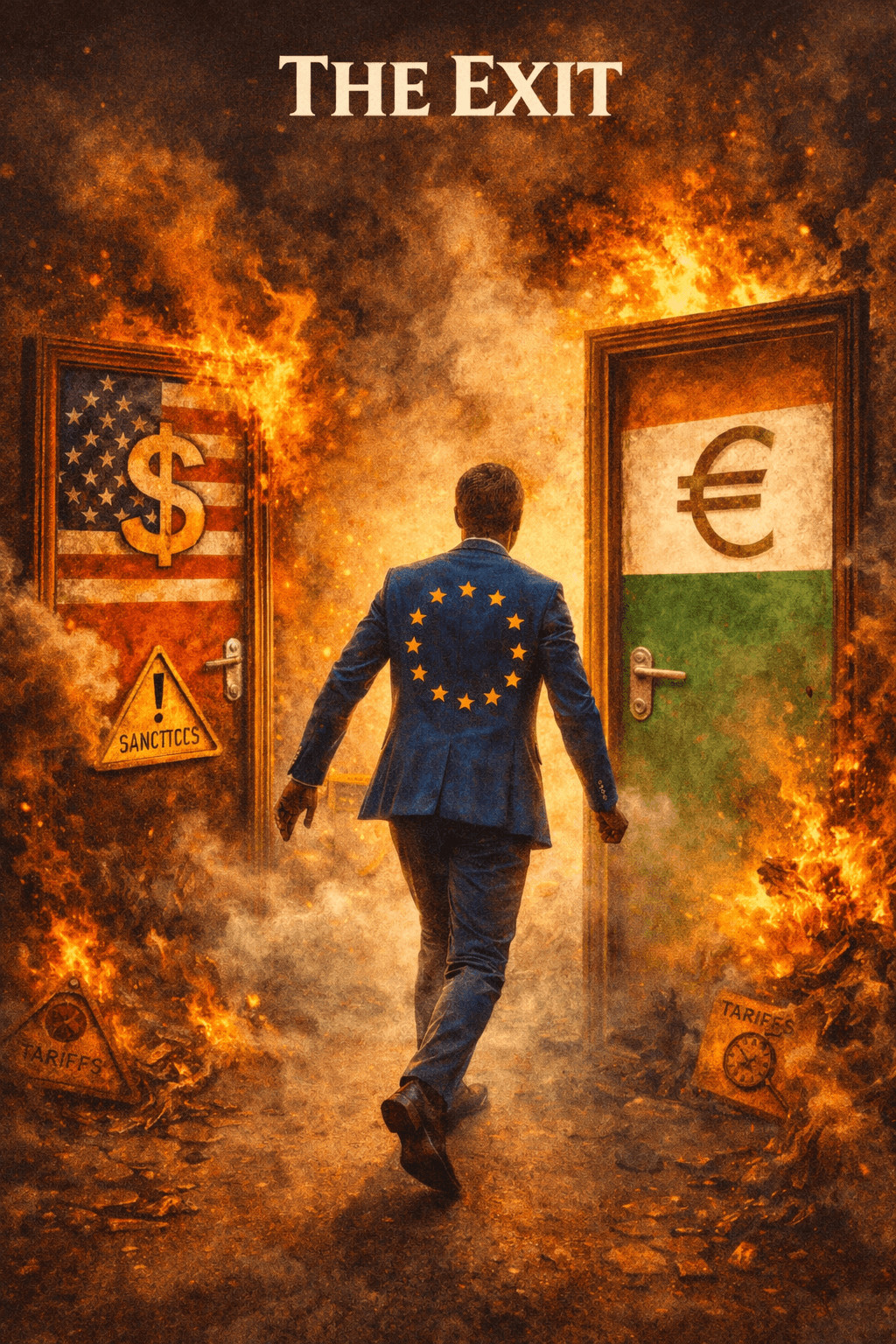
The delegation’s happiness was the relief of someone who just found a second exit in a burning building. They are finally decoupling their economic survival from U.S. enforcement.
Validation by Kaja Kallas, Vice President EC
Kaja Kallas later gave an interview to The Tribune (Punjabi) on 27 January 2026 itself, in which she validated all my points raised above. For example:
Kallas explicitly called maritime security “very concrete” and mentioned it first among cooperation areas. She said “weaponization of trade routes” is a mutual concern. The phrase “mutual interests” appeared repeatedly.
She admitted “if the European industry is not able to deliver, then we can buy outside.” This is a remarkable admission of capability gaps. She emphasized India as a source of “competition” that makes European industry “work faster.”
She said the EU values being “predictable” in contrast to “constant threat of tariffs in the air.” She emphasized “not putting all eggs in the same basket” and diversifying partnerships. Her discomfort with then-Defense Secretary Pete Hegseth’s Shangri-La speech (telling Europeans to “stay out of the Indo-Pacific”) was telling. She described feeling “uncomfortable because it sounded very much so that, you know, we do here and we don’t really care what you think.”
Her statement: “every dependence you have is also your vulnerability. And make sure you’re dependent on friends because the other side might hurt you. But in a world where you don’t know actually who are your friends, then let’s diversify” makes it clear beyond doubt.
This interview confirms this is far more than an India-EU trade deal.
This deal is a strategic realignment. Another step towards a New World Order.
Reference: The link to interview of Kaja Kallas:
Leave a Response