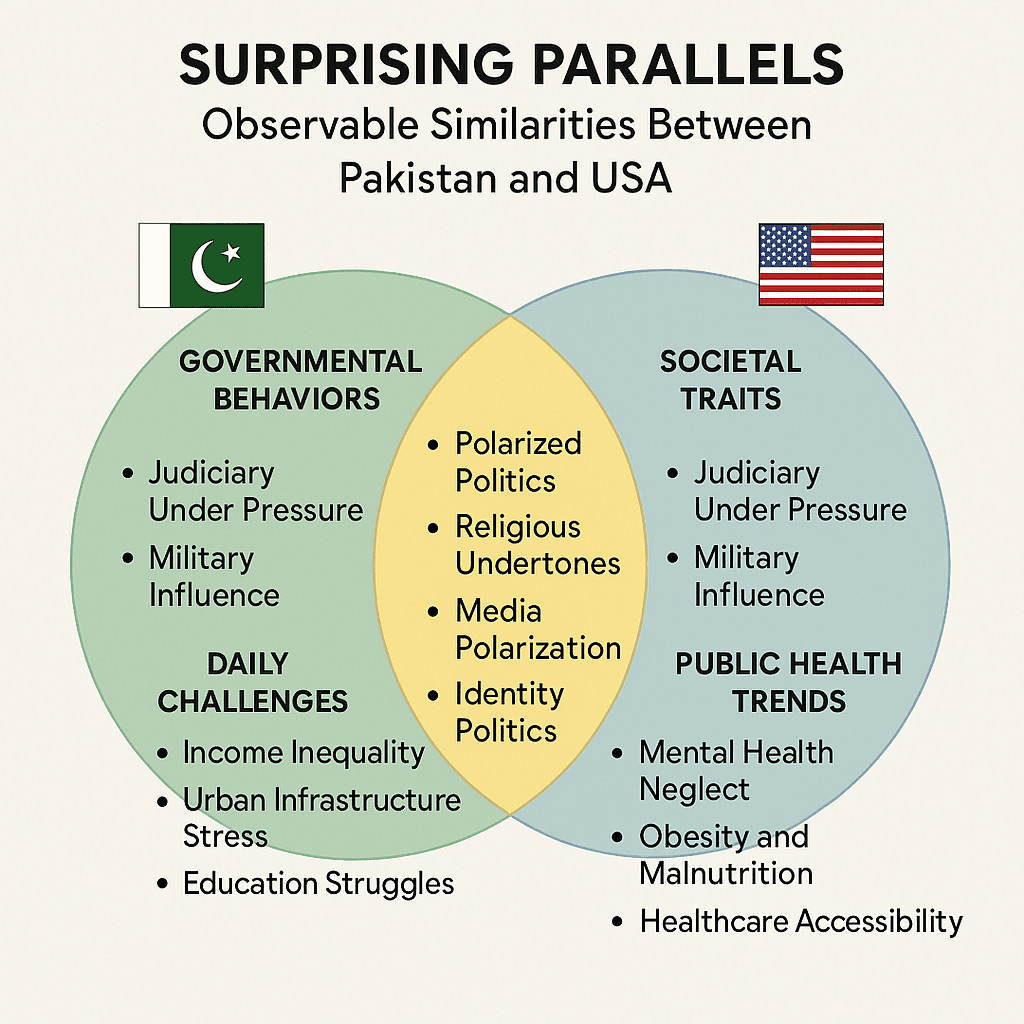
Surprising Parallels: Observable Similarities Between Pakistan and USA
It’s a provocative thought: two nations as seemingly disparate as Pakistan and the United States sharing a surprising number of observable similarities. Beyond the obvious geopolitical differences, a closer look at their governmental behaviors, societal traits, daily challenges, and public health trends reveals unexpected parallels. This analysis focuses purely on these observable “yellows,” without delving into the complex “chemicals” that may have induced them. Here are 33 distinct observable similarities:
I. Governance & Fiscal Management
- Persistent Budget Deficits: Pakistan and USA governments consistently spend more money than they collect in revenue, leading to ongoing budget deficits year after year.
- Growing National Debt: Pakistan and USA exhibit a continuous increase in their national debt.
- Significant Budget Allocation to Debt Servicing: A substantial and increasing portion of Pakistan and USA governments’ annual budgets is consumed by payments on their existing debt.
- Political Gridlock on Fiscal Reform: Pakistan and USA governments demonstrate a recurring inability to make politically difficult decisions regarding significant spending cuts or tax increases necessary to address their fiscal imbalances.
- Fluctuating Diplomatic Relationships: Pakistan and USA, both nations experience “rollercoaster” alliances and partnerships, characterized by periods of close cooperation followed by significant estrangement or mistrust with key international actors.
II. Societal & Cultural Traits
- High Levels of Media Consumption of Sensationalist Content: Citizens in Pakistan and USA consume large amounts of media that often features simplified good-versus-evil narratives, and they show a strong interest in dramatic or even violent entertainment.
- Widespread Belief in Conspiracy Theories: A notable segment of the population in Pakistan and USA exhibits a propensity to believe in elaborate conspiracy theories.
- Strong Cultural Connection to Firearms: Pakistan and USA societies have a significant and visible cultural connection to guns and weapons.
- A Sense of National Exceptionalism: Citizens in Pakistan and USA, both nations often express a strong belief in their country’s unique destiny or special place in the world.
- Prevalence of Gambling/Lotteries: Citizens in Pakistan and USA, both countries show a widespread interest in various forms of gambling, including lotteries.
- Reluctance to Critically Engage with Foreign Policy/Intelligence Operations: There is a shared tendency among citizens in Pakistan and USA to prefer not to deeply scrutinize or question the foreign policy decisions and intelligence operations of their respective governments.
- Presence of Strong Fanaticism Among Segments of the Citizenry: Pakistan and USA exhibit significant segments of their population demonstrating intense, unyielding, and often intolerant devotion to specific ideologies, leading to deep societal divisions. [1, 2, 3, 4]
- Prevalence of Strong Opinions on Social and Cultural Issues: Citizens in Pakistan and USA both nations are observably characterized by holding very strong, often polarized, opinions on a range of social and cultural issues, leading to heated public discourse and sometimes social friction.
- Impact of Social Media on Political Discourse and Polarization: In Pakistan and USA, societies demonstrate a clear observable trend where social media platforms play a dominant role in shaping political discourse, spreading information (and misinformation), and contributing to societal polarization. [5, 6]
- Cultural Influence of Diaspora/Overseas Communities: Pakistan and USA, both countries experience a significant cultural and economic influence from their large diaspora populations living abroad, impacting trends, remittances, and social values. [7, 8]
- Emphasis on Material Success and Consumerism / Preference for Global Brands: Both in Pakistan and USA, societies exhibit an observable cultural emphasis on material success, personal acquisition of goods, and a strong drive towards consumerism, often fueled by advertising and media, including a preference for global brands. [9, 10, 11, 12, 13, 14, 15]
- High Rates of Individual Charitable Giving: Pakistan and USA, both nations exhibit high rates of individual charitable giving, often at a micro or community level.
- Vibrant Public Celebrations and National Pride: Pakistan and USA, both nations exhibit widespread public enthusiasm for national events (e.g., holidays) and sports, often marked by widespread celebrations, collective engagement, and the elevation of athletes to national hero status. This includes the commercialization of such events. [16, 17, 18, 19, 20, 21, 12]
- Commercialization of Public Holidays and Major Events: Pakistan and USA, both countries show a clear trend of commercializing public holidays and major sporting events, driving sales of related merchandise and media engagement.
- Elevation of Athletes to National Hero Status: Successful athletes in Pakistan and USA are elevated to national hero status, with their achievements serving as powerful symbols of national pride and unity. [22, 11, 23, 24, 25]
- Central Role of Food and Music in Social Bonding: Food and music are central to social gatherings and community bonding, including shared meals, communal feasting, and the evolution of fusion cuisine in both Pakistan and USA. [16, 26, 9, 27, 22, 28, 29, 21, 30, 31, 32, 33, 12, 34, 35, 2, 36, 37]
- Shared Social Etiquette and Interpersonal Warmth: In Pakistan and USA, cultures place importance on respecting elders and exhibit common interpersonal behaviors like hugging among friends as a form of greeting and warmth. [26, 9, 22, 28, 31]
III. Daily Life, Infrastructure & Public Services
- Prominent Urban-Rural Divide in Development and Lifestyles: Pakistan and USA, both countries exhibit a clear and significant observable divide between urban and rural areas in terms of infrastructure, access to services (healthcare, education), and economic opportunities, with rural areas generally lagging.
- Significant Urban Traffic Congestion and Behavioral Contributions: Pakistan and USA, both countries experience pervasive urban traffic congestion, leading to observable negative impacts such as wasted time, fuel consumption, and air pollution, exacerbated by observable human behavioral contributions like “offensive driving” or “road rage.” [38, 39, 30, 40, 41]
- Widespread Challenges with Aging and Unreliable Infrastructure: Pakistan and USA, both nations grapple with significant infrastructure deficiencies, particularly concerning aging systems and unreliable power supply, leading to widespread disruptions and substantial economic and social costs. These issues are exacerbated by climate change and observable political/bureaucratic factors.
IV. Health & Well-being
- Significant Internal Disparities in Human Development Outcomes: Pakistan and USA, both nations, despite their differing overall development levels, demonstrate profound and observable inequalities in access to quality education, healthcare, and opportunities among different segments of their populations.
- Significant Burden of Non-Communicable Diseases (NCDs) and Healthcare Disparities: Pakistan and USA, both countries face a significant and growing burden from NCDs (e.g., cardiovascular, diabetes, cancer, chronic respiratory, mental health, injuries), with observable disparities in prevalence across demographic groups and strains on healthcare systems to provide uniform access and quality of care for chronic conditions. [42, 43, 44, 45, 46, 13, 5, 47, 48, 49, 50]
- High Prevalence of Self-Medication and Associated Risks: Pakistan and USA, both nations exhibit a high prevalence of self-medication, driven by perceived barriers in formal healthcare (e.g., cost, access), leading to potential public health risks, including antibiotic misuse.
- Observable Stigma Around Mental Health: Pakistan and USA, both countries exhibit a significant and observable stigma surrounding mental health conditions, contributing to negative attitudes, behaviors, and reluctance to seek help. [27, 51, 52, 36, 6, 53, 15]
V. Institutional & Governance (Citizen Interaction)
- Less-Than-Average Voter Enthusiasm in the Democratic Process: Pakistan and USA, both countries exhibit a pattern where a significant portion of the eligible voting population consistently chooses not to participate in elections, indicating a less-than-full enthusiasm for direct engagement in the democratic process via voting.
- Challenges in Law Enforcement’s Public Image: In Pakistan and USA, the countries’ law enforcement agencies often face significant public perception challenges, including issues of trust, accountability, and a strained relationship with communities. [38, 54, 55, 56, 57]
- Public Frustration with Legal Bureaucracy and Delays in Justice: Citizens in Pakistan and USA, both nations express observable frustration with legal bureaucracy, systemic inefficiencies, and significant delays in case adjudication, leading to erosion of public trust.
- Challenges in Critical Thinking Education: Pakistan and USA, both countries face observable challenges in effectively teaching critical thinking skills within their education systems.
References
- U.S. Department of State. (2023). 2023 Country Reports on Human Rights Practices: Pakistan .
- U.S. Department of State. (2022). 2022 Country Reports on Human Rights Practices: Pakistan .
- The Polis Project. (n.d.). Fear and Control of Blasphemy in Pakistan .
- Forte, D. F. (n.d.). Apostasy and Blasphemy . Retrieved from EngagedScholarship.csuohio.edu.
- Saleem, A., et al. (2024). Congratulatory responses . Retrieved from Taylor & Francis Online.
- ResearchGate. (n.d.). Exploring Stigmatizing Discourses of Mental Illness in Pakistani Newspapers through CDA Lens in Psychology .
- Dawn. (n.d.). M Asim Siddiqui, who works with a local Urdu newspaper for Pakistani community in Virginia, argues that after 9/11, Muslim populations in general and the Pakistani community in particular felt insecure and preferred to stay within their community .
- SCIRP. (n.d.). As a frontline ally, Pakistan shares a long history of fighting with the CIA since the Soviet invasion .
- Atta Sabir. (2012, March 22). American Culture Versus Pakistani Culture .
- McKinsey & Company. (n.d.). State of Consumer .
- Deloitte. (n.d.). State of the Consumer Tracker .
- The Sociological Mail. (2017, November 22). Culture of Pakistan and America .
- ResearchGate. (n.d.). Exploring the Influence of Brand Authenticity on Consumer Behavior: Insights from Generation Y Consumers in Pakistan .
- The CRSSS. (n.d.). Exploring the Influence of Brand Authenticity on Consumer Behavior: Insights from Generation Y Consumers in Pakistan .
- TikTok. (n.d.). Exploring Pakistani Markets: A Cultural Shopping Experience .
- StudyCorgi. (n.d.). Holiday and Celebrations in Pakistan .
- Facts and Details. (n.d.). HOLIDAYS IN PAKISTAN .
- Dawn. (n.d.). USA shock cricket world and curious public with unexpected win over Pakistan in T20 World Cup .
- TIME. (n.d.). Americans Upset Pakistan in Cricket World Cup .
- U.S. Embassy & Consulates in Pakistan. (n.d.). UNITED STATES CELEBRATES 75 YEARS OF PAKISTAN-U.S. FRIENDSHIP WITH PUBLIC ILLUMINATION .
- Wikipedia. (n.d.). Public holidays in Pakistan .
- Britannica. (n.d.). Daily life and social customs .
- E-commerce.com.pk. (n.d.). Major Buying Holidays .
- America’s Best Racing. (n.d.). From the Court to the Field— 20 American Sports Heroes Everyone Remembers .
- Team USA. (n.d.). U.S. Olympic & Paralympic Hall of Fame .
- Wikipedia. (n.d.). Pakistani cuisine .
- IPCC. (n.d.). Social and cultural norms around food eating practices .
- Country Studies. (n.d.). Pakistani social life revolves around family and kin .
- Facts and Details. (n.d.). FAMILIES IN PAKISTAN .
- ResearchGate. (n.d.). Exploring Causes, Effects and Possible Solutions of Traffic Congestion in Pakistan: The Case of Quetta Metropolitan City .
- Wikipedia. (n.d.). Traffic congestion .
- UCLA Institute of Transportation Studies. (n.d.). Traffic Congestion: Three Big Questions, Three Short Answers .
- Arab News. (n.d.). By utilizing drone surveillance, we aim to reduce violations, ease traffic congestion and ensure the safety of all road user .
- D+C Development and Cooperation. (n.d.). Rural communities generally lack good public services and have too few economic opportunities .
- NC State University. (n.d.). You Decide: Can We Begin to Close the Urban-Rural Divide in 2021? .
- PakObserver. (n.d.). Pakistan: The Urban-Rural Education Divide .
- AgriEconomist. (n.d.). Bridging the Healthcare Gap in Rural Pakistan .
- PAHO. (n.d.). Non-communicable diseases (NCDs) are responsible for 3.9 million deaths each year in the Region of the Americas, representing ¾ of all deaths .
- PLOS ONE. (n.d.). Among all NCDs, hypertension has the highest prevalence (29.2%), showing a significant difference between females (32.7%) and males (25.0%) .
- World Bank. (n.d.). Aging changes in Pakistan’s demography will increase the burden of NCDs .
- AHA. (n.d.). Report examines racial and ethnic disparities in health, health care access .
- PMC. (n.d.). The prevalence of self-medication in males and females in Karachi is found to be 84.8% (males 88.4% and females 81.2%) .
- Annals ASHKMDC. (n.d.). The prevalence of self-medication was found to be 43.6% .
- YouGov. (n.d.). Nearly two in five consumers prefer to self-medicate simply because it worked for them earlier .
- Becker’s Hospital Review. (n.d.). 2 in 5 patients prefer to self-medicate .
- PBS NewsHour. (n.d.). The curse of God: Stigma of mental illness in Pakistan .
- CDC. (n.d.). Mental Health Stigma .
- NCOA. (n.d.). Mental Health Stigma: Changing the Conversation .
- Human Rights Watch. (2016, September 27). Crooked System: Police Abuse and Reform in Pakistan .
- ResearchGate. (n.d.). Public Perceptions of Police Service Quality: Empirical Evidence from Pakistan .
- Accountability Lab Pakistan. (n.d.). Is delayed justice breaking Pakistan’s legal system? . Retrieved from YouTube.
- ResearchGate. (n.d.). Pendency of Cases in Pakistan: Causes and Consequences .
- The Friday Times. (n.d.). Justice Delayed: The Tragic Consequences of Pakistan’s Legal System Crisis .
- Human Rights Asia. (n.d.). Unfortunately, today’s Pakistan presents a typical example of this maxim because the judicial system of the country is so slow and lethargic that for a case started by a grandfather, his grandson would be able to get the verdict .
- Advance LRF. (n.d.). The criminal justice system (CJS) serves as the backbone of any society, ensuring law enforcement, judicial fairness, and penal rehabilitation .
- The Critical Thinking Institute. (n.d.). 5 Reasons Education Fails Critical Thinking .
- Reboot Foundation. (n.d.). The State of Critical Thinking 2020 .
Leave a Response